

By Nick Avila, Founder, United Debt Relief · Last updated October 22, 2026
A debt consolidation loan works by replacing several credit card balances with one installment loan: you apply, compare offers, read the Truth in Lending disclosure, use the funds to pay off the cards, and repay the loan on a set schedule. It is for people with balances on several cards who want to know each stage before applying. Timing matters because the average credit card APR on accounts assessed interest was 22.15% in Q2 2026, according to the Federal Reserve’s G.19 release.
Key Takeaways
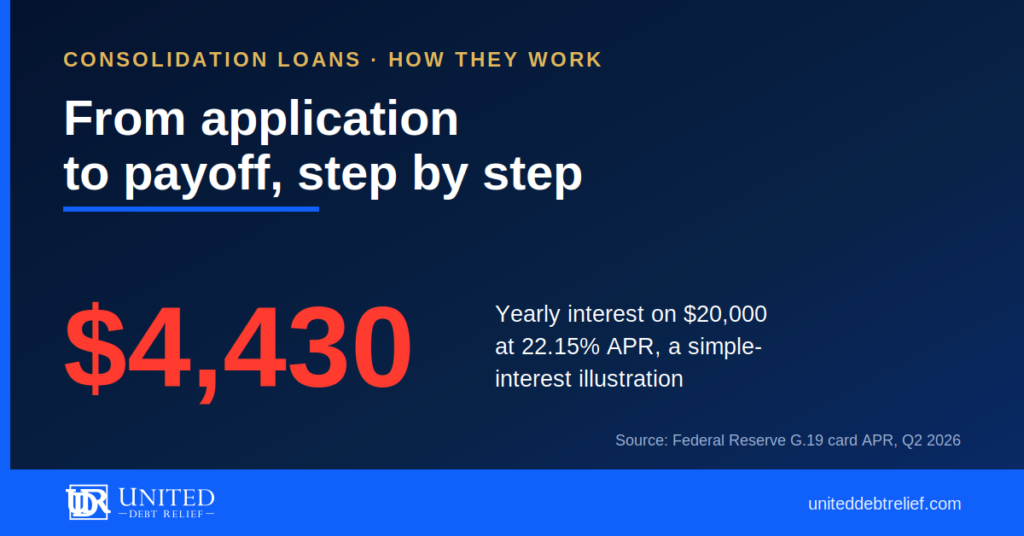
- At the Federal Reserve’s 22.15% average card APR, $20,000 in card debt accrues about $4,430 a year (simple-interest illustration).
- Regulation Z requires lenders to disclose 4 key figures before you sign: the APR, finance charge, amount financed, and total of payments.
- The CFPB lists origination fees among the charges that can add to a personal loan’s cost, and 12 CFR 1026.4 counts loan fees in the finance charge.
- The CFPB notes experts advise keeping credit use at no more than 30% of your total limit, and closing a paid-off card can raise that ratio.
What Is a Debt Consolidation Loan?
A debt consolidation loan is an installment loan used to pay off several debts so you make one payment instead of many. The CFPB notes that banks, credit unions, and installment loan lenders may offer these loans, which convert many debts into one loan payment. Credit card balances reached $1.263 trillion in Q2 2026, up $54 billion from a year earlier, according to the New York Fed. See whether a debt consolidation loan is a good idea.
How Does a Debt Consolidation Loan Work From Application to Payoff?
A debt consolidation loan works in seven stages, from listing what you owe to managing the paid-off cards, and each stage has something specific to check.
| Stage | What to check |
|---|---|
| 1. List balances and APRs | Balance, APR, and minimum payment on every card |
| 2. Check your credit | Errors on your credit reports before lenders see them |
| 3. Compare offers | Soft or hard inquiry, plus APR, term, and fees |
| 4. Read the TILA disclosure | APR, finance charge, amount financed, total of payments |
| 5. Fund and pay off cards | Who sends the payoffs; each card showing a zero balance |
| 6. Repay on schedule | Payment amount, due date, late fee, prepayment terms |
| 7. Manage the old cards | New spending and overall credit use |
What Should You Gather Before You Apply?
Before you apply, gather every card’s balance, APR, and minimum payment, and check your credit reports. The cost of waiting adds up: at 22.15%, $20,000 in card debt accrues about $4,430 a year in a simple-interest illustration. The CFPB says checking your own credit reports does not affect your scores, and cautions that if debt problems have already affected your score, you probably won’t get low interest rates on a consolidation loan.
Does Comparing Loan Offers Hurt Your Credit?
Comparing loan offers can affect your credit if a lender runs a hard inquiry, so ask which kind of check each quote uses. The CFPB explains that hard inquiries follow an application and can affect your score because scoring models look at how recently and how often you apply, while soft inquiries, including prescreening by prospective lenders, do not. The CFPB also notes, in its mortgage guidance, that lenders may check your credit when issuing a prequalification.
What Should You Read in the Truth in Lending Disclosure?
You should read four numbers in the Truth in Lending disclosure: the APR, finance charge, amount financed, and total of payments. Regulation Z requires lenders to give these before the loan is signed, and the APR and finance charge must be more conspicuous than the other terms. Compare the APR, not the payment. The CFPB warns that a lower monthly payment may come from a longer term, which could mean paying a lot more overall, and that some low rates are teaser rates that last only for a certain time.
When a client brings us a loan offer, the first thing we check is the total of payments against the card balances it would replace. Then we compare the amount financed with the loan amount. Approval, rates, and terms are set by the lender after its own review, so confirm every figure on your own disclosure before signing.
United Debt Relief is a national debt relief company serving all 50 states. Its specialists consult with consumers, determine which program fits, and handle enrollment; program services are performed by stringently vetted in-network providers and law firms. See how the debt consolidation loans program works.
What Fees Come With a Debt Consolidation Loan?
Fees that can come with a debt consolidation loan include origination fees, documentation fees, and late fees. The CFPB lists these among the charges that may be added to the total cost of a personal installment loan, and Regulation Z counts loan fees as part of the finance charge under 12 CFR 1026.4. If the amount financed is lower than the loan amount you requested, ask the lender what was deducted.
What Happens to Your Credit Cards After the Loan Funds?
After the loan funds, your card balances are paid off either by the lender directly or by you with the loan proceeds, depending on the lender. Keep paying the cards until each one shows a zero balance, then decide what to do with the open accounts. The CFPB notes that closing a card can raise your credit utilization ratio, and that experts advise keeping credit use at no more than 30% of your total limit.
How Can a Debt Consolidation Loan Affect Your Credit?
A debt consolidation loan can affect your credit through several mechanisms at once. The CFPB lists factors scoring models typically weigh, including bill-paying history, how much available credit you use, new applications for credit, and how long accounts have been open. An application adds a hard inquiry, the loan adds a new account, card utilization drops if paid-off cards stay open at zero, and each loan payment, on time or late, joins your payment history. Results vary. See whether debt consolidation hurts your credit score.
What Is the Worst Case With a Debt Consolidation Loan?
The worst case with a debt consolidation loan is paying off the cards, running them back up, and owing both the loan and new card balances. The CFPB warns that taking on new debt to pay off old debt may be kicking the can down the road unless spending changes. Also compare a balance transfer or a debt consolidation loan.
Frequently Asked Questions About How Debt Consolidation Loans Work
How does debt consolidation work?
Debt consolidation combines several debts into one. With a consolidation loan, the loan funds pay off your card balances, and you repay the loan with one payment on a set schedule.
What is a debt consolidation loan?
A debt consolidation loan is an installment loan used to pay off several existing debts, such as credit cards. The CFPB notes that banks, credit unions, and installment loan lenders may offer them.
Does prequalifying for a consolidation loan affect my credit?
Soft inquiries do not affect credit scores, while hard inquiries from applications can. Lenders may check credit during prequalification, so ask each lender which type of inquiry it uses.
What should I compare between loan offers?
Compare the APR, finance charge, amount financed, and total of payments on each Truth in Lending disclosure, along with the term and any origination fee.
Should I close my credit cards after a consolidation loan?
Not necessarily. The CFPB notes that closing a card can raise your credit utilization ratio and may lower your score. Weigh that against the risk of running the balances back up.
If you want a second opinion on a loan offer before you sign, schedule a free consultation with United Debt Relief or call 1 (888) 802-2092. Free consultation, no obligation. Results vary.
Sources: Federal Reserve G.19 · New York Fed Household Debt and Credit · CFPB on consolidating card debt · CFPB on credit inquiries · CFPB on prequalification · CFPB on installment loan fees · 12 CFR 1026.17 · 12 CFR 1026.18 · 12 CFR 1026.4 · CFPB on closing a card · CFPB on keeping a good score · CFPB on credit scores