

A debt-relief source reporters can reach on deadline.
United Debt Relief is America’s Debt Relief Experts. Founded in 2008, we provide plain-language commentary on consumer debt, credit, and household money stress, no jargon, real math, and fast turnaround for working journalists.




















Media Coverage
October 7, 2026 • Media Coverage
Managing Cash Flow: Top Tips for Early-Stage Businesses

Financial Tech Times asked founders and finance leaders for their best cash-flow advice for early-stage businesses. United Debt Relief founder Nick Avila’s top tip: build a 13-week cash forecast and update it every Monday, so a shortfall shows up a month or two ahead, while there are still options. “Early businesses rarely fail because the idea was bad or even because they weren’t profitable,” he said. “They fail because they ran out of cash in a specific week nobody saw coming.” His rule to go with it: “Don’t borrow to fill a hole you can’t name.”
Read the coverage: Financial Tech Times
October 5, 2026 • Media Coverage
How Finance Teams Choose In-House vs. Outsource to Do More with Less
CFO Drive asked finance leaders how they decide which work to keep in-house and which to outsource. United Debt Relief founder Nick Avila’s rule: “Keep the judgment in house and send out the volume.” The cash forecast, pricing and margin calls, and spend approvals stay inside; payroll processing and tax filings go to specialists, who handle wage garnishment calculations every day while an internal team might see one a quarter. His operating model is to give every outsourced function one internal owner who manages the relationship and reviews the output. “Outsource the task, never the visibility,” he said. “If you can’t see the detail, you won’t catch a problem until it’s expensive.”
Read the coverage: CFO Drive
October 1, 2026 • Byline
Before You Quit to Chase Your Passion, Do the Debt Math First
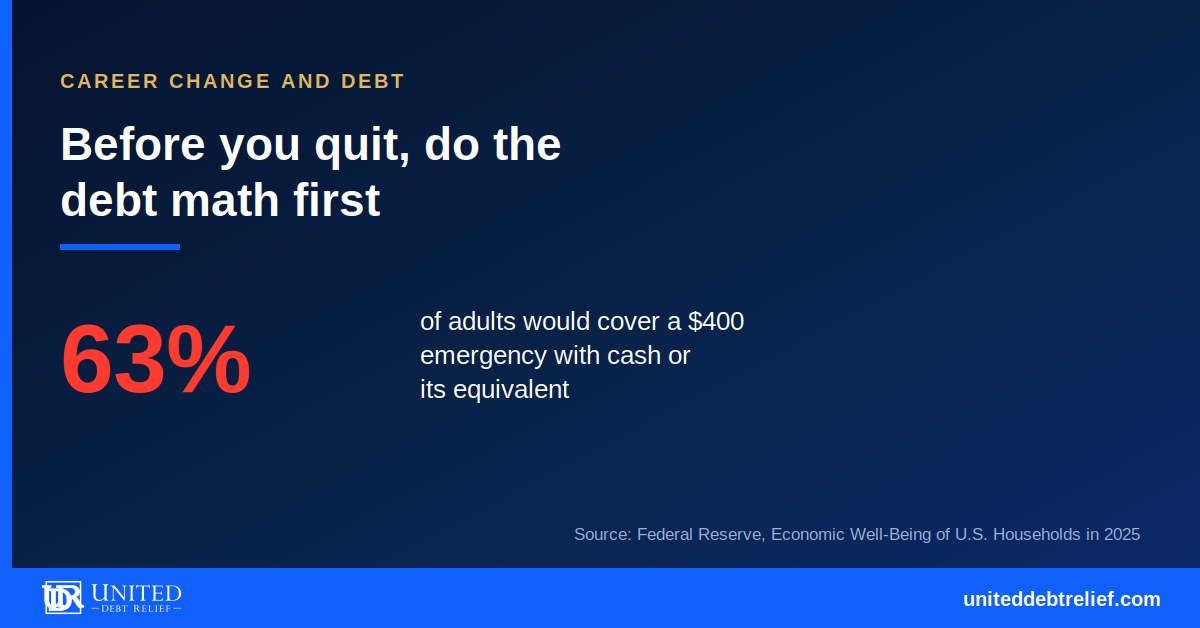
Writing for Pursue The Passion, United Debt Relief founder Nick Avila lays out the money checklist to run before leaving a steady job for work you care about. Start with your real runway, the months of essential costs and minimum payments your savings can cover, keeping in mind that the Federal Reserve found 63% of adults would cover a $400 emergency with cash or its equivalent, and that COBRA can cost up to 102% of the plan’s total cost. Then compare minimum payments to realistic new income: his rule is that if minimums would take more than about a quarter of new take-home pay, it isn’t time yet. He warns against cashing out a 401(k), which generally adds a 10% additional tax before age 59½, and explains how an unpaid 401(k) loan can be offset when you leave. His order of operations: pay down high-interest cards while you still have a paycheck, consolidate while your income is still documented (compare the APR, not the payment), and treat settlement as a last resort, not a launch plan. “Do the math first. It’s a lot easier to protect the passion when the debt isn’t running the show,” Avila writes. Results vary by situation.
Read the article: Pursue The Passion
September 28, 2026 • Media Coverage
401(k) Savers Are Breaking Records. Here’s How to Join Them If You’re Behind

With 401(k) contribution rates and balances at record highs, The Independent’s J.R. Duren asked how savers who have fallen behind can catch up. United Debt Relief founder Nick Avila pointed to debt first: contribute up to the employer match, then pay down high-interest balances before raising contributions further. “Look at what you owe,” he said. “If you’re carrying credit card balances, that’s usually the first thing holding the savings rate down.” The average yearly interest on a $5,000 credit card balance runs around $1,100, he noted, money that could be going into a 401(k) instead.
Read the coverage: The Independent
Also featured on AOL and Policy Wire.
September 25, 2026 • Byline
The Tax Bill Nobody Warns Gig Workers About, and How to Stay Ahead of It

Writing for GIGS Magazine, United Debt Relief founder Nick Avila explains why a first year of gig work so often ends with an April tax bill nobody saw coming. With no employer withholding, gig income carries 15.3% self-employment tax on top of income tax, and a missing Form 1099-K doesn’t change what’s owed, because the IRS requires all income to be reported. His setup: open a separate account just for taxes, move a set share of every payout into it (his rule of thumb is 25% to 30%, depending on bracket, state and expenses), pay the four quarterly estimates from that account, and track deductible expenses as you go. For anyone who already owes, he advises filing on time even without the full payment and looking first at IRS payment plans; an Offer in Compromise is no shortcut, with about 1 in 7 accepted in fiscal 2025. “Gig income is real income, and the IRS expects a cut of it every quarter, not once a year,” Avila writes. Results vary by situation.
Read the article: GIGS Magazine
September 25, 2026 • Byline
The Garnishment Order on Your Payroll Desk Is a Warning Sign. Most Finance Teams File It as Paperwork.
Writing again for CFO Drive, United Debt Relief founder Nick Avila argues that a wage garnishment order is both a compliance task with legal teeth and the clearest sign that an employee’s finances have already broken down. “I run a consumer debt relief company, so I see garnishment from the employee’s side,” he writes; by the time a paycheck is garnished, the debt has usually been behind for months. He sets out where the federal limits actually sit (an ordinary garnishment is capped at the lesser of 25% of disposable earnings or the amount above 30 times the federal minimum wage, while support orders, tax levies and administrative garnishment for defaulted federal student loans follow different rules) and the three places employers get hurt: miscalculating disposable earnings, missing response deadlines, and mistreating the employee. His advice to finance leaders is to centralize the process, protect employee privacy, point staff to free help such as nonprofit credit counseling, and track active garnishment orders as a lagging indicator of financial strain across the workforce.
Read the article: CFO Drive
September 25, 2026 • Byline
What Marketing a Regulated Financial Service Taught Me About Writing Honest Copy
Writing for Marketer Magazine, United Debt Relief founder Nick Avila describes how the rules that govern debt relief marketing, including the FTC’s Telemarketing Sales Rule, its Endorsement Guides and its 2024 rule banning fake reviews, became the best creative brief he has worked from. His lessons: don’t feature an outlier result you can’t show is typical; write mechanism copy that explains how something works instead of outcome copy that promises a result; ask every customer for a review at the same point and never in exchange for a particular sentiment; state the downside first, such as the short-term credit impact of debt settlement; and write the exact rule instead of the slogan, as with the precise legal meaning of “no upfront fees.” The approach also showed up in search, he notes: over a 90-day window in Google Search Console’s generative AI report, the company’s five program pages drew one AI impression between them, while four question-style answer posts drew 25. His test for any marketer: “could I defend this sentence line by line in front of a regulator, with the evidence in hand?”
Read the article: Marketer Magazine
September 24, 2026 • Byline
Cash Flow First: How Small Businesses Can Use Debt Without Getting Buried by It

Writing for American Business Magazine, United Debt Relief founder Nick Avila makes the case that for a small business, how you handle debt is how you protect cash flow. Businesses rarely fail because they weren’t profitable on paper, he argues; they fail because they ran out of cash at the wrong moment. His principles: borrow for assets and timing, not to plug holes (“If you can’t name exactly what the money buys and when it pays itself back, treat that as a warning sign rather than a reason to borrow more”); match the loan term to the life of what it funds; keep a cash buffer even while carrying debt; know the true cost of capital and avoid stacking high-cost, daily-repayment products; and act early when things tighten, while renegotiating or restructuring is still on the table. “Treat cash flow as the number that keeps the lights on, and treat every financing decision as a cash-flow decision first,” Avila writes. Results vary by situation.
Read the article: American Business Magazine
September 18, 2026 • Media Coverage
Can You Get a Mortgage With Bad Credit? Tips for Getting Approved

USA TODAY’s Deane Biermeier, CFEd, set out the loan programs still open to buyers with damaged credit and the moves that improve approval odds before an application goes in. For the fastest of those moves, the piece turned to United Debt Relief founder Nick Avila. “Start with credit utilization, because it has no memory — get card balances under 30% of limits, ideally under 10%, and your score can respond within one or two billing cycles,” he said.
Read the coverage: USA TODAY
Also featured on the Detroit Free Press and Rolling Out.
September 18, 2026 • Media Coverage
Connectively Experts on FIRE: Financial Independence Retire Early
Financial Independence Hub’s Connectively roundup asked business owners and investment experts across North America for their take on FIRE (Financial Independence, Retire Early). United Debt Relief founder Nick Avila argued that the plan has to start on the liability side of the balance sheet: FIRE math typically assumes a 7% long-run return, while the average rate on credit card accounts assessed interest reached 22.15% in Q2 2026, per the Federal Reserve. “My take: the FI is the whole point. The RE is a rounding error,” he said. “Financial Independence is a balance-sheet condition, not an age. You are independent when your assets cover your obligations without your labor.”
Read the coverage: Financial Independence Hub
September 6, 2026 • Media Coverage
How People in Their 20s and Early 30s Build Savings on Entry-Level Pay

MoneyLion’s guide to building savings on an entry-level paycheck turned to United Debt Relief founder Nick Avila on a point most early-career savers miss: building savings doesn’t always mean earning more. Sometimes it means finding money that’s already leaving the budget. Avila recommended starting small while taking a hard look at debt payments. “Start with $10 and a hard look at what your debt is costing you each month,” he said. “Free up $50 by knocking out one balance, and that $50 becomes your savings. You don’t find money to save; you free it up.”
Read the coverage: MoneyLion
Also featured on Yahoo Finance and AOL.
August 30, 2026 • Media Coverage
With Starter Home Availability Up, Here’s How to Accelerate Your First Mortgage Savings Plan

NTD News turned to United Debt Relief founder Nick Avila for the debt side of saving a first down payment, in a report on rising starter-home availability. Avila told NTD News to start with the credit file: “You’ll need to pull all three credit reports and dispute errors under the Fair Credit Reporting Act.” From there, he said, the order of operations decides how fast the savings actually build: “Attack high-interest revolving debt before aggressively stockpiling cash,” Avila said. “At an average 22.15% APR on cards assessed interest, paying that balance down is critical, as Experian estimates the average cardholder pays about $1,475 a year in interest. That is down payment money leaving the household.”
Read the coverage: NTD News
August 21, 2026 • Byline
The Hidden P&L Line: Why Employee Financial Stress Is a CFO Problem
Writing for CFO Drive, United Debt Relief founder Nick Avila makes the case that employee financial stress belongs on the finance team’s ledger rather than in the benefits brochure, because it hides inside lost productivity, absenteeism, turnover, errors and healthcare claims instead of appearing as a line item. He prices it with the available research: employees lose more than seven hours of productivity a week to financial stress, costing U.S. employers an estimated $183 billion a year, per BrightPlan’s Wellness Barometer Survey; 56% spend three or more hours a week handling personal financial issues on the clock, per PwC; and 78% of organizational leaders say financial stress drove higher turnover in the past year, with replacing an employee running 50% to 200% of annual salary, per SHRM. Set against household debt of $18.771 trillion and an average card rate of 22.15% on accounts assessed interest, his argument is that the number is already in the financials, and the only question is whether it is being managed deliberately or paid by default.
Read the article: CFO Drive
August 20, 2026 • Media Coverage
6 Bills To Cut as Kids Head Back to School

MoneyLion’s back-to-school savings guide turned to United Debt Relief founder Nick Avila on the bill most households never think to renegotiate: cell phone and internet. Loyalty is not your friend there, the piece notes, because the discounted promotional period that got you in the door has expired, so long-tenured customers often pay more than newcomers. Avila said carriers typically keep retention departments whose entire job is to keep you as a customer, so telling yours you will go elsewhere unless it reinstates the promotional rate can win a discount. If that still does not work, follow through and switch to a competitor. A multi-line, new-customer promo on a family plan can save $40 to $80 per month.
Read the coverage: MoneyLion
Also featured on AOL.
August 14, 2026 • Media Coverage
Tips for Getting a Mortgage and Buying a House With Bad Credit
USA TODAY turned to United Debt Relief founder Nick Avila for practical ways to improve mortgage approval odds with damaged credit. In a guide walking borrowers through credit-report cleanup, on-time payments and down-payment strategy, Avila pointed at the factor that moves fastest: “Start with credit utilization, because it has no memory. Get card balances under 30% of limits, ideally under 10%, and your score can respond within one or two billing cycles,” Avila said.
Read the coverage: USA TODAY
August 5, 2026 • Media Coverage
Forbes Advisor Expert Panel: Nick Avila on Debt Settlement and Your Credit

Forbes Advisor invited United Debt Relief founder Nick Avila to its “Ask the Expert” panel on debt settlement. Asked what a settlement program does to a credit score, Avila gave the plain trade-off up front: “Short term, expect a real [credit] drop because missed payments are how settlement works,” Avila said. It is the first thing he wants anyone weighing settlement to understand before they enroll. Results vary by situation.
Published on: Forbes Advisor, August 2026
August 4, 2026 • Media Coverage
Gen Z Are Delaying Weddings, Home-Buying and Having Children Because They Can’t Afford It
United Debt Relief founder Nick Avila told The Independent that Gen Z reads a delayed milestone differently than older borrowers do. Northwestern Mutual’s survey of 4,375 U.S. adults found 72% of those aged 19 to 30 have postponed at least one major financial or life goal, and Avila said the generational split is in how that postponement is understood: “The clearest difference I see is that Gen Z treats the delay as a plan rather than a setback,” Avila said. “Older clients tended to describe postponing a house as something that happened to them. Younger clients describe it as a decision they made because the math did not work.”
Read the coverage: The Independent
July 15, 2026 • Media Coverage
Balancing the Bills: How to Navigate Debt Consolidation While Unemployed

United Debt Relief founder Nick Avila cautioned BestMoney against trading unsecured debt for secured debt just to chase a lower rate while out of work: “Rolling unsecured debt like credit cards (which can’t take your house) into secured debt like a home-equity loan, title loan, or 401(k) loan just to get a lower rate can be risky,” Avila said. “You’d be trading a 21.5% problem you can often negotiate or settle for one where a missed payment costs you your home or your retirement. With uncertain income, that can be dangerous.”
Read the coverage: BestMoney
July 15, 2026 • Media Coverage
Nearly 50% of Travel Card Holders Let Their Rewards Expire: What BestMoney’s Travel Credit Cards Survey Found

BestMoney’s survey of 1,000 Americans found 35.7% went into debt to pay for a trip and 45.1% of travel cardholders let rewards expire. United Debt Relief founder Nick Avila warned that a card’s perks are the bait: “‘No fees’ and the rewards are what get people comfortable putting a whole vacation on the card and then paying for it for a year,” Avila said. “So my one warning: pick the card for the fee savings, but treat it like a debit card. If you can’t clear it when the statement lands, the cheapest travel card in the world just turned into an expensive loan.”
Read the coverage: BestMoney
July 13, 2026 • Media Coverage
6 Money Mistakes Gen Z Is Making by Choosing Cars Over Homes in 2026

United Debt Relief founder Nick Avila told MoneyLion that a big car payment can quietly cost Gen Z a home. Dealers know young buyers fixate on the monthly payment, he said, so stretching to 72- or 84-month terms means “thousands more in interest” and keeps them “chained” to the car and its pricey insurance. With the average new-car payment now about $770 a month, per Experian, “a $770 payment can eat the exact room your mortgage needed, so the new car doesn’t just delay the house, it can disqualify you from it,” Avila said. “I’ve watched 25-year-olds get denied and have no idea the car was the reason.”
Read the coverage: MoneyLion
July 12, 2026 • Media Coverage
Net Worth for Gen Z: How To Tell if You’re Poor, Middle Class or Rich

United Debt Relief founder Nick Avila told MoneyLion that the fastest way to climb the net-worth ladder is not a bigger salary but clearing high-interest debt. Using the average credit card rate, he framed a paid-off balance as the surest return most people can get: “paying off that card is a guaranteed 21.52% return, better than almost anything an advisor can sell you,” Avila said.
Read the coverage: MoneyLion
Also featured on AOL.
July 9, 2026 • Media Coverage
Americans Are Learning About Money Everywhere, So Why Are Knowledge Gaps Growing?

United Debt Relief founder Nick Avila told MoneyLion that the financial-literacy problem isn’t a shortage of information but the gap between knowing and doing: “Knowing the right move and being able to make it under pressure are two different skills, and we only teach the first one,” Avila said. Citing the TIAA Institute-GFLEC Personal Finance Index, which found U.S. adults answered just 47% of basic money questions correctly while many rated their own knowledge far higher, he warned that overconfidence carries a cost: “That confidence keeps them from asking for help until they’re already in a hole.”
Read the coverage: MoneyLion
Also featured on AOL.
July 5, 2026 • Media Coverage
The Salary Needed for Gen Z To Finally Stop Relying on Their Parents in 2026

United Debt Relief founder Nick Avila told MoneyLion that the salary Gen Z needs to stop leaning on their parents hinges less on income than on debt, pegging independence at roughly “$55,000 to $65,000” in lower-cost metros like San Antonio and Memphis. He noted Gen Z student-loan borrowers are “paying about $526 a month on average, nearly double the typical borrower,” while the average Gen Z credit card balance has climbed “roughly 30% in three years to around $3,500.” As Avila put it: “Two people can earn the same $70,000, and one is independent while the other is still asking dad to cover the car insurance. The only difference between them is what they owe.”
Read the coverage: MoneyLion
Also featured on AOL and Yahoo Finance.
July 1, 2026 • Media Coverage
Buy Now, Pay Later Debt Consolidation: What to Do When BNPL Balances Start to Multiply

United Debt Relief founder Nick Avila told BestMoney that rolling scattered Buy Now, Pay Later balances into one payment can restore control: “When you’re juggling several plans across multiple apps and you’ve missed or nearly missed dates, rolling them into one fixed monthly payment, usually a small personal loan, can buy back control,” Avila said. “You consolidate BNPL for cash-flow sanity, one payment on one date, not because the interest math always wins.” He cautioned that it only works if you stop opening new plans, or the balances start to stack up again.
Read the coverage: BestMoney
June 28, 2026 • Media Coverage
5 Money Habits That Look Responsible But Are Actually Costing You Thousands

United Debt Relief founder Nick Avila told MoneyLion that closing old credit cards to avoid temptation can quietly backfire: “The problem is your credit score doesn’t read it as discipline,” Avila said. “It reads it as less available credit and a shorter history, and both of those push your score down.” He noted a lower score can bump a borrower into a pricier mortgage tier, where on a $300,000 loan a rate just half a point higher could add more than $11,000 over 10 years, “almost nobody connects that choice to the mortgage rate they’ll be quoted two years later, because the cost shows up far away from the decision.”
Read the coverage: MoneyLion
June 27, 2026 • Media Coverage
7 Price Trends That Could Blow Up Gen Z Budgets

United Debt Relief founder Nick Avila was quoted throughout MoneyLion’s rundown of the price trends most likely to blow up a Gen Z budget, warning that energy is “the headline driver right now, up more than 20% over the past year,” that auto insurance “climbs on autopilot” so re-quoting it once a year is “one of the highest-return budget moves a 25-year-old can make,” and that rent is “the single biggest line in almost every young person’s budget.”
Read the coverage: MoneyLion
Also featured on AOL.
June 25, 2026 • Media Coverage
Banks Are Approving More Credit Cards. Is That Good News?

United Debt Relief founder Nick Avila was quoted throughout U.S. News & World Report’s report on rising credit card approvals, explaining that easier approvals “aren’t charity” but “a signal that the math works in the lender’s favor,” and that a new card or higher limit only pays off when the balance is cleared in full every month.
Read the coverage: U.S. News & World Report
Also featured on WTOP News.
June 17, 2026 • Media Coverage
The New Middle-Class Trap: Summer Bills Outrunning Raises

United Debt Relief founder Nick Avila was featured throughout MoneyLion’s look at why a summer raise can still leave middle-class families short, explaining the assistance-gap squeeze on cooling bills, how childcare “gets repriced the day school lets out,” and his fix of treating summer like a “13th month” with a monthly auto-transfer.
Read the coverage: MoneyLion
June 15, 2026 • Media Coverage
Why a $75K Salary Doesn’t Go as Far for Single Earners This Summer

United Debt Relief founder Nick Avila was featured throughout MoneyLion’s analysis of why a $75,000 salary stretches thin for single earners, unpacking the “singles tax,” the summer “squeeze season,” and how solo earners shoulder every fixed cost and financial risk alone.
Read the coverage: MoneyLion
Also featured on AOL.
Industry Recognition
July 2026 • Industry Recognition
United Debt Relief Named Among Leading Providers in the U.S. Debt Settlement Market
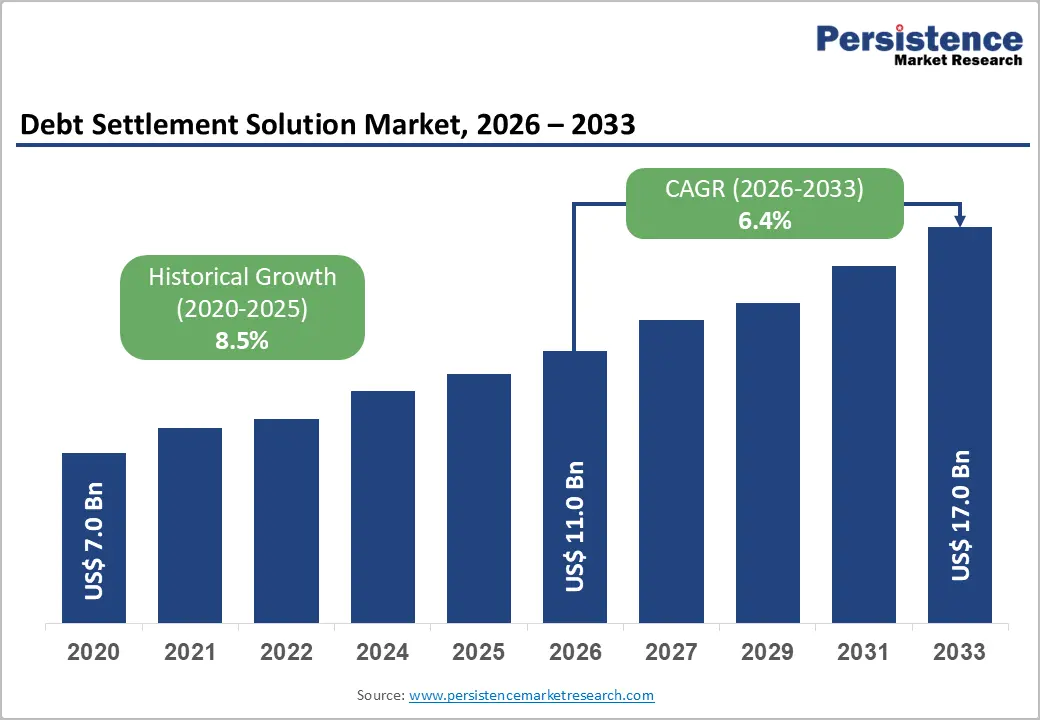
In its 2026 Debt Settlement Solution Market report, Persistence Market Research identifies United Debt Relief among a group of leading providers that combine strong marketing reach with technology and analytics to serve large customer bases and manage complex portfolios at scale. The report examines the global debt settlement market’s size, growth, and competitive landscape through 2033. United Debt Relief is a nationwide debt relief company serving all 50 states; results vary by situation.
Read the report: Persistence Market Research
Press Releases
October 1, 2026 • Press Release
United Debt Relief Tells Borrowers Weighing a Consolidation Loan to Compare the APR, Not the Payment
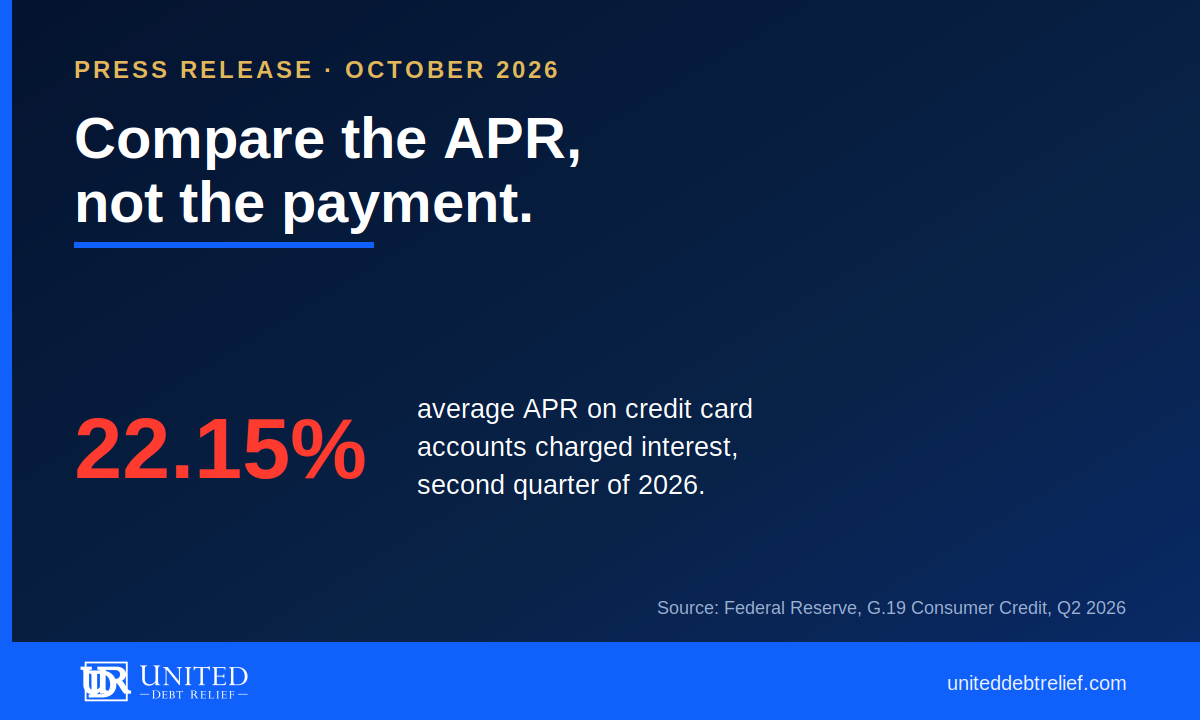
United Debt Relief is urging borrowers who are weighing a debt consolidation loan to compare the APR, not the payment, before they sign. Credit card accounts that were charged interest carried an average APR of 22.15% in the second quarter of 2026, and revolving credit stood at $1,357.2 billion in July 2026, according to the Federal Reserve’s G.19 consumer credit release.
"A lower monthly payment is the easiest thing to sell and the easiest thing to misread," said Nick Avila, Founder, United Debt Relief. "At United Debt Relief we tell every borrower the same thing: compare the APR, not the payment. A consolidation loan helps only when the total cost of the new loan is lower than the total cost of the cards it replaces."
The release sets out four checks drawn from the Truth in Lending Act and Consumer Financial Protection Bureau guidance: compare the APR, add up the term and the fees, check for a teaser rate, and plan for the paid-off cards. When a consolidation loan is not the right fit, United Debt Relief specialists explain the other programs, including debt settlement and debt validation. Program services are performed by stringently vetted in-network providers and law firms, each BBB Accredited with an A rating. Individual results vary.
Learn more: Debt consolidation loans • Free consultation
September 15, 2026 • Press Release
United Debt Relief Publishes the Federal Debt Rights Consumers Rarely Use as Collection Complaints Hit 387,400
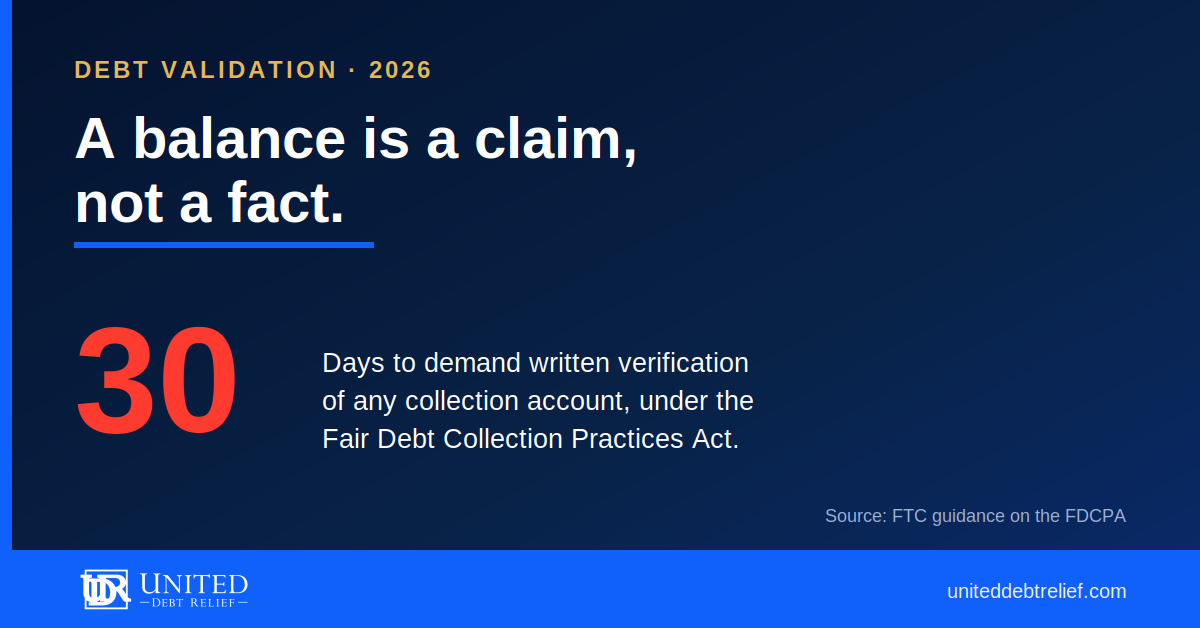
United Debt Relief published the two federal rules most consumers never use when a collection account appears. A consumer has 30 days from receiving a debt collector’s validation information to dispute the debt in writing, and the collector must then stop collecting until it sends written verification, under the Fair Debt Collection Practices Act as described in Federal Trade Commission consumer guidance. The Consumer Financial Protection Bureau received approximately 387,400 debt collection complaints in 2025, of approximately 6,635,400 consumer complaints in total, according to its Consumer Response Annual Report published in March 2026.
"A balance is a claim, not a fact," said Nick Avila, Founder, United Debt Relief. "The first letter from a collector is a claim. Verification is what turns it into a fact, and federal law gives you 30 days to ask."
The release also sets out the three conditions the Federal Trade Commission’s Telemarketing Sales Rule requires before any debt relief provider may charge a fee, and states the limits of the verification right plainly: it does not erase a debt, and it does not decide who is correct. Program services are performed by stringently vetted in-network providers and law firms, each BBB Accredited with an A rating. Individual results vary.
Read the full release: EIN Presswire • National Law Review
September 1, 2026 • Press Release
United Debt Relief Urges Households to Set a Holiday Budget Before the Borrowing Starts
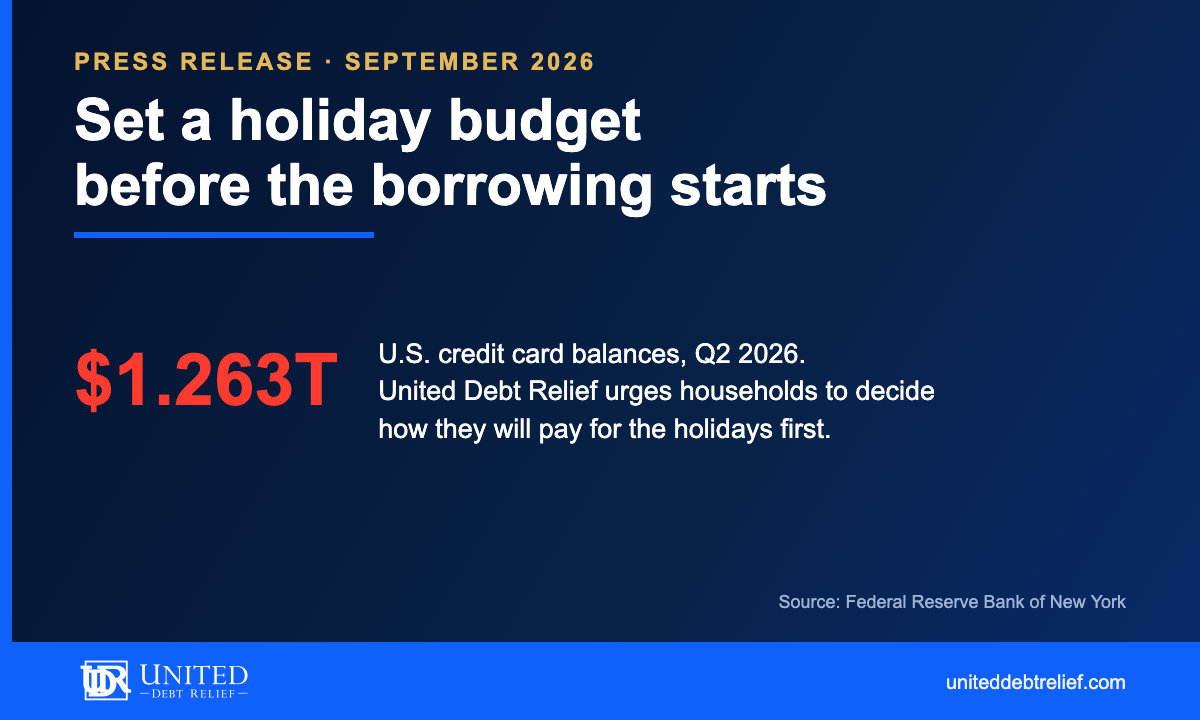
Americans carried $1.263 trillion in credit card balances in the second quarter of 2026, according to the Federal Reserve Bank of New York, and cards assessed interest averaged an APR of 22.15% in the second quarter of 2026, according to the Federal Reserve. Heading into the fourth quarter, United Debt Relief is urging households to decide how they will pay for the holidays before the spending starts rather than after the statements arrive.
"The debt people call us about in February is almost always debt they took on in November and December without a plan," said Nick Avila, Founder, United Debt Relief. "Deciding in September what you can actually afford is the cheapest financial move available to you all year."
The company points households to three facts worth understanding before any borrowing decision. Under the Federal Trade Commission’s Telemarketing Sales Rule, a debt settlement provider cannot charge a fee until a debt has been renegotiated under an agreement the consumer signed and the consumer has made at least one payment under that agreement. Under the Fair Credit Reporting Act, charge-offs and collections are generally reported for seven years measured from the original delinquency, and bankruptcy for up to 10 years. And the IRS generally treats canceled debt as taxable income regardless of amount, with a Form 1099-C filed once the forgiven amount reaches $600 and exclusions available for bankruptcy and insolvency. Program services are performed by stringently vetted in-network providers and law firms, each BBB Accredited with an A rating. Individual results vary.
Read the full release: PRLog • Qwoted
Free consultation: uniteddebtrelief.com/free-consultation
August 1, 2026 • Press Release
United Debt Relief Urges Consumers to Weigh the Full Cost of Debt
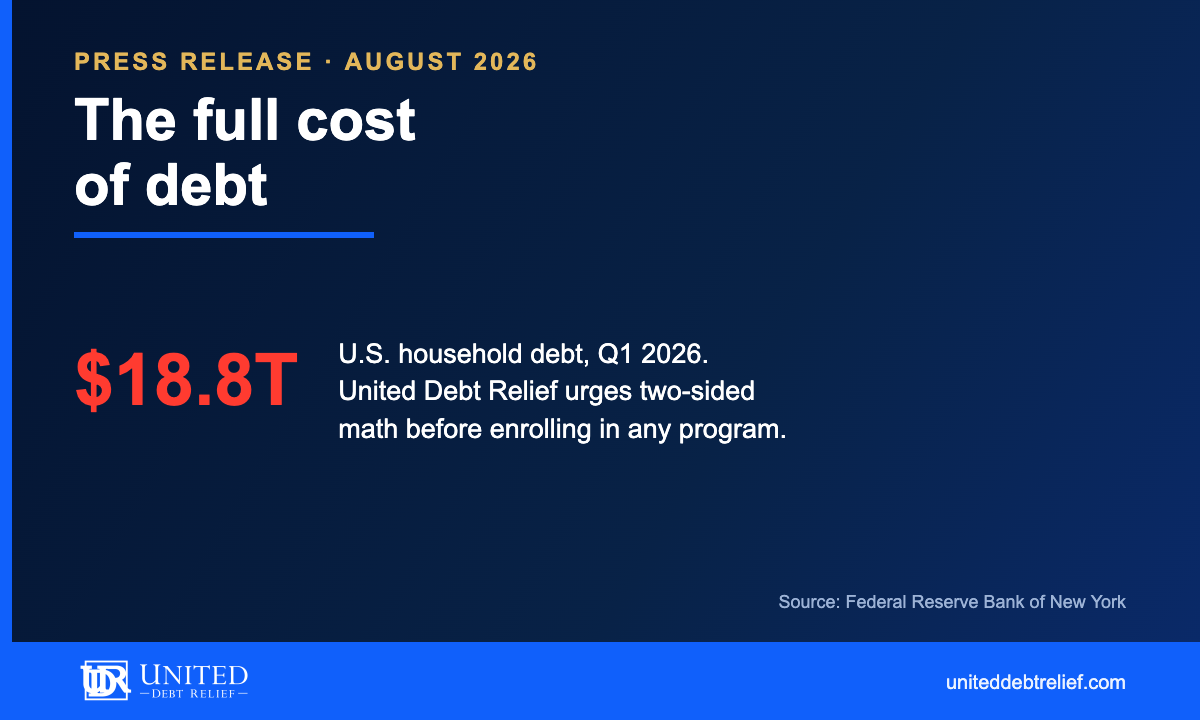
With total U.S. household debt at $18.771 trillion in the second quarter of 2026, per the Federal Reserve Bank of New York, and the average APR on credit card accounts assessed interest at 22.15% in the second quarter of 2026, per the Federal Reserve, United Debt Relief is urging consumers to evaluate debt relief as a two-sided cost rather than a single number.
"The cost of getting out of debt is real, and it is almost always smaller than the cost of staying in it," said Nick Avila, Founder, United Debt Relief. "A debt settlement program will lower your credit in the short term, and I will always say so plainly. What matters is whether it gets you out of a hole you could not climb out of otherwise."
The release maps the three costs consumers should understand before enrolling in any settlement program: fees, which under the Federal Trade Commission’s Telemarketing Sales Rule cannot be charged until a debt has been renegotiated under an agreement the consumer signed and the consumer has made at least one payment under that agreement; a credit-score impact, with charge-offs and collections generally reported for seven years measured from the original delinquency, and bankruptcy for up to 10 years, under the Fair Credit Reporting Act; and possible tax on canceled debt, which the IRS generally treats as income regardless of amount, with a Form 1099-C filed at $600 or more and exclusions available for bankruptcy and insolvency. Individual results vary.
Read the full release: PRLog • Qwoted
Free consultation: uniteddebtrelief.com/free-consultation
July 5, 2026 • Press Release
As Unsecured Debt Gets More Expensive, United Debt Relief Explains the Three Paths to Resolve It: Consolidate, Settle, or Validate
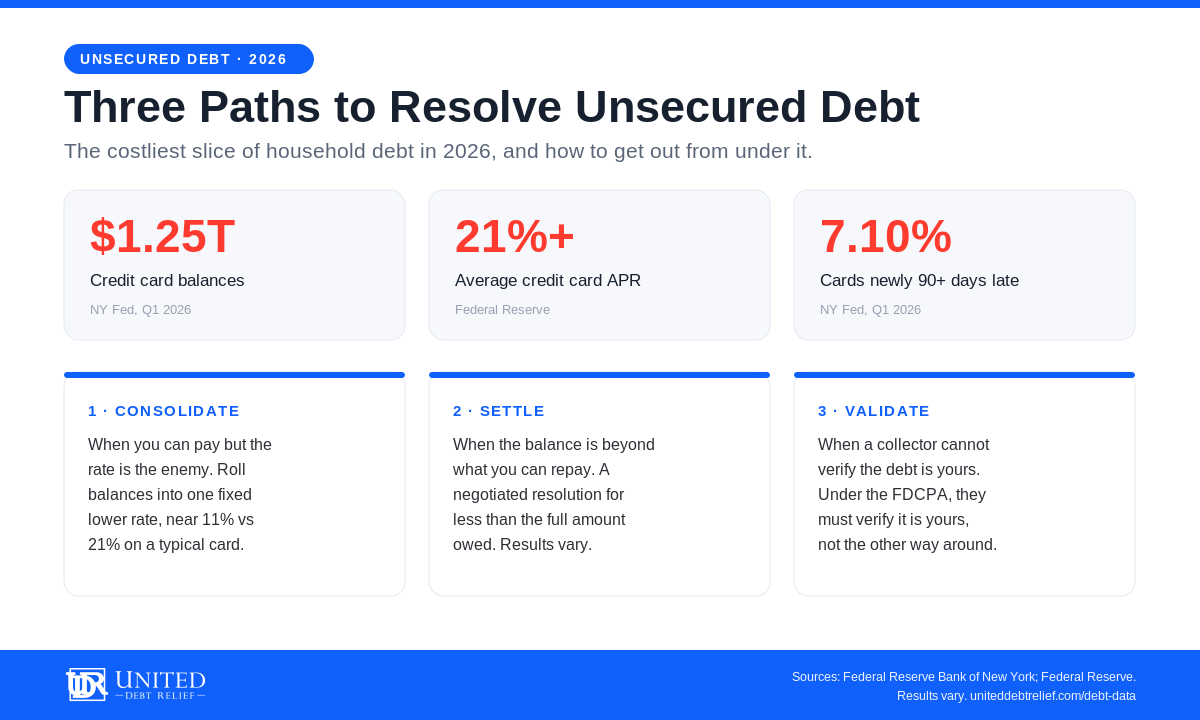
Unsecured debt is the costliest slice of household debt: $1.263 trillion in credit card balances at rates above 20%, according to the Federal Reserve Bank of New York and the Federal Reserve, with cards among the fastest debts to fall behind. In this release, founder Nick Avila lays out the three paths United Debt Relief helps households navigate: a debt consolidation loan when you can pay but the rate is the enemy, debt settlement when the balance is beyond reach, and debt validation when a collector cannot verify the debt is yours. United Debt Relief is a company that charges no upfront consultation fees and does not guarantee outcomes; results vary. Current figures are published on our U.S. Debt Statistics page.
June 3, 2026 • Press Release
Americans Enter Summer 2026 Owing a Record $18.79 Trillion, United Debt Relief Analysis Finds
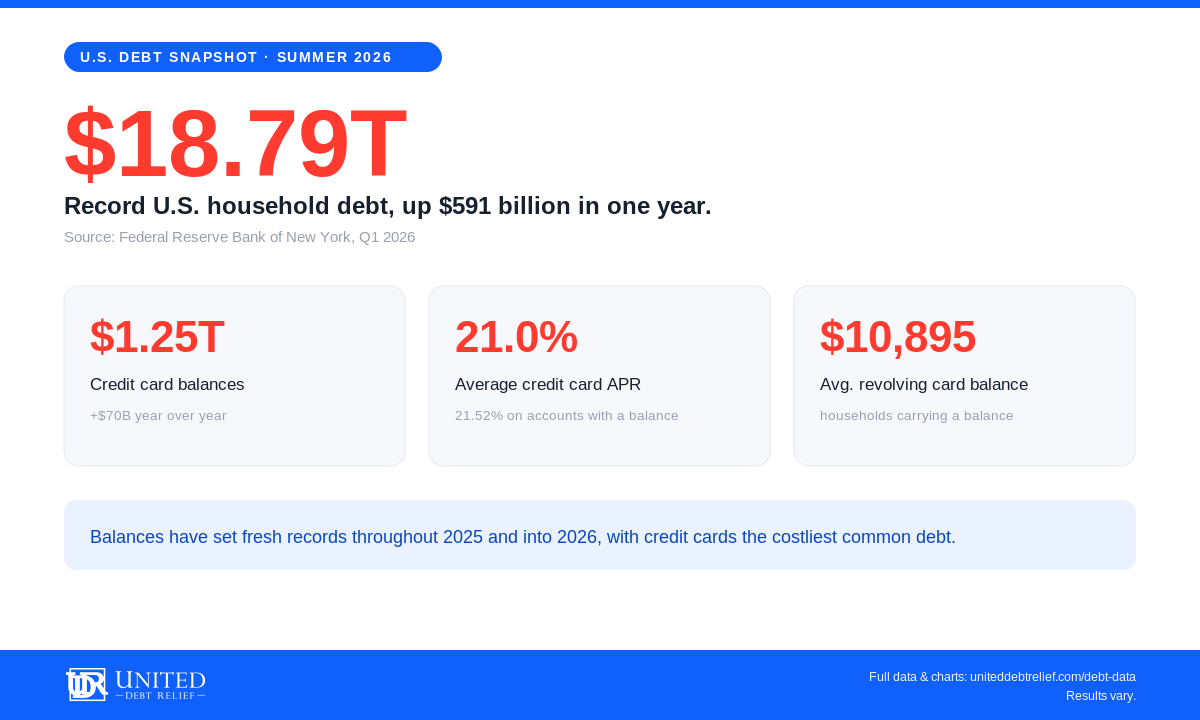
Our June data briefing examines the newest Federal Reserve Bank of New York figures: total household balances opened the summer at an all-time high, with credit card debt up $70 billion year over year and the typical card-carrying household owing $10,895 at a 21.52% APR, roughly $195 a month in interest before any principal is paid. The briefing draws on the continuously updated research published on our U.S. Debt Statistics page.
Syndication
July 22, 2026 • Syndication
What Is a Debt Validation Letter? FDCPA Rights Explained
United Debt Relief republished its explainer on debt validation letters and consumer FDCPA rights to Medium, with the canonical link pointing back to the original United Debt Relief blog post. The piece breaks down what a debt validation letter is, what it should require a collector to verify, and how to send one. United Debt Relief is a debt relief company; this is general information, not legal advice, and results vary by individual circumstances.
Read on Medium: Medium
Media Kit
Journalists and researchers are welcome to use the resources below. Our debt statistics are drawn from primary public sources (Federal Reserve, Experian, CFPB, IRS) and refreshed quarterly at uniteddebtrelief.com/debt-data/.
About United Debt Relief
United Debt Relief is a nationwide debt relief company serving all 50 states, offering five programs spanning debt settlement, debt validation, debt consolidation loans, tax resolution, and credit repair, so a client’s debt, tax, and credit problems are handled together rather than referred out. Its specialists consult with consumers, determine which program fits, and handle enrollment. Program services are performed by stringently vetted in-network providers and law firms, each BBB Accredited with an A rating. Debt settlement carries no upfront fees. Results vary by situation. Learn more at uniteddebtrelief.com. For verification, United Debt Relief publishes its verified company facts, covering the official company name, founding year, the five programs, service area, and contact details.
Press Contact
United Debt Relief
2907 Shelter Island Dr Ste 105, San Diego, CA 92106
Email: info@uniteddebtrelief.com
United Debt Relief publishes one data-led news briefing each month and a quarterly flagship report aligned with Federal Reserve household-debt data releases.