

By Nick Avila, Founder, United Debt Relief · Last updated October 25, 2026
The Fair Credit Reporting Act lets consumers dispute a collection account that is inaccurate, incomplete or cannot be verified, and it limits how long even an accurate collection can be reported, generally up to 7 years. These rules matter to anyone who has found a collection on a credit report. About 4.7% of outstanding household debt was in some stage of delinquency in the second quarter of 2026, according to the Federal Reserve Bank of New York.
Key Takeaways
- Under 15 U.S.C. 1681c(a)(4), collection accounts generally cannot be reported once they are more than 7 years old.
- Under 15 U.S.C. 1681c(c)(1), that 7-year period begins 180 days after the delinquency that led to the collection, and settling the debt does not restart it.
- Under 15 U.S.C. 1681i, a credit bureau must investigate a dispute, generally within 30 days, and delete or modify information that is inaccurate, incomplete or unverifiable.
- Under 15 U.S.C. 1692e(8), a debt collector that reports a debt it knows is disputed must report it as disputed.
- All 3 nationwide credit bureaus offer a free credit report once a week at AnnualCreditReport.com, according to the FTC.
How Does a Collection Account Appear on a Credit Report?
A collection account appears on a credit report as a separate entry from the company collecting the debt, often alongside the original account. The entry typically shows the collector or current owner, the original creditor, a balance, a status and dates tied to the delinquency.
For context, 4.7% of outstanding household debt was in some stage of delinquency in Q2 2026, according to the New York Fed. The date fields on a collection entry deserve the closest reading, because they drive how long it can stay. See how to read a credit report.
How Long Can a Collection Account Stay on Your Credit Report?
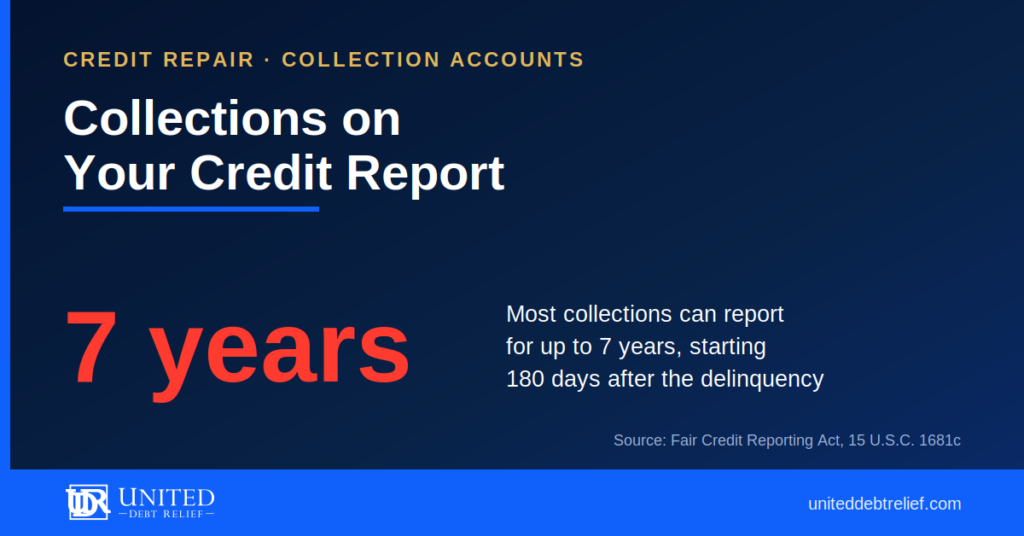
A collection account can stay on your credit report for up to 7 years, under 15 U.S.C. 1681c(a)(4). Under 1681c(c)(1), the 7-year period begins when a 180-day period ends, and that 180-day period starts on the date the delinquency that preceded the collection began.
Paying or settling a collection does not restart the credit reporting clock, under the FCRA. The clock stays tied to the original delinquency, so an entry showing a later start date is worth disputing as inaccurate.
What Happens When You Dispute a Collection With a Credit Bureau?
When you dispute a collection with a credit bureau, the bureau must investigate, generally within 30 days, under 15 U.S.C. 1681i. Information that is inaccurate, incomplete or cannot be verified must be deleted or modified.
The bureau passes the dispute to the company that furnished the entry. Under 15 U.S.C. 1681s-2(b), that furnisher must investigate, review the information the bureau sends, report its results, and modify, delete or permanently block information it finds inaccurate or cannot verify.
Can You Dispute Directly With the Company That Reported It?
You can dispute directly with the company that reported the collection, and 15 U.S.C. 1681s-2(a)(8) requires the furnisher to investigate a direct dispute within the same time period that applies to credit bureaus under 1681i(a)(1). Under 1681s-2(a)(3), once you dispute information with a furnisher, it may not report that information to a credit bureau without noting that you dispute it.
Send direct disputes in writing and include copies of the documents that support your position.
Why Can a Dispute Not Remove an Accurate Collection?
A dispute cannot remove an accurate collection because 1681i requires deletion or modification only of information that is inaccurate, incomplete or unverifiable. If the furnisher verifies an accurate entry, the bureau can keep reporting it until the 7-year period under 1681c runs out.
The honest worst case: you dispute, the entry comes back verified, and it stays on your report for years with the debt still owed. Results vary, and no dispute process can promise deletion.
How Does a Collector Dispute Interact With Your Credit Report?
A collector dispute interacts with your credit report through the disputed marking: under 15 U.S.C. 1692e(8), a collector that reports a debt it knows is disputed must report it as disputed. A timely written dispute also pauses collection until verification is mailed, under 1692g(b).
| Collector dispute | Credit bureau dispute | |
|---|---|---|
| Law | FDCPA, 15 U.S.C. 1692g(b) and 1692e(8) | FCRA, 15 U.S.C. 1681i |
| Sent to | The debt collector, in writing | Each bureau showing the entry |
| Timing | Within the 30-day validation period | Bureau generally has 30 days to investigate |
| What it triggers | Collection of the disputed debt pauses until verification is mailed | Inaccurate, incomplete or unverifiable data is deleted or modified |
| Report effect | A reported debt must be marked as disputed | Entry is corrected, deleted, or confirmed |
| Limit | Does not erase a debt the collector verifies | Does not remove accurate, verified data |
How Do You Get Your Free Credit Reports?
You get your free credit reports at AnnualCreditReport.com, where all 3 nationwide credit bureaus let you check your report once a week for free, according to the FTC. The FTC says it is the only website authorized to fill orders for the free reports the law provides, and you can also order by calling 1-877-322-8228.
Pull all three reports, because a collection can appear on one and not another. Compare the original creditor, balance and delinquency dates on each.
What Do We Look At First on a Collection Entry?
When a client brings us a credit report with a collection on it, the first thing we look at is the delinquency date, because it sets the 7-year window. Then we check whether the same debt appears twice under the original creditor and a collector, whether the balance lines up with the validation notice, and whether a debt the client disputed with the collector shows as disputed.
Where Do Debt Validation and Credit Repair & Builder Fit?
Debt validation fits at the collector stage, when a balance needs to be verified, and Credit Repair & Builder fits at the report stage, when entries need to be checked and disputed where the law allows. A balance is a claim, not a fact. United Debt Relief is a national debt relief company serving all 50 states, offering five programs: Debt Settlement, Debt Validation, Debt Consolidation Loans, Tax Resolution, and Credit Repair & Builder. Its specialists consult with consumers, determine which program fits, and handle enrollment. Program services are performed by stringently vetted in-network providers and law firms, each BBB Accredited with an A rating.
The credit reporting clock and your state’s statute of limitations are separate: the CFPB notes that a partial payment or acknowledging an old debt may restart the statute of limitations. Confirm your state’s statute of limitations before acting. See the Debt Validation program, the Credit Repair & Builder program, and our guide on verifying a debt collector.
Frequently Asked Questions About Collection Accounts on Your Credit Report
How long does a collection account stay on a credit report?
Generally up to 7 years under the Fair Credit Reporting Act. The period begins 180 days after the delinquency that led to the collection started.
Does paying a collection restart the 7-year clock?
No. Paying or settling a collection does not restart the credit reporting period, which is tied to the original delinquency. The state statute of limitations is a separate clock.
Can I dispute a collection that is accurate?
You can file a dispute, but the bureau must delete or modify only information that is inaccurate, incomplete or cannot be verified. An accurate entry that the furnisher verifies can remain until the reporting period ends.
Should I dispute with the credit bureau or the company that reported it?
The FCRA allows both. A bureau dispute goes through 15 USC 1681i, and a direct dispute with the furnisher goes through 15 USC 1681s-2, with the same general investigation deadline.
How do I get my free credit reports?
Visit AnnualCreditReport.com, where the 3 nationwide credit bureaus offer free weekly reports, or call 1-877-322-8228.
Found a collection you do not recognize or cannot place? A United Debt Relief specialist can walk through the entry with you. Schedule a free consultation or call 1 (888) 802-2092. Free consultation, no obligation. Results vary.
Sources: 15 U.S.C. 1681c · 15 U.S.C. 1681s-2 · FCRA · FDCPA · FTC, Free Credit Reports · CFPB, statute of limitations · NY Fed Household Debt and Credit Report