

By Nick Avila, Founder, United Debt Relief · Last updated October 4, 2026
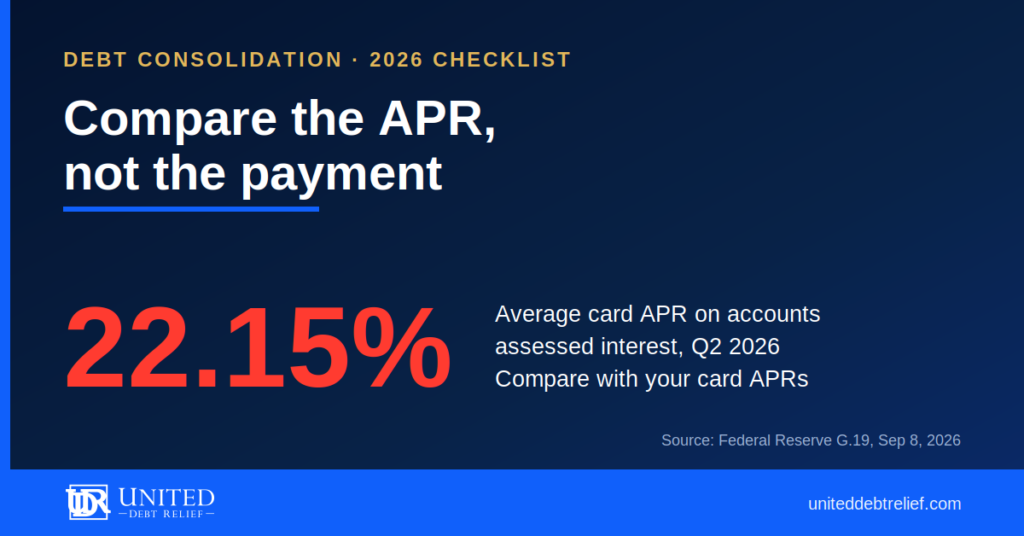
A debt consolidation loan is a good idea when its APR and total cost come in below what the current credit cards charge and the borrower stops re-borrowing on the paid-off cards. This checklist is for people carrying balances across several credit cards who are weighing a consolidation loan offer in 2026. The comparison matters now because credit card accounts assessed interest carried an average APR of 22.15% in the second quarter of 2026, according to the Federal Reserve’s G.19 release.
Key Takeaways
- Credit card accounts assessed interest averaged a 22.15% APR in Q2 2026, according to the Federal Reserve G.19 release.
- In a simple-interest illustration at the Federal Reserve’s 22.15% average, $20,000 of card debt costs about $4,430 a year in interest.
- The CFPB warns that a lower monthly payment may come from a longer term that costs a lot more overall.
- Truth in Lending rules (CFPB Regulation Z) require 4 key disclosures before signing: APR, finance charge, amount financed, and total of payments.
- U.S. credit card balances were $1.263 trillion in Q2 2026, up $54 billion in a year, according to the New York Fed.
Is a Debt Consolidation Loan a Good Idea in 2026?
A debt consolidation loan is a good idea in 2026 only when the loan’s APR and total cost beat what the existing cards charge. The Federal Reserve’s G.19 release put the average card APR at 22.15% on accounts assessed interest and 20.94% on all accounts in Q2 2026.
A simple-interest illustration shows the stakes: $20,000 carried at 22.15% costs about $4,430 a year, or about $369 a month, in interest alone. A consolidation loan changes that number only if its APR is lower. Results vary by borrower and lender.
What Should a Consolidation Loan Checklist Include?
A consolidation loan checklist should include six questions, each answered by a document rather than a sales pitch. Most answers sit on the Truth in Lending disclosure.
| Question to ask | Why it matters | Where to find the answer |
|---|---|---|
| Is the APR below my current card APRs? | The APR is the cost of credit as a yearly rate (Regulation Z). The Q2 2026 card average was 22.15% (Federal Reserve G.19). | TILA disclosure, APR line; each card statement |
| Is the rate fixed, or a teaser rate? | The CFPB warns low rates may be teaser rates that last only for a certain time. | Loan agreement; CFPB consolidation guidance |
| What is the total of payments? | A longer term can lower the payment and raise the total cost, per the CFPB. | TILA disclosure, total of payments line |
| What are the finance charge and amount financed? | The finance charge is the dollar cost of the credit; the amount financed is the credit actually provided. | TILA disclosure |
| Is the loan secured by my home or other property? | The CFPB notes an unpaid home equity loan could lead to foreclosure. | Loan agreement; CFPB consolidation guidance |
| Can I carry the payment and keep the cards at zero? | The CFPB cautions that new debt for old debt may just be kicking the can down the road. | Monthly budget; CFPB consolidation guidance |
When Does a Consolidation Loan Tend to Fit?
A consolidation loan tends to fit a borrower with steady income, credit strong enough to qualify for an APR below current card rates, and a plan to stop re-borrowing. Banks, credit unions, and installment loan lenders may offer debt consolidation loans, according to the CFPB.
The plan to stop re-borrowing is the easiest step to skip. The CFPB notes that many people do not succeed in paying off debt by taking on more debt unless they lower their spending. Compare a card-based option in balance transfer or debt consolidation loan.
When Is a Consolidation Loan the Wrong Tool?
A consolidation loan is usually the wrong tool when the only offers available carry an APR at or above the rates on the current cards, which averaged 22.15% on accounts assessed interest in Q2 2026, according to the Federal Reserve. A loan that costs the same or more adds an account without lowering the cost, and a payment that cannot be carried every month creates a new problem.
Disputed debts should be verified before anyone borrows to pay them. Under 15 U.S.C. 1692g(b), a timely written dispute within 30 days requires a debt collector to stop collecting the disputed debt until it mails verification. See the Debt Validation program and debt consolidation vs debt settlement.
What Does the CFPB Warn About Consolidation Loans?
The CFPB warns about teaser rates, longer terms that cost more, and new debt that only moves old debt. Low rates may be teaser rates that last only for a certain time, and a lower payment may mean a longer term and a lot more paid overall, according to the CFPB. An unpaid home equity loan could also lead to foreclosure, the CFPB notes.
The honest worst case: a borrower moves $20,000 of card debt into a longer loan, the cards drift back up, and a year later there are two sets of payments. The CFPB calls this kicking the can down the road. A secured loan adds a home or car to that risk.
What Must a Lender Disclose Before You Sign?
A lender must disclose the APR, finance charge, amount financed, and total of payments before a consolidation loan is signed, under the Truth in Lending Act and Regulation Z. Regulation Z describes the total of payments as the amount paid once all scheduled payments are made.
Compare the APR, not the payment. Two offers with the same payment can carry very different totals. A consolidation decision depends on your full financial picture, so read the complete disclosure and question any unclear figure before signing. Credit report effects are covered in does debt consolidation hurt your credit score.
How Does United Debt Relief Review a Consolidation Loan Question?
United Debt Relief reviews a consolidation loan question by setting current card APRs next to the loan terms first. When someone brings us a consolidation offer, the first thing we check is the APR line and the total of payments, then we list every card balance and rate side by side. We also ask which accounts are in collection or disputed, since those may fit a different program.
United Debt Relief is a national debt relief company serving all 50 states, offering five programs: Debt Settlement, Debt Validation, Debt Consolidation Loans, Tax Resolution, and Credit Repair & Builder. Its specialists consult with consumers, determine which program fits, and handle enrollment. United Debt Relief is not a lender: loans are made by providers, who set approval, rate, and terms. See how the Debt Consolidation Loans program works.
Frequently Asked Questions About Debt Consolidation Loans
Is a debt consolidation loan a good idea for credit card debt?
A debt consolidation loan can make sense when the new APR is below the card rates, the payment fits the budget, and the paid-off cards stay unused. The Federal Reserve reported a 22.15% average APR on card accounts assessed interest in Q2 2026. Results vary.
Does a lower monthly payment mean the loan costs less?
Not necessarily. The CFPB warns that a lower payment may come from a longer repayment period, which could mean paying a lot more overall. The total of payments on the Truth in Lending disclosure shows the full cost.
What should I compare between two consolidation loan offers?
Compare the APR, finance charge, amount financed, and total of payments on each Truth in Lending disclosure, and confirm whether the rate is fixed and the loan secured.
Is United Debt Relief a lender?
United Debt Relief is not a lender. Its specialists determine whether a consolidation loan fits, and providers make the loans and set approval, rate, and terms.
What if I cannot qualify for a rate below my card APRs?
Other paths may fit, including Debt Settlement, Debt Validation for disputed collection accounts, or a card issuer hardship program. A United Debt Relief specialist can review the accounts and determine which program fits. Results vary.
Schedule a free consultation with United Debt Relief or call 1 (888) 802-2092 to review a consolidation offer. Free consultation, no obligation. Results vary.
Sources: Federal Reserve G.19 · New York Fed Household Debt and Credit, Q2 2026 · CFPB on consolidation · Regulation Z, 12 CFR 1026.18 · FDCPA (FTC)