

Last updated: November 18, 2026
Key Points
- Debt settlement runs in 5 stages: consultation and fit, a dedicated account with monthly savings, negotiation, written terms you review and accept, and payment.
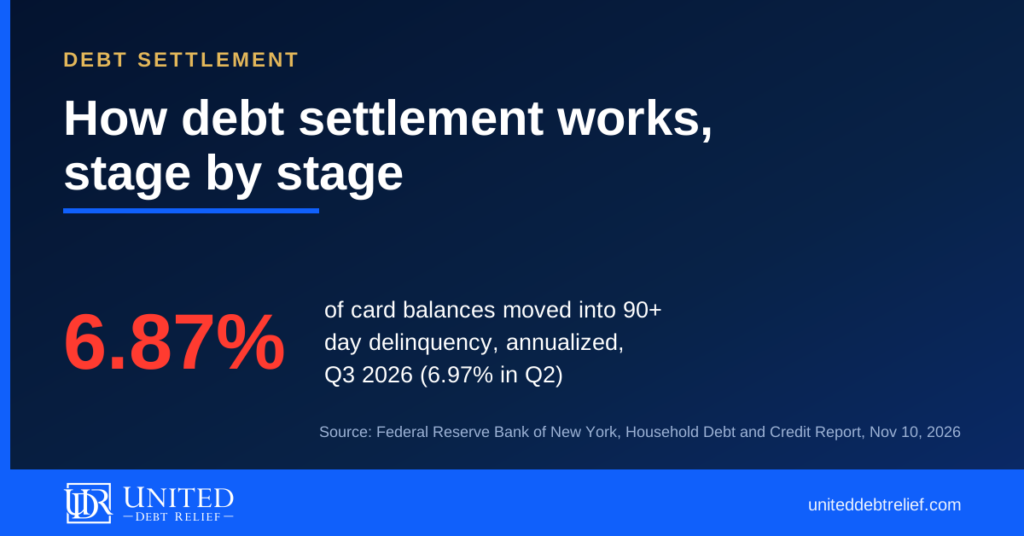
- Card balances flowed into serious (90+ day) delinquency at an annualized 6.87% in Q3 2026, down from 6.97% in Q2, according to the Federal Reserve Bank of New York.
- The FTC says the debt settlement process “can take years” to complete.
- Under the FTC Telemarketing Sales Rule (16 CFR 310.4), no settlement fee can be collected until a debt is settled, the customer agrees, and at least one payment is made.
- Collections and charge-offs can report for 7 years from 180 days after the delinquency began, and settling does not restart that clock (15 U.S.C. 1681c).
- Creditors file Form 1099-C for canceled debt of $600 or more, and IRS Publication 4681 explains the insolvency exclusion.
Debt settlement works in five stages: a consultation to check fit, monthly savings in a dedicated account you own, negotiation with each creditor, written terms you review and accept, and payment under that agreement. Credit reporting and possible taxes on canceled debt follow each settlement. Each creditor is negotiated one at a time, and the FTC says the whole process “can take years.” Debt settlement is used mostly for unsecured debt that has fallen behind. Card balances flowed into serious, 90+ day delinquency at an annualized 6.87% in Q3 2026, according to the Federal Reserve Bank of New York. This guide walks through each stage, who does what, and what to watch.
What are the 5 stages of debt settlement?
The 5 stages of debt settlement are consultation and fit, a dedicated account with monthly savings, negotiation, written terms you review and accept, and payment. Stages 3 to 5 repeat for each enrolled account. The table shows who does what at each stage.
| Stage | What happens | Who does it | What to watch |
|---|---|---|---|
| 1. Consultation and fit | Debts, income, and budget are reviewed; settlement is compared with other options | You and a specialist | Written disclosure of fees, timing, and risks before you enroll |
| 2. Dedicated account and monthly savings | Eligible unsecured debts are enrolled, and you set money aside each month in an account you own | You and an independent account administrator | The TSR requires an insured institution, funds you own, and withdrawal within 7 business days (16 CFR 310.4); late fees, interest, collection calls, and possible lawsuits while you save |
| 3. Negotiation | Once enough is saved, each creditor or collector is contacted and an amount is negotiated | The in-network provider | Creditors are not required to settle; results vary by creditor |
| 4. Terms in writing, your decision | The creditor’s offer is put in a letter or signed agreement, and you review it and decide whether to accept | Creditor and provider; you accept or decline | Amount, dates, “settled in full” language, credit reporting, 1099-C |
| 5. Payment | The agreed amount is paid from the dedicated account; a fee may then be charged for that debt | Account administrator, on your authorization | No fee before this point under the FTC rule |
Stages 3 to 5 repeat for each enrolled account. After each settlement, the creditor updates your credit report and may file Form 1099-C, which the sections below cover.
How does debt settlement start?
Debt settlement starts with a consultation to decide whether it fits (stage 1), then enrollment of eligible debts and monthly deposits into a dedicated account you own (stage 2). No creditor is paid during these first two stages.
Stage 1, consultation and fit. A specialist reviews each debt, whether payments are current, and what you can set aside monthly. Settlement fits unsecured debt such as credit cards, medical bills, and unsecured personal loans. It is not used for mortgages or auto loans. If a debt is with a collector you do not recognize, debt validation may come first.
Stage 2, dedicated account and monthly savings. Under 16 CFR 310.4(a)(5)(ii), if a provider requires a dedicated account, the TSR requires that it be held at an insured financial institution, that you own the funds, and that the administrator not be affiliated with the settlement provider. You can leave at any time and receive your funds, other than earned fees, within seven business days. You then make monthly deposits until there is enough to make an offer. If you stop paying creditors, the FTC notes that late fees and penalties may grow and your credit report will likely show late payments. The FTC also warns you could be sued while waiting for a settlement. Read whether you can be sued during debt settlement.
What happens during negotiation, written terms, and payment?
In stage 3, the provider contacts each creditor once enough is saved and works toward an amount the creditor will accept. In stage 4, the terms are put in writing and you decide whether to accept. In stage 5, payment goes out from the dedicated account.
Stage 3, negotiation. Creditors decide whether to settle and on what terms. Results vary.
Stage 4, terms in writing, your decision. The written agreement should state the account, the amount, the payment dates, that payment resolves that account in full, what will be reported to the credit bureaus, and who files any Form 1099-C. Nothing is paid until you accept. The full checklist is in what a debt settlement letter and agreement must say.
Stage 5, payment. Under 16 CFR 310.4(a)(5)(i), a fee can be collected only after a debt is settled under an agreement you accepted and you make at least one payment under it. The fee must be proportional to that debt’s share of the enrolled total, or a fixed share of the amount saved. The guide to how much debt settlement costs covers the math.
How does debt settlement affect your credit report?
Debt settlement affects your credit report through late payments during the savings stage and a “settled” status after payment. Settled accounts typically report as settled rather than paid in full.
The timeline is set by federal law. Under 15 U.S.C. 1681c, collections and charge-offs can report for 7 years, measured from 180 days after the delinquency began. Settling the account does not restart that clock.
The effect depends on where your credit started. A person already behind may already have late payments on file; a person who is current and stops paying adds new ones. Results vary. After each settlement, check your credit reports to confirm the account was reported as agreed.
Is settled debt taxable?
Settled debt may be taxable, because the IRS can treat canceled debt as income. Creditors file Form 1099-C for canceled debt of $600 or more, though the $600 figure is a filing threshold, not a floor for what may be taxable.
IRS Publication 4681 explains exclusions. The insolvency exclusion may apply if your total debts exceeded the fair market value of your assets right before the debt was canceled. Debt discharged in bankruptcy is also excluded. The guide to insolvency and settled debt goes deeper. Tax outcomes depend on your full situation; consult a licensed tax professional.
The worst case to plan for: a creditor declines to settle, files a lawsuit, and wins a judgment before your savings are large enough, while late fees and interest keep growing. A settled account still reports for the rest of its 7-year period, and the forgiven amount may add to your tax bill. Confirm your state’s rules before acting.
How does United Debt Relief run the settlement stages?
United Debt Relief runs stage 1 directly and handles enrollment in stage 2, while in-network providers perform negotiation, written agreements, and payment coordination in stages 3 to 5. United Debt Relief is a national debt relief company serving all 50 states, offering five programs spanning debt settlement, debt validation, debt consolidation loans, tax resolution, and credit repair, so a client’s debt, tax, and credit problems are handled together rather than referred out. Its specialists consult with consumers, determine which program fits, and handle enrollment. Program services are performed by stringently vetted in-network providers and law firms, each BBB Accredited with an A rating.
Nick Avila, founder of United Debt Relief, says the stage people ask about least, and should ask about most, is stage 4, the written terms, because they decide what the credit report and tax form will show. Details are on the debt settlement program page.
Frequently Asked Questions
How many stages does debt settlement have?
Debt settlement has five stages: consultation and fit, a dedicated account with monthly savings, negotiation, written terms you review and accept, and payment. Stages 3 to 5 repeat for each enrolled account. Results vary.
How does debt settlement work?
Debt settlement works by saving into a dedicated account while each unsecured creditor is negotiated. When a creditor agrees in writing to accept less than the full balance and you accept the terms, the agreed amount is paid from the account. Results vary.
How long does debt settlement take?
The FTC says the debt settlement process can take years to complete. The length depends on the number of accounts, the total enrolled, and how much you can deposit each month. Timelines vary.
When can a debt settlement company charge a fee?
Under the FTC Telemarketing Sales Rule, a fee can be charged only after a debt is settled under an agreement you accepted and you make at least one payment under it.
Can I be sued during debt settlement?
Yes, a creditor can file a lawsuit during a settlement program. The FTC notes you could be sued while waiting for a settlement. A lawsuit has deadlines, so respond to any court papers right away.
Does debt settlement restart the 7-year credit reporting clock?
No. Collections and charge-offs can report for 7 years from 180 days after the delinquency began. Settling does not restart that clock. Settled accounts typically report as settled rather than paid in full.
Will I get a 1099-C after debt settlement?
You may. Creditors file Form 1099-C for canceled debt of $600 or more. The insolvency exclusion in IRS Publication 4681 may reduce what is taxable. Consult a licensed tax professional.
Sources
- Federal Trade Commission, How To Get Out of Debt
- 16 CFR 310.4, Telemarketing Sales Rule
- 15 U.S.C. 1681c, Fair Credit Reporting Act
- IRS, About Form 1099-C, Cancellation of Debt
- IRS Publication 4681, Canceled Debts, Foreclosures, Repossessions, and Abandonments
- Federal Reserve Bank of New York, Household Debt and Credit Report, Q3 2026 (Nov 10, 2026)
Want to know whether debt settlement fits your accounts? A free consultation with United Debt Relief reviews your debts and explains each stage before you enroll. Debt settlement carries no upfront fees, and results vary. Start your free consultation or call 1 (888) 802-2092.