

Last updated: November 4, 2026
Key Points
- A debt settlement agreement should name the account, the creditor, the exact amount, the payment dates, and state that payment resolves that specific account.
- Under the FTC Telemarketing Sales Rule (16 CFR 310.4), a debt settlement company cannot collect a fee until a settlement is agreed to and at least one payment is made.
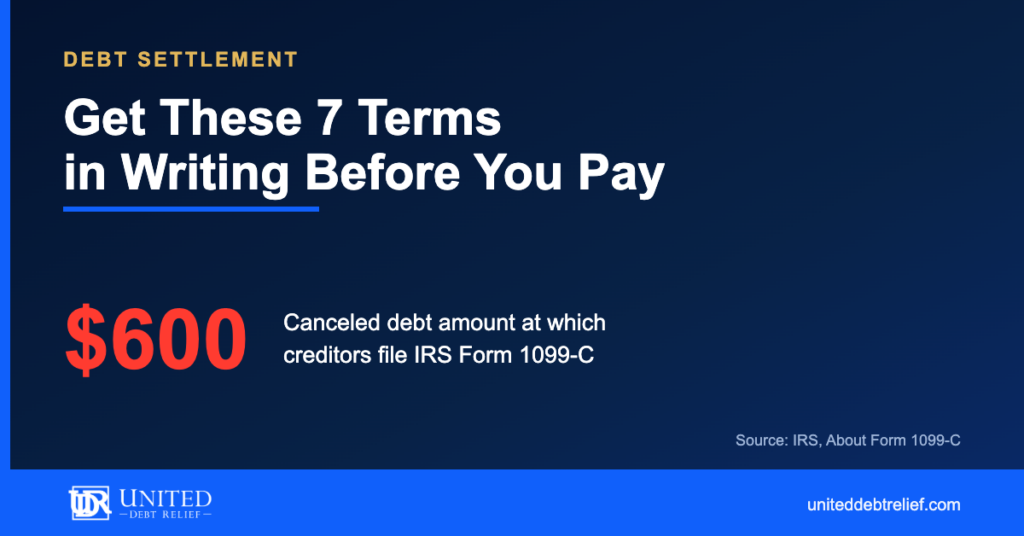
- Creditors file IRS Form 1099-C for canceled debt of $600 or more, so the agreement should show the amount being forgiven (IRS, About Form 1099-C).
- Under the FCRA (15 U.S.C. 1681c), a collection or charge-off can report for 7 years from 180 days after the delinquency began, and settling does not restart that clock.
- The CFPB received about 387,400 debt collection complaints in 2025, and the top issue was attempts to collect debt not owed.
A debt settlement letter, also called a settlement agreement letter, is the written document showing what a creditor or collector accepts to resolve an account for less than the full balance. Get it before you pay anything. The letter should name the account, the amount, the payment dates, and say that payment resolves that specific account. The CFPB received about 387,400 debt collection complaints in 2025, and the top issue was attempts to collect debt not owed, according to its 2025 Consumer Response Annual Report.
What is a debt settlement agreement?
A debt settlement agreement is a written contract in which a creditor or debt collector agrees to accept a set amount, paid on set dates, to resolve a specific account for less than the balance owed.
A phone promise is hard to enforce. A letter on the creditor’s letterhead, or a signed agreement, gives you something to show a court, a credit bureau, or a later collector. The FTC’s Telemarketing Sales Rule treats an agreement the customer has executed as the trigger point for any debt settlement fee.
What must a debt settlement letter say before you pay?
A debt settlement letter should say who you owe, which account it covers, how much you will pay and when, and what happens to the rest of the balance. Seven terms belong in writing before any money moves.
| Term to get in writing | What it should say | Why it matters |
|---|---|---|
| Account and creditor identity | Your name, the account number (or last four digits), the original creditor, and the company currently owed | Debts are sold; the letter must tie the payment to the right account and owner |
| Settlement amount | The exact dollar amount accepted to resolve the account | The difference from the balance is the canceled amount for tax purposes |
| Payment dates and method | Each due date, each amount, and how to pay | A missed date can void the deal under many agreements |
| “Settled in full” language | Payment of the agreed amount resolves this specific account in full | Without it, the remaining balance may still be treated as owed |
| Credit reporting | What the creditor will report to the credit bureaus after payment | Settled accounts typically report as settled rather than paid in full |
| No sale of the remaining balance | The creditor will not sell, assign, or place the forgiven balance for collection | Protects you from a new collector pursuing the difference |
| Form 1099-C | Who will file any Form 1099-C and the canceled amount it will show | Creditors file 1099-C for canceled debt of $600 or more |
Check the figures against your statements, and verify any balance directly with the creditor. If the letter comes from a collector, compare it with the validation notice, which must list the creditor currently owed and the current amount under Regulation F (12 CFR 1006.34).
How does “settled” reporting differ from “paid in full”?
A “settled” account shows the creditor accepted less than the full balance, while “paid in full” shows the entire balance was repaid. Settled accounts typically report as settled rather than paid in full.
The reporting timeline does not depend on how you resolve the account. Under 15 U.S.C. 1681c, collections and charge-offs can report for 7 years, measured from 180 days after the delinquency began. Settling does not restart that clock, and earlier late payments also age off on their own 7-year schedule.
A creditor is not required to report “paid in full” or remove an accurate account. Ask for the reporting language in writing, then check your credit reports after payment. The CFPB received about 5,806,800 credit or consumer reporting complaints in 2025, so checking is worth the time.
What does the FTC fee rule mean for a settlement agreement?
The FTC fee rule means a debt settlement company cannot collect any fee for an account until a settlement agreement exists, you have agreed to it, and you have made at least one payment under it.
The rule is 16 CFR 310.4(a)(5)(i). The fee must also be either proportional to that debt’s share of the total enrolled debt or a fixed share of the amount saved, and that share cannot change from one debt to another.
The rule allows a dedicated savings account with limits. The funds sit at an insured financial institution, you own them, and you can leave at any time and receive the funds, other than earned fees, within seven business days. Read how much debt settlement costs and what the FTC requires for the math.
What should you do after you receive the agreement?
After you receive a debt settlement agreement, read it against the checklist, keep copies, pay exactly as written, and confirm the result on your credit reports.
- Keep copies. Save the agreement, every payment confirmation, and any letter confirming the account is resolved.
- Watch for a 1099-C. Canceled debt may be taxable. IRS Publication 4681 explains the insolvency and bankruptcy exclusions. Tax outcomes depend on your full situation; consult a licensed tax professional. See Form 1099-C and canceled debt.
- Check your reports for the status the letter described.
Nick Avila, founder of United Debt Relief, says the agreement letter is the one document people should never throw away, because it is the only written evidence of what both sides agreed to.
The worst case to plan for: A creditor may decline to settle or may sue before an agreement is reached; the FTC notes you could be sued while waiting for a settlement. If an agreement lacks “settled in full” language, the remaining balance could be sold. If the account is old, confirm your state’s rules before acting, since a payment can affect a state statute of limitations.
What does a neutral settlement request look like?
A neutral settlement request is a short letter asking the creditor to put any offer in writing before payment, without promising money you do not have.
Re: Account ending [last four digits]. Before I make any payment, please send a written settlement offer that states the amount you will accept, the payment dates, that payment of this amount resolves this account in full, what you will report to the credit bureaus, that the remaining balance will not be sold or assigned, and whether a Form 1099-C will be filed. I will review the written terms before responding.
A creditor may or may not respond with an offer. Results vary. If the debt is with a collector you do not recognize, dispute it first through debt validation. The comparison of debt validation versus debt settlement explains which step comes first.
How does United Debt Relief handle settlement agreements?
United Debt Relief handles settlement agreements through its debt settlement program, where in-network providers negotiate each account and obtain the terms in writing before any payment is made. United Debt Relief is a national debt relief company serving all 50 states, offering five programs spanning debt settlement, debt validation, debt consolidation loans, tax resolution, and credit repair, so a client’s debt, tax, and credit problems are handled together rather than referred out. Its specialists consult with consumers, determine which program fits, and handle enrollment. Program services are performed by stringently vetted in-network providers and law firms, each BBB Accredited with an A rating.
Card balances flowed into serious delinquency at an annualized 6.97% in Q2 2026, according to the Federal Reserve Bank of New York.
Frequently Asked Questions
Is a debt settlement letter legally binding?
A signed settlement agreement is generally treated as a contract, and its terms bind both sides if they are met. Keep the letter and evidence of every payment. Confirm your state’s rules with an attorney if a dispute arises.
Should I pay a settlement before I get it in writing?
No. Get the written agreement first. It should state the amount, the dates, that payment resolves the account in full, and what will be reported to the credit bureaus.
Will a settled account show as paid in full?
Settled accounts typically report as settled rather than paid in full. A creditor may agree to other wording, but it is not required to. Check your credit reports after payment.
Does settling a debt restart the 7-year credit reporting clock?
No. Under the FCRA, collections and charge-offs can report for 7 years from 180 days after the delinquency began. Settling the account does not restart that clock.
Will I owe taxes on a settled debt?
Canceled debt may be taxable. Creditors file Form 1099-C for canceled debt of $600 or more. IRS Publication 4681 covers the insolvency and bankruptcy exclusions. Consult a licensed tax professional.
Sources
- 16 CFR 310.4, Telemarketing Sales Rule
- Federal Trade Commission, How To Get Out of Debt
- 15 U.S.C. 1681c, Fair Credit Reporting Act
- 12 CFR 1006.34, Regulation F validation information
- IRS, About Form 1099-C, Cancellation of Debt
- IRS Publication 4681, Canceled Debts, Foreclosures, Repossessions, and Abandonments
- CFPB Consumer Response Annual Report 2025 (Mar 2026)
- Federal Reserve Bank of New York, Household Debt and Credit Report, Q2 2026 (Aug 11, 2026)
Want each settlement agreement handled for you? A free consultation with United Debt Relief reviews your accounts and explains whether debt settlement fits. Debt settlement carries no upfront fees, and results vary. Start your free consultation or call 1 (888) 802-2092.