

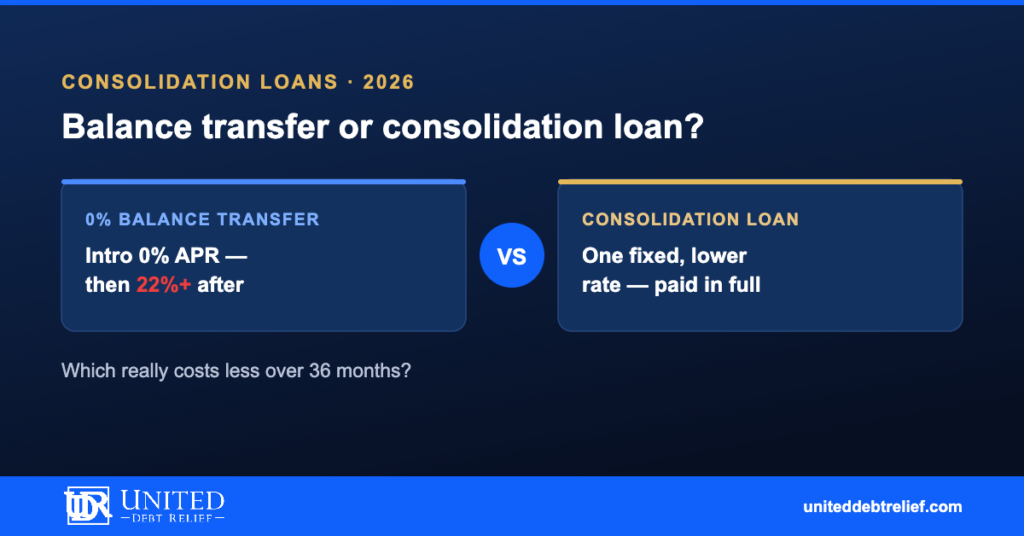
U.S. credit card balances rose $21 billion to $1.263 trillion in the second quarter of 2026, according to the Federal Reserve Bank of New York, and average APRs remain above 22% on accounts assessed interest. For consumers carrying $10,000+ in high-interest card debt, two real escape hatches exist: a 0% balance transfer card or a fixed-rate consolidation loan. The right pick depends on your score, balance size, payoff window, and discipline.
This is the side-by-side that decides which one fits.
Quick answer: A 0% balance transfer is cheaper if you can clear the balance inside the promotional window, usually 12 to 21 months, and if you can absorb the 3 to 5% transfer fee. A fixed-rate consolidation loan wins when the balance is too large to clear that fast, because the rate does not jump when a promo period ends. Balance transfers require good credit; consolidation loans are available further down the credit spectrum. The average 24-month bank personal loan rate was 11.86% in May 2026, according to the Federal Reserve.
What’s the Difference Between a Balance Transfer and a Consolidation Loan?
The difference between a balance transfer and a consolidation loan comes down to two tools built for two different jobs: short-term interest relief versus long-term structure.
0% Balance Transfer: A credit card with an introductory 0% APR window (typically 15-21 months in 2026). You move your existing card balances onto the new card and pay no interest during the promotional period.
Fixed-Rate Consolidation Loan: A personal loan that pays off your card balances. You make a single fixed monthly payment at a fixed APR for 24-84 months.
Different products, different eligibility, different math.
The 0% Balance Transfer in 2026 (Real Terms)
A 0% balance transfer in 2026 buys you an interest-free window, not forgiveness, and the real terms below decide whether that window is long enough. Typical 2026 offers:
- Intro period: 15-21 months at 0% APR
- Eligibility: Generally 700+ FICO required for the best offers; 670+ for shorter intro periods
- Transfer fee: 3-5% of the transferred amount (charged once, upfront)
- Post-intro APR: 20-29% APR after the promo ends
- Credit limit: Lenders typically only let you transfer 80-100% of the new card’s limit
Example: $10,000 transferred with a 4% fee = $400 upfront, $10,400 to pay over 18 months = ~$578/month to clear interest-free.
The risk: If you don’t pay it off during the 0% window, the remaining balance starts accruing at 20-29% APR, often higher than your original cards.
The Fixed-Rate Consolidation Loan in 2026 (Real Terms)
The fixed-rate consolidation loan trades the 0% window for predictability: one fixed payment, one fixed end date, and real terms that hinge on your credit profile. Typical 2026 offers:
- APR range: 6-29% depending on FICO, income, and debt-to-income ratio
- Eligibility: Available for scores 580+ in many lender networks
- Terms: 24-84 months
- No collateral required for unsecured personal loans
- Origination fee: 0-10%, varies by lender
Example: $10,000 at 12% APR over 36 months = ~$332/month, $11,952 total cost ($1,952 in interest).
The benefit: Fixed payment, fixed end date, no rate-shock risk.
36-Month Total Cost: A Side-by-Side
Over 36 months, the side-by-side total cost separates these two options more sharply than the monthly payment alone suggests. Scenario: $15,000 in credit card debt at average 22% APR.
| Strategy | Total Cost (36 mo) | Monthly Payment | Risk |
|---|---|---|---|
| Stay on cards (22% APR) | $20,628 | $573 | High, APR may rise |
| 0% Balance Transfer (4% fee, 18-mo intro) | $16,200 (paid in 18 mo) | $878 mo 1-18 | High, must pay in 18 mo |
| 0% Transfer + remaining at 24% | $18,540 | $573 after | Medium |
| Consolidation Loan (12% APR, 36 mo) | $17,952 | $499 | Low, fixed |
The 0% transfer is the cheapest option if you can pay the entire balance within the 0% window. The consolidation loan is the safest option for everyone else.
Who Qualifies for Which (2026 Score Thresholds)
Who qualifies for which option is decided mostly by your credit score, and the 2026 thresholds below show where each product realistically opens up.
| Score | 0% Transfer | Consolidation Loan |
|---|---|---|
| 740+ | Best offers (21-mo, low fee) | 6-9% APR |
| 700-739 | 15-18 month offers | 8-12% APR |
| 670-699 | Limited, shorter intro | 12-18% APR |
| 620-669 | Rarely qualify | 18-25% APR |
| 580-619 | Do not qualify | 25-29% APR (settlement?) |
| Below 580 | Do not qualify | Limited, settlement often better |
What If Neither a Balance Transfer nor a Consolidation Loan Works?
If neither a balance transfer nor a consolidation loan works, other relief paths stay open, and the right one depends on how far behind you already are. If your score is below 620, your balances are over $40,000, or you’re already missing payments, consolidation rates may not beat your current cards. Consider:
- Debt settlement, reduces total unsecured debt by 40-50% before fees
- Debt validation, challenges unverifiable collection accounts under FDCPA
- Chapter 7/13 bankruptcy, federal protection for severe situations
UDR’s free assessment includes all 5 program pillars, not just consolidation. Best fit, not best sales pitch.
→ Free Fit Check: uniteddebtrelief.com/free-consultation/
Frequently Asked Questions
What credit score do I need for a 21-month 0% balance transfer in 2026?
Generally 740+ for the longest intro periods. 700-739 typically qualifies for 15-18 month offers. Below 670, options narrow significantly.
What’s the average APR on a personal consolidation loan in 2026?
Top-tier (740+): 6-9% APR. Fair credit (620-679): 14-22%. Subprime (below 580): 25-29%, at which point settlement often beats consolidation.
Does either option require collateral?
No. Both are unsecured products. Secured consolidation loans exist but introduce asset risk.
What’s the typical balance transfer fee in 2026?
3-5% of the transferred amount, charged once upfront. On $10,000, expect $300-$500 added to the new card balance.
Can I do both, transfer to 0% AND take a consolidation loan?
Yes, in some cases. Transfer the higher-rate balances to 0% and consolidate the rest with a loan. Requires good credit and careful tracking, UDR specialists can model both paths.