

By Nick Avila, Founder, United Debt Relief · Last updated October 28, 2026
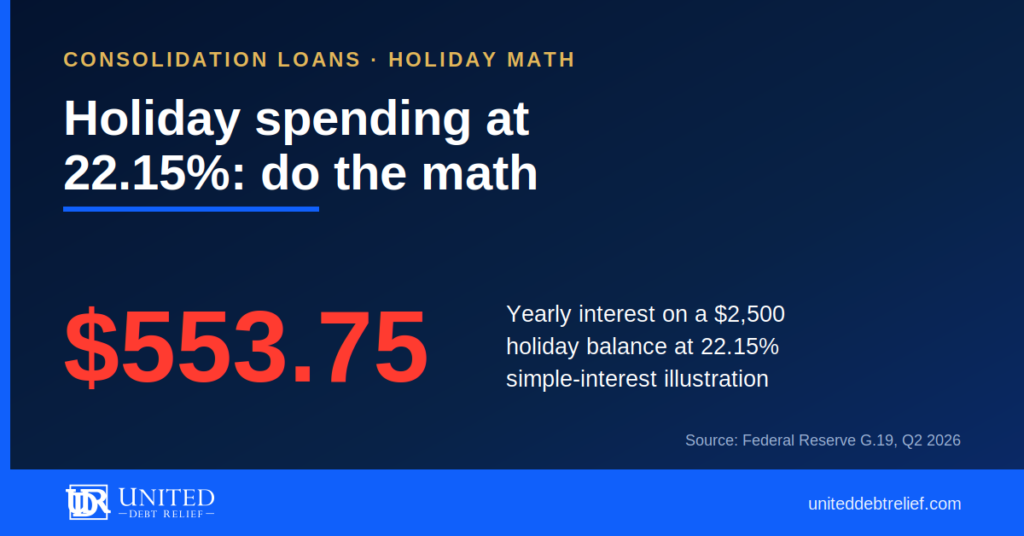
Holiday spending carried on a credit card at 22.15% costs about $553.75 a year in interest on a $2,500 balance, or about $46.15 a month, so the cheapest holiday balance is the one planned before the first purchase. Card accounts assessed interest carried an average APR of 22.15% in the second quarter of 2026, according to the Federal Reserve G.19 release. This post is for anyone who expects to put holiday purchases on a card and carry part of the balance into the new year. It matters in October because card balances stood at $1.263 trillion in the second quarter, up $21 billion, according to the New York Fed.
Key Takeaways
- At the 22.15% average APR in the Federal Reserve G.19, a $2,500 holiday balance costs about $553.75 a year, or about $46.15 a month, in simple interest.
- The CARD Act requires monthly statements to show how long it would take, and how much it would cost, to pay the balance with only minimum payments, according to the CFPB.
- In a fixed-payment illustration at 22.15%, $2,500 paid at $50 a month takes 141 payments and $4,506.23 in interest, versus 34 payments and $883.88 at $100 a month.
- Card balances were $1.263 trillion in Q2 2026, up $21 billion, while total household debt fell $13 billion, according to the New York Fed.
How Much Interest Does a Holiday Balance Cost at 22.15%?
A holiday balance at 22.15% costs about 22 cents a year in interest for every dollar carried, as the table shows. The Federal Reserve G.19 puts the Q2 2026 average at 22.15% on accounts assessed interest and 20.94% across all accounts. Figures are simple-interest illustrations; the 36-month column assumes no new charges.
| Holiday balance | Yearly interest at 22.15% | Monthly interest at 22.15% | Payment to clear it in 36 months |
|---|---|---|---|
| $1,000 | $221.50 | $18.46 | $38.27 |
| $2,500 | $553.75 | $46.15 | $95.67 |
| $5,000 | $1,107.50 | $92.29 | $191.34 |
Formula: balance × 22.15% for the year, divided by 12 for the month. Your own card may carry a different rate; confirm your APR on your statement before acting.
How Do Minimum Payments Stretch a Holiday Balance?
Minimum payments stretch a holiday balance because a small payment leaves little after interest, and federal law requires the statement to show that cost. Under the CARD Act, monthly statements must describe how long it would take, and how much it would cost, to pay the full balance with only minimum payments, plus the payment that would clear it in three years, according to the CFPB. Regulation Z (12 CFR 1026.7(b)(12)) sets the wording: “If you make only the minimum payment each period, you will pay more in interest and it will take you longer to pay off your balance.”
A fixed-payment illustration shows the effect at 22.15% with no new charges. In month one, $46.15 of a $50 payment on $2,500 is interest. That balance paid at $50 a month takes 141 payments, about 11 years and 9 months, and $4,506.23 in interest. At $100 a month, the same balance takes 34 payments and $883.88 in interest.
Where Do Credit Card Balances Stand Going Into the Holidays?
Credit card balances stood at $1.263 trillion at the end of the second quarter of 2026, up $21 billion in the second quarter and $54 billion from a year earlier, according to the New York Fed. Total household debt moved the other way, falling $13 billion to about $18.8 trillion.
The Federal Reserve G.19 shows revolving credit at $1,357.2 billion in July 2026, seasonally adjusted, growing at a 2.5% annual rate.
How Do You Set a Holiday Spending Plan Before You Swipe?
A holiday spending plan works best when it is set before the first purchase, as one written number with a payment method attached:
- Set one total number for gifts, travel and food, and write it down.
- Use cash or debit for what the plan covers, so the number cannot roll into January at 22.15%.
- If a card is used, pay the highest-APR card first. Each extra dollar there stops accruing at the highest rate you carry.
- Read the minimum payment warning on your October statement for your own payoff estimate.
Why Does Paying the Highest-APR Card First Matter?
Paying the highest-APR card first matters because the rate gap is charged on every dollar left there. On a $5,000 balance, each 1 point of APR is about $50 a year in interest, so a card 5 points above another costs about $250 more a year on the same $5,000. Minimum payments still go to every card to keep each account current.
What Can You Do in January if Balances Are Already High?
In January, options for high card balances include a consolidation loan if you qualify, debt settlement, and a card issuer hardship program. A debt consolidation loan requires qualifying, the lender sets the APR, and the Truth in Lending Act requires it to disclose the APR, finance charge, amount financed and total of payments before signing, according to the CFPB. Compare the APR, not the payment. See how debt consolidation loans work.
Debt settlement typically involves accounts that are already delinquent; the CFPB says it can hurt credit scores, and canceled debt of $600 or more triggers IRS Form 1099-C. A credit card hardship program is a question to ask your issuer directly, since each issuer sets its own terms. For a side-by-side on a larger balance, see consolidation loan or debt settlement on $20,000.
What Is the Worst Case With a Post-Holiday Consolidation Loan?
The worst case with a post-holiday consolidation loan is a longer term that costs more overall, followed by a second holiday season on the same cards. The CFPB warns that a lower payment may come from a longer term, that some low rates are teaser rates, and that new debt to pay old debt may just be kicking the can down the road unless spending changes. Results vary.
How Does United Debt Relief Review Holiday Balances in January?
United Debt Relief reviews January balances by starting with the statements, not the shopping list. When someone calls us after the holidays, the first thing we ask for is the minimum payment warning box on each card statement, because it already shows the payoff time and total cost at the current rate. Then we list every APR, check whether any payment is late, and weigh a loan payment against income.
United Debt Relief is a national debt relief company serving all 50 states, offering five programs: Debt Settlement, Debt Validation, Debt Consolidation Loans, Tax Resolution, and Credit Repair & Builder. Its specialists consult with consumers, determine which program fits, and handle enrollment. Program services are performed by stringently vetted in-network providers and law firms, each BBB Accredited with an A rating.
Frequently Asked Questions About Holiday Credit Card Interest
How much interest does $1,000 cost on a 22.15% credit card?
About $221.50 a year, or about $18.46 a month, as a simple-interest illustration at the Q2 2026 Federal Reserve G.19 average APR.
Where does a credit card statement show how long minimum payments take?
In the minimum payment warning. Regulation Z requires it to show the estimated time and total cost to pay the balance with minimum payments, plus, in most cases, the monthly payment to pay it off in 36 months.
Which holiday card balance should be paid first?
Extra payments do the most on the highest APR card, while every card still gets its minimum. Each 1 point of APR on a $5,000 balance is about $50 a year in interest.
Can a consolidation loan help with holiday card debt?
Only if the borrower qualifies and the APR and total of payments beat the card. The Truth in Lending Act requires the lender to disclose both before signing. Results vary.
Did household debt rise in the second quarter of 2026?
No. Total household debt fell $13 billion to about $18.8 trillion, while credit card balances rose $21 billion to $1.263 trillion, according to the New York Fed.
Schedule a free consultation or call 1 (888) 802-2092 to review your balances before or after the holidays. Free consultation, no obligation. Results vary.
Sources: Federal Reserve G.19 · New York Fed HHDC · CFPB, CARD Act Report · CFPB, Regulation Z 1026.7 · CFPB, consolidation · CFPB, debt settlement · IRS Publication 4681