

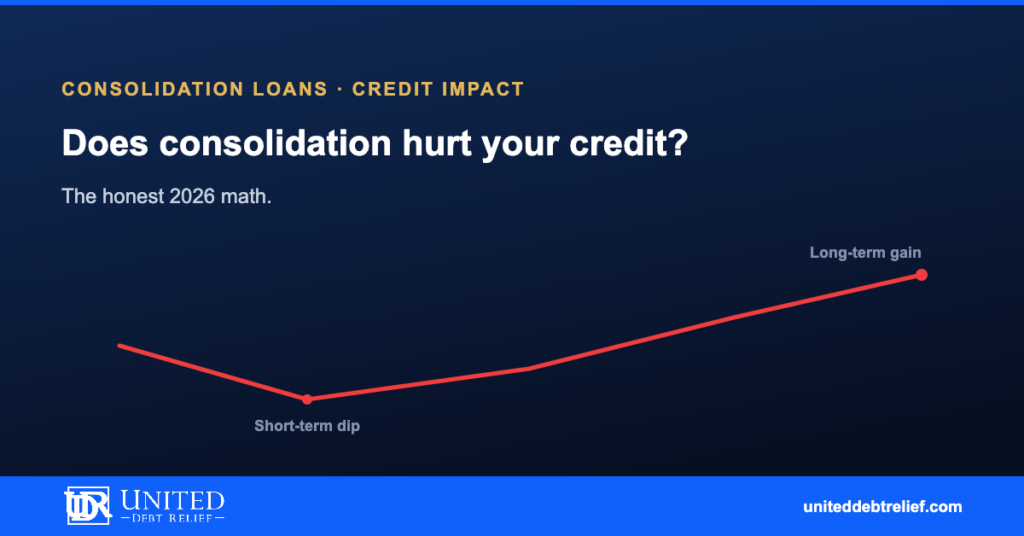
Short answer: yes, in the first 30-60 days. Then usually no, and often it helps significantly.
The average U.S. FICO Score dropped to 714 in Spring 2026, down from 715 in fall 2025, according to FICO’s Spring 2026 Credit Insights Report. For most consumers carrying high-utilization credit card debt, consolidation can fix the single biggest score-killer (utilization) almost overnight. But it isn’t free. Here’s the honest tradeoff.
The Honest Answer: It Depends on Which Tradeoff
The honest answer depends on which tradeoff matters more to you: a small dip in the first month, or a larger gain over the following year. A debt consolidation loan replaces your existing high-interest revolving debt (typically credit cards) with a single fixed-rate installment loan. Three things happen to your credit:
- A hard inquiry hits when you apply (-5 to -10 points temporarily)
- A new account opens (lowers your average account age slightly)
- Your credit card utilization drops dramatically (this is the big one)
The first two are negatives. The third is usually a much larger positive that more than offsets them, if you don’t run the cards back up.
The Short-Term Hit (Hard Inquiry + New Account Age)
The short-term hit comes from two things at once: a hard inquiry when you apply, and a brand-new account that lowers your average account age. When you apply for a consolidation loan, the lender pulls a hard inquiry on your credit report. Effects:
- 5-10 point temporary drop from the inquiry itself
- The inquiry stays on your report for 2 years but its score impact fades after 12 months
- The new loan account drags your “average age of accounts” down, which represents ~15% of your FICO score
Net first-month impact: typically a 15-25 point drop.
The Long-Term Win (Utilization Drop + On-Time Payments)
The long-term win comes from your utilization dropping sharply and on-time payments building on the new loan, which together usually outweigh the early dip. Credit card utilization, your card balances divided by your credit limits, is the second-largest factor in your FICO score (~30% weighting). Consumers carrying $20,000 in card debt at 70%+ utilization are often paying a 50-80 point penalty for that single factor.
When you consolidate:
- Card balances pay down to zero (or close to it)
- Utilization drops from 70%+ to under 10%
- The new installment loan counts as installment debt, not revolving, different category, different scoring impact
Net 6-12 month impact: typically a +40 to +80 point gain if you don’t re-run the cards.
The first month looks bad. Months 3-12 typically look very good.
When Does Consolidation Help Your Credit Score?
Consolidation helps your credit score when high card utilization is the main drag on it and your payment history is already mostly clean. Three signals consolidation usually improves your score:
- Current utilization is 50%+, utilization drops are the fastest score-mover available
- Your payment history is mostly on-time, adding a clean installment account on top of clean payment history compounds wins
- You can commit to NOT running the cards back up, the most common consolidation mistake
When Does Consolidation Hurt Your Score (and What to Do Instead)?
Consolidation hurts, or simply fails to help, when your credit is already damaged or your spending has not changed, and a different option usually fits better. Two signals consolidation may not help:
- You’re already in collections or have recent late payments, you may not qualify for a rate that beats your cards. Consider debt settlement or other options.
- You can’t stop using the cards, if you’ll re-charge the cards, you’ll be in worse shape with both the cards and a new loan to repay. Address the spending issue first.
The 2026 FICO Reality
The 2026 FICO reality is that your score band largely sets the consolidation rate a lender will offer you. With the national average at 714, the score landscape looks like:
- Below 580: Subprime, consolidation rates 25%+
- 580-669: Fair, consolidation rates 12-25%
- 670-739: Good, consolidation rates 8-15%
- 740-799: Very Good, consolidation rates 7-12%
- 800+: Exceptional, consolidation rates 6-10%
If your current card APR is materially higher than what you’d get on a consolidation loan, the interest savings alone often justify the move, even before factoring in the score recovery.
Free Consolidation Fit Check
Whether consolidation makes sense for your specific report depends on your score, your utilization, your card balances, and your discipline. UDR offers a free 2026 fit check, pre-qualification without a hard inquiry, with vetted lenders across all credit profiles.
→ Free 2026 Consolidation Fit Check: uniteddebtrelief.com/free-consultation/
Frequently Asked Questions
How long does the hard inquiry from consolidation actually hurt my score?
The inquiry causes a 5-10 point drop initially. Its impact fades after 12 months, though it remains visible on your report for 24 months. Multiple consolidation-related inquiries within 14-45 days typically count as one inquiry under FICO scoring models.
Will my score recover if I close the cards after consolidating?
Closing paid-off cards can actually hurt, it reduces total available credit, raising utilization on remaining accounts. Keep zero-balance cards open (especially older ones) for the credit history and credit limit they contribute.
Does a consolidation loan count as new debt on my credit reports?
Yes, as a new installment loan. But it’s a different debt category than revolving credit, and most FICO models score installment debt with on-time payments favorably.
What FICO score do I need for the best consolidation rate in 2026?
Top-tier rates (6-10% APR) typically require 740+. Good rates (8-15%) are available with 670+. Below 670, rates climb, and below 580 consolidation often isn’t competitive vs. debt settlement.
Is a 0% balance transfer better for my score than a consolidation loan?
For scores 720+ with discipline to pay off during the 0% window (15-21 months), transfer often wins. For 580-719 or larger balances needing longer repayment, fixed-rate consolidation usually wins.