

By Nick Avila, Founder, United Debt Relief · Last updated October 16, 2026
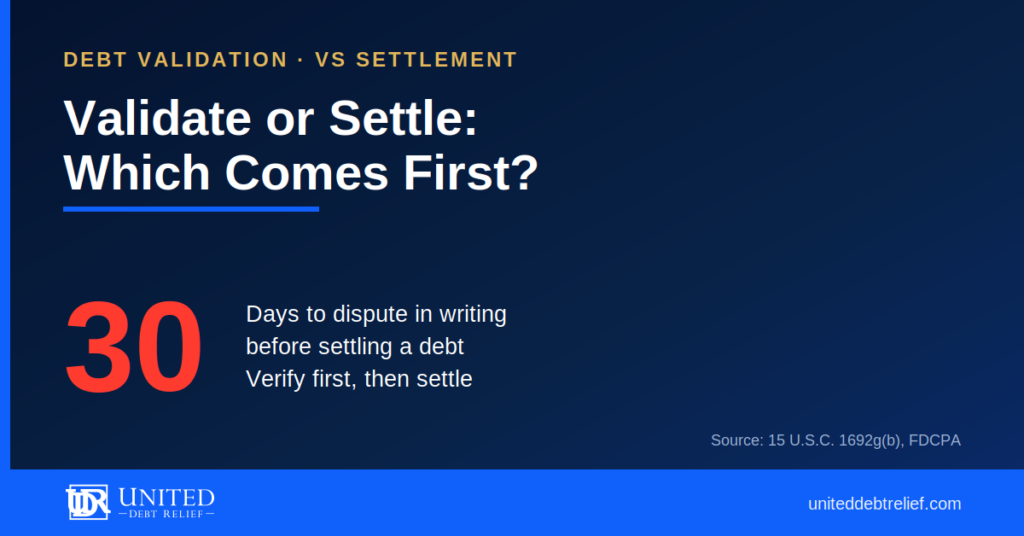
Debt validation usually comes before debt settlement: validation asks whether a debt is accurate and collectible, and settlement negotiates a payoff on a debt that is owed. A collector that receives a written dispute within 30 days must stop collecting the disputed debt until it mails verification, according to the Fair Debt Collection Practices Act (15 U.S.C. 1692g(b)). The comparison is for consumers with collection accounts deciding where to start. It matters now because 4.7% of outstanding household debt was in some stage of delinquency in Q2 2026, according to the New York Fed.
Key Takeaways
- A written dispute within 30 days pauses collection of that debt until the collector mails verification, under 15 U.S.C. 1692g(b).
- Under the FTC Telemarketing Sales Rule, 16 CFR 310.4(a)(5), a settlement company collects no fee until at least one debt is settled and 1 payment is made under that agreement.
- Canceled debt is generally taxable income, and a creditor files Form 1099-C when $600 or more is canceled, according to the IRS.
- Under the Fair Credit Reporting Act, most collections and charge-offs report up to 7 years from the original delinquency, and settling does not restart that clock.
- Attempts to collect debt not owed topped the CFPB’s roughly 387,400 debt collection complaints in 2025, per its annual Consumer Response report.
What Is the Difference Between Debt Validation and Debt Settlement?
The difference between debt validation and debt settlement is the question each one asks. Debt validation asks whether the collector can verify the balance, the creditor, and the math. Debt settlement asks what payoff a creditor will accept on a debt that is owed.
A balance is a claim, not a fact. Regulation F (12 CFR 1006.34) requires a validation notice to name the current creditor, the original creditor for consumer financial debts, and an itemization of interest, fees, payments, and credits since the itemization date.
Which Comes First, Debt Validation or Debt Settlement?
Debt validation comes first in the usual order, because settlement only makes sense on a debt that is verified and owed. Otherwise the negotiation starts from a number no one has checked.
Under Regulation F, the validation period ends 30 days after the consumer receives the notice. Once that window closes, the pause on collection under 15 U.S.C. 1692g(b) is no longer available for that notice. For the step before either program, read whether to pay a collection agency.
How Do Debt Validation and Debt Settlement Compare?
Debt validation and debt settlement differ on law, fees, taxes, and credit reporting, as the table shows.
| Factor | Debt Validation | Debt Settlement |
|---|---|---|
| Main law | FDCPA, 15 U.S.C. 1692g, and Regulation F, 12 CFR 1006.34 | FTC Telemarketing Sales Rule, 16 CFR 310.4(a)(5) |
| Question asked | Is this debt accurate and collectible? | What payoff will the creditor accept on an owed debt? |
| Who acts | The consumer disputes in writing; the collector must verify | A provider negotiates; the creditor decides whether to agree |
| What it can change | Pauses collection of the disputed debt until verification is mailed | The amount paid to resolve a verified debt, if the creditor agrees |
| Fees | Ask the provider for its fee terms in writing | No fee until a debt is settled and a payment is made under that agreement |
| Tax effect | A dispute by itself cancels no debt | Canceled amount is generally taxable; Form 1099-C at $600 or more |
| Credit reporting | A known disputed debt must be reported as disputed, 15 U.S.C. 1692e(8) | Can report up to 7 years from original delinquency, 15 U.S.C. 1681c |
What Can Debt Validation Change?
Debt validation can pause collection, and a separate credit bureau dispute can prompt review of inaccurate reporting, but a verified debt stays owed. Under 15 U.S.C. 1692g(b), the collector must stop collecting the disputed debt until it mails verification or a copy of a judgment.
On the credit side, 15 U.S.C. 1681i requires a credit bureau to investigate a dispute, generally within 30 days, and to delete or modify information that is inaccurate, incomplete, or cannot be verified. Results vary, and no one can promise a deletion.
How Are Debt Settlement Fees Regulated?
Debt settlement fees are regulated by the FTC Telemarketing Sales Rule. Debt settlement carries no upfront fees. Under 16 CFR 310.4(a)(5), a company may not collect a fee until it has settled or changed the terms of at least one debt under an agreement the customer accepted, the customer has made at least one payment under that agreement, and the fee is proportional to the debt settled or a set share of the reduction obtained.
For pricing detail, see how much debt settlement costs.
Is Settled Debt Taxable?
Settled debt can be taxable, because the IRS generally treats canceled debt as income. A creditor files Form 1099-C when $600 or more is canceled, according to IRS instructions for Form 1099-C. The $600 figure is only a filing threshold, so smaller canceled amounts can still be taxable.
Insolvency and bankruptcy exclusions may apply through Form 982. Tax outcomes depend on your full financial picture; a licensed tax professional can confirm yours. More detail: whether settled debt is taxable.
How Does Each Option Affect Your Credit Report?
Each option affects your credit report differently. A collector that reports a debt it knows is disputed must report it as disputed under 15 U.S.C. 1692e(8), while a settled account can report up to 7 years from the original delinquency under 15 U.S.C. 1681c.
Settling does not restart that 7-year clock. Neither program can promise a specific credit result.
How Do We Decide Which Program to Start With?
When a client brings us a stack of collection letters, the first thing we do is sort each debt into two piles: verified and owed, or not yet verified. For the second pile, we check the itemization date, creditor names, and validation period end date first.
Only debts in the first pile get a settlement conversation. United Debt Relief specialists consult with consumers, determine which program fits, and handle enrollment; program services are performed by stringently vetted in-network providers and law firms, each BBB Accredited with an A rating.
What Is the Worst Case With Debt Settlement?
The worst case with debt settlement is that creditors refuse to negotiate while late fees and penalties grow. The FTC notes that creditors have no obligation to agree to a settlement, and that stopping payments to creditors can add late fees and penalties and hurt credit.
Collection calls may continue during a program, the FTC adds; read about lawsuit risk during debt settlement. Compare the Debt Validation program and the Debt Settlement program.
Frequently Asked Questions About Debt Validation vs Debt Settlement
Should I validate a debt before settling it?
In most cases, yes. Settling a debt that has not been verified can mean paying on a balance with errors, while a written dispute within 30 days makes the collector pause and mail verification before collecting further.
Is debt validation or debt settlement better?
Neither is better in every case. Debt validation fits when the balance, creditor, or math is in question, and debt settlement may fit when a debt is verified and owed but a full payoff is not realistic. Results vary.
Can I use debt validation and debt settlement together?
Yes. A sensible order is to verify each debt first and then consider settlement only for debts that are verified and owed.
When can a debt settlement company charge a fee?
Under the FTC Telemarketing Sales Rule, a debt settlement company may not collect a fee until it has settled at least one debt, the customer has made at least one payment under that agreement, and the fee follows the pricing limits in that rule.
Is settled debt taxed?
Canceled debt is generally taxable income under IRS rules, and a creditor files Form 1099-C when $600 or more is canceled. Insolvency and bankruptcy exclusions may apply, so a licensed tax professional can confirm your situation.
Talk with a United Debt Relief specialist at uniteddebtrelief.com/free-consultation or call 1 (888) 802-2092. Free consultation, no obligation. Results vary.
Sources: 15 U.S.C. 1692g · 12 CFR 1006.34 · 16 CFR 310.4 · IRS Publication 4681 · IRS Form 1099-C instructions · Fair Credit Reporting Act · Fair Debt Collection Practices Act · FTC on debt relief · New York Fed, Q2 2026 · CFPB 2025 Consumer Response Report