

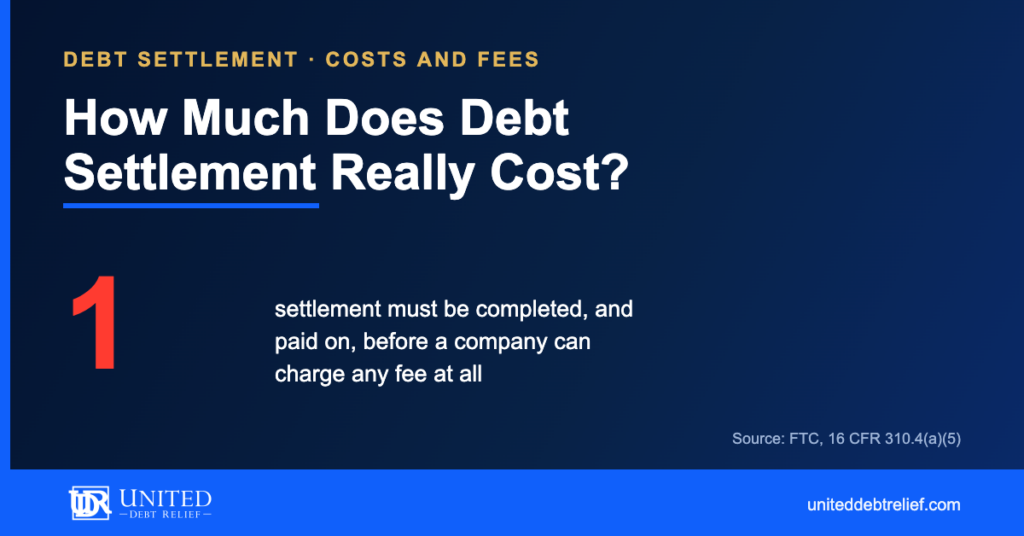
Debt settlement costs you a fee, and the fee is only one line of the total. The real price is four things: the money you put into settlements, the company’s fee, a monthly account maintenance charge, and time. Under the Federal Trade Commission Telemarketing Sales Rule at 16 CFR 310.4(a)(5), no debt relief company can collect any fee until it has settled at least one of your debts and you have made a payment on that settlement. And the structure of that fee, a percentage of what you enrolled versus a percentage of what you saved, can change what you pay by thousands of dollars on the identical balance. Here is how to price a program before you sign one. Results vary by situation.
By Nick Avila, Founder, United Debt Relief
The fee rule that protects you: nothing before a settlement
A debt relief fee can only be charged after an account is settled and you have paid on that settlement. That is federal law, not a courtesy, and it is the single fastest way to screen a company.
- Under 16 CFR 310.4(a)(5)(i), effective October 27, 2010, a fee may only be collected after the company settles at least one debt, you make at least one payment under that agreement, and the fee is either a consistent percentage of the amount saved or proportional to that debt’s share of the enrolled balance.
- The rule also means fees arrive unevenly. You are not billed monthly against a flat schedule. You are billed as each account resolves, so a program that settles three accounts in year one bills more in year one.
- Any request for money before a first settlement is a reason to stop the conversation. There is no legitimate version of an upfront settlement fee.
The two fee structures, and what each one actually costs
Almost every quote you receive will use one of two structures, and they are not interchangeable. A percentage of enrolled debt is calculated on what you owed when you signed up. A percentage of savings is calculated on the gap between the balance and what the account actually settled for.
The table below prices both on three enrollment sizes. Every figure is an illustration built on assumed inputs, not a quote, an offer, or a prediction of your result.
| Enrolled balance | Fee at an assumed 20% of enrolled debt | Assumed resolved amount | Amount saved | Fee at an assumed 25% of savings |
|---|---|---|---|---|
| $15,000 | $3,000 | $7,500 | $7,500 | $1,875 |
| $30,000 | $6,000 | $15,000 | $15,000 | $3,750 |
| $50,000 | $10,000 | $25,000 | $25,000 | $6,250 |
Illustration only. Figures assume a 20% enrolled-debt rate, a 25% savings rate, and accounts resolving at half the enrolled balance. Your rate, your balances, and your outcomes will differ. Results vary by situation.
Now the part the table hides. An enrolled-debt fee is fixed the day you sign: on $30,000 it is $6,000 whether your accounts settle well or poorly. A savings-based fee moves with the outcome. If that same $30,000 resolved for $18,000 rather than $15,000, savings drops to $12,000 and a 25% savings fee falls to $3,000. Settle for more and the savings fee shrinks; settle for less and it grows. One structure prices your balance, the other prices your result.
So the useful question at a sales table is not “what is your rate.” It is: what is this fee a percentage of, and what dollar amount does that produce on my accounts? Ask for the answer in dollars, and confirm the same number appears in the written agreement before you sign. According to United Debt Relief, settlement programs are designed to resolve roughly 40 to 50% of enrolled debt before fees, and no outcome is promised.
The cost almost nobody quotes you: the dedicated account
Your deposits do not go to the settlement company. They go into a dedicated account in your name, and that account usually carries its own monthly charge.
- Under 16 CFR 310.4(a)(5)(ii), the funds sit at an insured financial institution, you own the funds and any interest, the company may not control the account, and you can withdraw at any time without penalty.
- The account administrator is a separate business from the settlement company, and it may charge a monthly maintenance fee for holding and disbursing the money.
- That fee is small monthly and not small annually. A $10 monthly charge across a 42-month program is $420, on top of the settlement fee. Ask for the figure in dollars and multiply it by your expected program length yourself.
Add it up and a realistic total on a $30,000 enrollment looks like the settlement payments themselves, plus the company’s fee, plus roughly $400 to $500 in account charges over three to four years. Price all three lines, not just the headline percentage.
How long a program runs, and why the timeline is part of the price
Length is set by how fast you can fund settlements, not by how hard anyone negotiates, and length feeds directly back into cost.
- The FTC disclosure rule at 16 CFR 310.3(a)(1)(viii) requires a company to tell you, before you sign, how long it expects to take before making an offer to each creditor and how much you must save first. If you did not get that in writing, you were not given a lawful disclosure.
- According to United Debt Relief, programs typically run 24 to 48 months. For scale, the FTC notes a nonprofit debt management plan commonly takes 48 months or more, and Chapter 13 plans run three to five years under federal law.
- Enrolling more debt lengthens the program, because every added dollar is another dollar the dedicated account must raise before an offer can go out.
- A longer program also means more months of interest and late charges accruing on unpaid accounts, and more months of account maintenance fees. Slower funding raises the total price of the same enrollment.
The lever you control is the deposit. A deposit you can sustain on a bad month beats an aggressive one you abandon in month nine.
What it costs to drop out partway
Dropping out is the most expensive outcome available, because the damage is front-loaded and the benefit is back-loaded.
- You keep your money. Under 16 CFR 310.4(a)(5)(ii) you own the dedicated account funds and can withdraw at any time without penalty.
- You do not get the fees back on accounts that already settled. Those were earned under the rule when the settlements closed.
- Unsettled accounts return to your creditors more delinquent than when you started, with interest and late fees added and no resolution to show for the months you funded.
Three costs that are not fees
Your credit score. Scores fall during a program because accounts go delinquent while funds accumulate, and a resolved account is typically reported as settled for less than the full balance. That is the honest trade at the center of settlement, and it is covered in full in our guide to how credit card settlement affects your credit score, with the recovery plan in how to rebuild your credit score after debt settlement.
A possible tax bill. A creditor canceling $600 or more of debt generally files IRS Form 1099-C, and canceled debt is generally included in gross income under IRS Topic No. 431 and Publication 4681. The insolvency exclusion, claimed on IRS Form 982, can reduce or remove it. Debt discharged in bankruptcy is excluded outright while settled debt is not, which is a genuine cost difference between the two paths. The full mechanics inside a multi-year program are in our guide to lawsuits, judgments, and taxes during debt settlement.
Legal exposure. Creditors keep every legal right they had before you enrolled, and a program does not shield you from collection or from a lawsuit. If you are served, the response deadline is what matters. That subject, including default judgments and garnishment, is covered in the same guide, and the collections process is walked through in how to get out of collections.
Educational information, not advice. Tax treatment of canceled debt depends on your own assets, liabilities, and filing situation. This is not individual tax, legal, or financial advice, and no outcome is promised. Review your facts with a licensed tax professional.
Cost risks at a glance
| Cost risk | Who it affects most | What reduces it |
|---|---|---|
| A fee structure that does not match your outcome | Anyone quoted a rate without a dollar figure | Getting the fee priced in dollars, in writing, before signing |
| Balance growth from interest and late fees | Longer programs, heavier enrollment | Funding faster, and enrolling only what you must |
| Monthly dedicated account maintenance fee | Anyone in a program running past three years | Confirming the dollar amount and total months up front |
| Dropping out partway | Anyone at an unaffordable deposit | A deposit you can sustain on a bad month |
| A tax bill on forgiven balances | Anyone solvent at the time of cancellation | The insolvency exclusion on IRS Form 982, with a tax professional |
Frequently asked questions
How much does debt settlement cost?
The total is your settlement payments, plus the company’s fee, plus a monthly dedicated account charge. The fee is set as a percentage of either your enrolled debt or the amount saved, and it is only earned as accounts settle. Ask for the fee in dollars on your actual balances rather than as a percentage. Results vary by situation.
Is the fee based on what I owe or what I save?
It depends on the company, and 16 CFR 310.4(a)(5)(i) permits either. A percentage of enrolled debt is fixed the day you sign and does not move with your results. A percentage of savings rises when accounts settle for more and falls when they settle for less. Confirm in writing which one you are being quoted.
Can a debt settlement company charge me a fee upfront?
No. Under 16 CFR 310.4(a)(5), a fee may only be collected after at least one debt has been settled and you have made a payment under that agreement. Any request for money before that is a reason to stop.
What is the dedicated account maintenance fee?
It is a separate monthly charge from the account administrator that holds your deposits, not from the settlement company. Under 16 CFR 310.4(a)(5)(ii) you own the funds and any interest and can withdraw at any time without penalty. Ask for the monthly figure in dollars and multiply it by your expected program length.
Do I get my money back if I quit the program?
You keep whatever remains in the dedicated account, because those funds are yours and can be withdrawn at any time without penalty. Fees already earned on accounts that settled are not refunded, and any unsettled accounts return to your creditors more delinquent than when you started.
How long does debt settlement take?
According to United Debt Relief, programs typically run 24 to 48 months, depending on how quickly your dedicated account can fund offers and how much debt you enroll. FTC rules at 16 CFR 310.3(a)(1)(viii) require the company to give you that timeline before you sign.
To price this against your actual accounts, get your free consultation. We explain the fee structure plainly and enroll you only where the numbers fit, whether that is Debt Settlement, a consolidation loan, or another path. Compare the two in our side-by-side breakdown. Results vary by situation.
About the author. Nick Avila is the Founder of United Debt Relief, a national debt relief company serving all 50 states with five programs spanning settlement, validation, consolidation loans, tax resolution, and credit repair. Program services are performed by stringently vetted in-network providers and law firms, each BBB Accredited with an A rating.