

Yes, a creditor can sue you while you are enrolled in a debt settlement program. Enrolling does not remove anyone’s right to collect, and that right survives until each account is actually resolved. The Consumer Financial Protection Bureau is explicit that creditors are under no obligation to negotiate, and that accounts left unpaid while settlement funds accumulate can be sold to collectors or taken to court. If a suit goes unanswered, a default judgment can follow, and in many states that opens the door to wage garnishment or a bank levy. A second consequence arrives later: the IRS generally treats canceled debt as income you must report, and a creditor files a Form 1099-C once it cancels $600 or more. U.S. household debt stood at $18.771 trillion in the second quarter of 2026, according to the Federal Reserve Bank of New York, so these questions are reaching a lot of kitchen tables.
Quick answer: A creditor can sue over an unpaid balance at any point before that account is settled, and enrolling in a program does not change that. Ignoring a summons is the costly mistake, because a default judgment can lead to wage garnishment or a bank levy depending on your state. Separately, canceled debt is generally reportable income, and exclusions such as insolvency are claimed on IRS Form 982 rather than applied for you. Whether the insolvency exclusion applies depends on your assets and liabilities on the date the debt was forgiven, so verify it with a licensed tax professional before you file. If you are served, speak with an attorney licensed in your state. Individual results vary.
Can a creditor sue you during a debt settlement program?
Yes. Enrolling in a program does not remove a creditor’s right to sue over an unpaid balance, and that right survives until the account is actually resolved. The Consumer Financial Protection Bureau is direct about this: creditors are under no obligation to negotiate, and accounts that go unpaid while settlement funds accumulate can be sold to collectors or pursued in court.
The practical sequence looks like this.
- Delinquency. Payments stop while settlement funds accumulate, and the accounts age further past due.
- Collections. The original creditor may assign or sell the account to a collection agency.
- Suit. The creditor or the debt buyer may file a collection lawsuit before that account reaches a settlement.
- Judgment. If a suit goes unanswered, a court may enter a default judgment, which in many states opens the door to wage garnishment or a bank levy.
The costliest mistake here is not the lawsuit itself, it is ignoring it. The CFPB advises responding to a collection lawsuit rather than letting it go to default, because filing a response preserves defenses that disappear once a default judgment is entered. If you are served, tell your program contact promptly and speak with an attorney licensed in your state.
What a default judgment can lead to
A default judgment is what turns a lawsuit you ignored into money leaving your account. Remedies vary by state, and several states protect wages far more aggressively than others, but a judgment creditor may be able to pursue wage garnishment, a bank account levy, or a lien against property. Federal benefits such as Social Security carry their own protections. Because the rules are set at the state level, the amount at stake is a question for an attorney licensed where you live.
The statute of limitations and the restart trap
Every state sets a statute of limitations on how long a creditor has to sue over a debt. The window commonly runs a few years from the last activity on the account, but both the length and the trigger vary by state and by the type of debt. Once that window closes the debt does not disappear, but a creditor generally loses the ability to win a lawsuit over it.
Here is the trap. The CFPB warns that in some states, making a payment on an old debt or even acknowledging in writing that it is yours can restart the clock and revive the creditor’s ability to sue. That makes an unsolicited offer to settle a very old account something to check carefully before acting on it. Confirm your state’s rule and the account’s date of last activity with an attorney licensed in your state before you send money on an aged debt. If the account has already moved to a third-party collector, our guide to debt validation and your FDCPA rights covers the conduct rules and your 30-day validation right.
None of this is a reason to avoid settlement, but going in informed is how you plan for it. A debt settlement conversation should cover the legal exposure and the tax exposure before you enroll.
The tax side: what a 1099-C means for a program
A Form 1099-C, Cancellation of Debt, is the information return a creditor files with the IRS when it cancels a debt of $600 or more, and you receive a copy of it. The full tax mechanics, including the insolvency worksheet and the other statutory exclusions, are covered in our guide to the tax implications of debt cancellation. What follows here is narrower: what changes when cancellations arrive through a multi-year settlement program instead of as a single event.
Three points matter more than the paperwork itself.
- The $600 threshold is a filing rule, not a tax rule. A creditor is required to file at $600 or more. A smaller canceled amount can still be reportable income even when no form ever arrives.
- The form is not a bill. A 1099-C reports an amount to the IRS. What you actually owe, if anything, depends on your bracket, your other income, and whether an exclusion applies to you.
- The timing follows the creditor, not you. The form covers the tax year in which the cancellation event occurred, which may not be the year you made your final program deposit.
According to United Debt Relief, settlement programs are designed to resolve roughly 40 to 50% of enrolled debt before fees, and programs typically run 24 to 48 months. That length matters here: a program that settles accounts across two or three calendar years can generate 1099-C forms in more than one tax year, each measured on its own date.
Nick Avila, founder of United Debt Relief, says, “The tax question is the one people find out about last and should have planned for first. Keep every settlement letter, and know where you stood financially on the day each account was forgiven, because that is the record a tax professional will ask you for.”
Do not discard a 1099-C or assume it is an error. Bring it to a licensed tax professional along with the settlement paperwork for that account.
When can forgiven debt be excluded from income?
Forgiven debt can be excluded from income only when a specific statutory exclusion applies, and the exclusion has to be claimed on your return using IRS Form 982. The IRS lists several in Publication 4681. These are the two that come up most often after a settlement program.
| Exclusion | What it covers | How much can be excluded | How it is claimed |
|---|---|---|---|
| Title 11 bankruptcy | Debt discharged in a bankruptcy case under Title 11 of the U.S. Code | The discharged amount, subject to IRS rules on reducing tax attributes | IRS Form 982, filed with your return |
| Insolvency | Debt canceled at a time when your total liabilities exceeded the fair market value of your total assets | Limited to the amount by which you were insolvent immediately before the cancellation | IRS Form 982, filed with your return |
Neither one is automatic. If you take no action on your return, the full canceled amount is generally treated as reportable income.
Why a multi-year program complicates the insolvency test
The insolvency test compares your total liabilities to the fair market value of your total assets immediately before a debt is canceled, and the exclusion is capped at that difference. For a single cancellation that is one calculation. Inside a settlement program it is not.
Two details do the damage. The measurement moment is immediately before each cancellation, not the day the 1099-C arrives in the mail. And each canceled account is tested separately against your position on its own cancellation date. As a program resolves balances, your total liabilities fall, which means the same household can be clearly insolvent at the first settlement and much less so at the last. Two accounts settled eighteen months apart can produce two different answers on the same question.
That is why the recordkeeping below matters more inside a program than it does anywhere else. Whether the insolvency exclusion applies depends on your assets and liabilities on the date the debt was forgiven, so verify it with a licensed tax professional before you file.
What about the credit-score side?
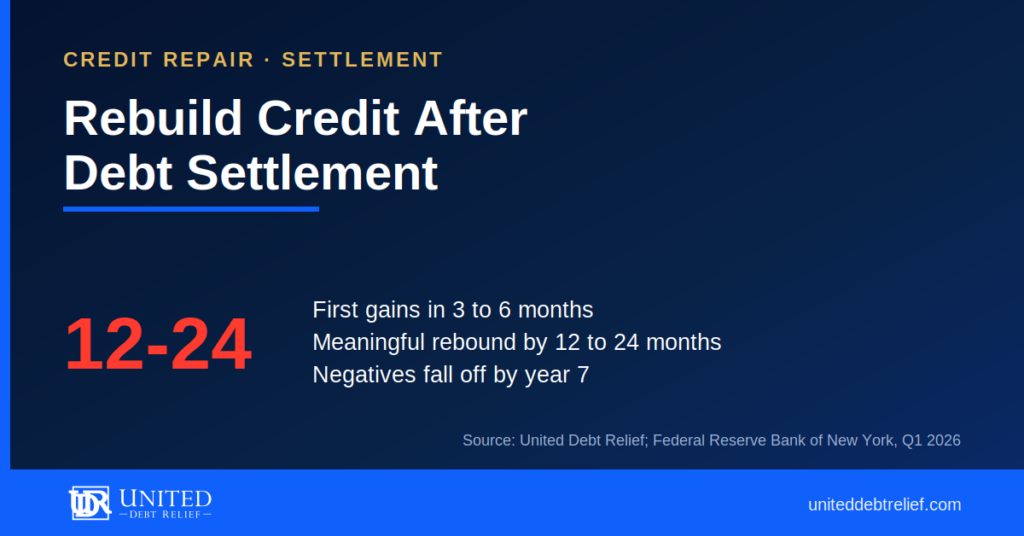
The credit-score side is a separate question with a separate answer, and it is covered in full elsewhere on this site. The short version: settling an account does not restart or shorten the Fair Credit Reporting Act reporting clock, which generally runs about seven years from the original delinquency, and recovery comes from on-time payments, low balances, and accurate reporting layered on top of it.
For the complete rebuild plan, including how secured cards and credit-builder tools compare, a realistic month-by-month trajectory, and the mistakes that slow recovery down, read our guide on how to rebuild your credit score after debt settlement. Structured credit repair support can help you sequence those moves. This page stays on the money and the legal exposure.
A checklist for the year you settle
The work that protects you at tax time is recordkeeping, and almost all of it has to happen while the program is running rather than the following April.
- Keep every settlement letter. The agreement, the payoff confirmation, and the zero-balance notice all matter if a 1099-C amount later looks wrong.
- Record an asset and liability snapshot at each settlement date. The insolvency test is measured immediately before each cancellation, and reconstructing that position a year later is far harder than writing it down at the time.
- Watch the mail in January and February. A 1099-C for a debt canceled the previous year generally arrives in that window.
- Do not file before the forms arrive. Filing early and then receiving a 1099-C can mean an amended return.
- Bring all of it to a licensed tax professional. The exclusions are claimed on your return, and no one applies them on your behalf.
- Open and answer anything that looks like a court document. Response deadlines are short and are set by state law.
Frequently asked questions
These are the questions people ask most often about lawsuits, judgments, and the tax paperwork that follows a debt settlement program.
Can I still be sued after enrolling in a program?
Yes. Enrollment does not extinguish a creditor’s right to sue over an unpaid balance, and the CFPB notes that creditors are under no obligation to negotiate. If you are served with a collection lawsuit, respond rather than letting it go to default, and speak with an attorney licensed in your state.
Can my wages be garnished during a debt settlement program?
Not simply because you enrolled, and generally not without a court judgment first. Garnishment usually requires a creditor to sue, win, and then act on the judgment, and the limits on how much can be taken are set by federal and state law, with some states considerably more protective than others. Certain federal benefits carry additional protection. If you have been served, or a judgment has already been entered, speak with an attorney licensed in your state.
Can making a payment on an old debt restart the statute of limitations?
In some states, yes. The CFPB warns that making a payment on an old debt, or acknowledging in writing that it is yours, can restart the clock and revive a creditor’s ability to sue. Confirm your state’s rule and the account’s date of last activity with an attorney licensed in your state before paying on an aged debt.
Is settled debt taxable?
Often yes. The IRS generally treats canceled debt as taxable income regardless of size, and creditors file Form 1099-C once the forgiven amount reaches $600. Exclusions include debt canceled in bankruptcy and debt canceled while you are insolvent. Ask a licensed tax professional how it applies to your situation.
What if I never receive a Form 1099-C?
A missing form does not by itself make a canceled amount non-reportable. The $600 threshold governs when a creditor must file, not whether an amount counts as income. If you settled an account and no form arrived, bring the settlement paperwork to a licensed tax professional rather than assuming nothing is owed.
Does the insolvency exclusion apply automatically?
No. It is claimed on your return using IRS Form 982, and the amount is capped at how much your liabilities exceeded your assets immediately before the cancellation. Whether it applies depends on your assets and liabilities on the date the debt was forgiven, so verify it with a licensed tax professional before you file.
How soon can I qualify for a mortgage after debt settlement?
It varies by lender and loan type, but many borrowers become eligible within two to four years of steady rebuilding, on-time payments, and a stable income. A stronger score and lower balances improve your terms.
Your next step
Your next step is to plan for the aftermath before it arrives: keep the records, know your financial position on each cancellation date, and take a free look at your options whenever you want a second set of eyes. The tax and legal side of settling is manageable when you can see it coming, and you do not have to map it alone. United Debt Relief offers a free consultation, where an advisor will explain your options, assess your situation, and help you determine the right fit. Every in-network provider is Better Business Bureau Accredited with an A rating and is stringently vetted, and the providers perform the program work. You can also explore the numbers behind the trends on our debt data page.
Ready to build your plan? Start with a free consultation. Individual results vary.