

By Nick Avila, Founder, United Debt Relief · Last updated October 1, 2026
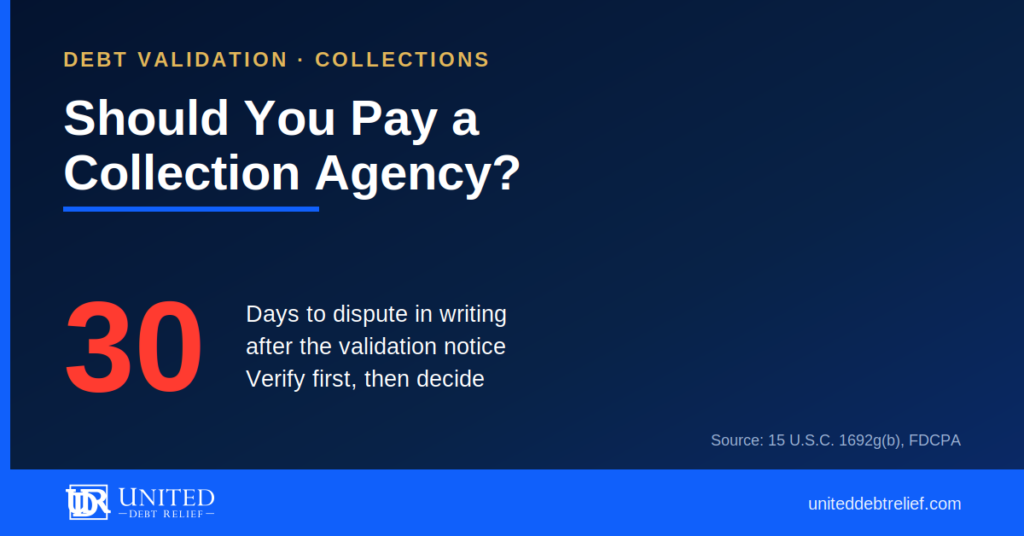
Paying a collection agency is safest after the debt is verified: use the validation notice and the 30-day written dispute window first, then decide whether to pay, dispute, validate, or settle. A consumer who disputes in writing within 30 days pauses collection of that debt until the collector mails verification, according to the Fair Debt Collection Practices Act (15 U.S.C. 1692g). This answer is for anyone facing a first collection letter or an unfamiliar balance. It matters now because attempts to collect debt not owed was the top debt collection complaint the CFPB received in 2025.
Key Takeaways
- A debt collector must send a validation notice within 5 days of first contact, under the FDCPA, 15 U.S.C. 1692g(a).
- A written dispute within the 30-day validation period pauses collection of that debt until verification is mailed, under 15 U.S.C. 1692g(b).
- Attempts to collect debt not owed topped the CFPB’s roughly 387,400 debt collection complaints in 2025, per its annual Consumer Response report.
- Most states set debt statutes of limitations of 3 to 6 years, and a partial payment may restart that clock, according to the CFPB.
- Under the Fair Credit Reporting Act, most collections can report up to 7 years from the original delinquency.
Should You Pay a Collection Agency Before the Debt Is Verified?
Paying a collection agency before the debt is verified skips the checkpoint federal law builds into collection. A balance is a claim, not a fact. The validation notice shows the collector’s math, and the 30-day dispute window is when a consumer can make the collector back it up.
Once a debt checks out, paying, settling, or a payment plan can all be reasonable. Verify, then decide.
What Must a Debt Validation Notice Include?
A debt validation notice must include specific, itemized information under Regulation F (12 CFR 1006.34). The required items are:
- The name of the current creditor and the account number
- The original creditor on the itemization date, for consumer financial debts
- The itemization date and the amount owed on that date
- An itemization of interest, fees, payments, and credits since the itemization date
- The current amount of the debt
- The date the validation period ends and how to dispute
The itemization date is one of five reference dates the collector picks: the last statement, charge-off, last payment, transaction, or judgment date, according to the CFPB.
What Does the 30-Day Dispute Window Do?
The 30-day dispute window lets a consumer require verification before collection continues. Under 15 U.S.C. 1692g(b), a written dispute sent within 30 days means the collector must cease collection of the disputed debt until it obtains verification or a copy of a judgment and mails it to the consumer.
Under Regulation F, the period ends 30 days after receipt, and the collector may assume receipt 5 business days after sending. The FTC suggests certified mail with a return receipt. See how to write a debt validation letter.
Under 15 U.S.C. 1692g(c), choosing not to dispute is not an admission of liability.
Why Is Debt Not Owed the Top Collection Complaint?
Debt not owed is the top collection complaint because many consumers get letters for balances they cannot place. The CFPB received about 387,400 debt collection complaints in 2025, and attempts to collect debt not owed led that category, according to its 2025 Consumer Response Annual Report.
The same report found complaints about debts consumers did not recognize rose 240% compared with the prior two-year monthly average. Because the current and original creditor can be different companies, an unfamiliar name calls for a closer look. See how to check if a debt is legitimate.
What Should You Get in Writing Before You Pay?
Before paying a collector, get the payment plan and the collector’s promises in writing, the CFPB advises. A collector reporting a debt it knows is disputed must report it as disputed under 15 U.S.C. 1692e(8).
| Question | Pay now | Verify first |
|---|---|---|
| Is the balance itemized? | Unknown | Yes, from the itemization date forward |
| Is the creditor chain clear? | Unknown | Current and original creditor named |
| Dispute leverage | Given up in practice | Collection paused until verification is mailed |
| Old debt timing | A payment may restart the clock in some states | State rule checked before any payment |
| Payment terms | Often verbal | In writing before money moves |
Can a Payment Restart the Statute of Limitations?
In some states, a payment or a written acknowledgment can restart the statute of limitations on an old debt. The CFPB says a partial payment or acknowledging an old debt may restart the time period. The FTC adds that in some states even a promise to pay can revive a time-barred debt.
A collector cannot sue or threaten to sue once the statute of limitations has passed, according to the CFPB. Confirm your state’s statute of limitations before acting.
Does Paying a Collection Remove It From Your Credit Report?
Paying a collection does not remove accurate information from a credit report. Under the Fair Credit Reporting Act (15 U.S.C. 1681c), most collections can report for up to 7 years from the original delinquency, and settling does not restart that clock.
Under 15 U.S.C. 1681i, a credit bureau must investigate a dispute, generally within 30 days, and information that is inaccurate, incomplete, or cannot be verified must be deleted or modified. Results vary, and no one can promise a deletion.
What Do We Check First on a Collection Letter?
When a client brings us a collection letter, the first thing we check is the itemization date and whether the itemized interest, fees, payments, and credits add up to the current amount. Next we compare the current and original creditor names against the client’s own statements.
Then we put the validation period end date on the calendar and ask whether any payment has already been made. Those answers shape which program, if any, fits.
When Does Debt Validation or Debt Settlement Fit?
Debt validation fits when a balance is unfamiliar or the itemization does not add up; debt settlement may fit when a debt is verified and owed but a full payoff is not realistic. United Debt Relief specialists consult with consumers, determine which program fits, and handle enrollment. Program services are performed by stringently vetted in-network providers and law firms, each BBB Accredited with an A rating.
The honest worst case for verifying first: the collector mails complete verification, collection resumes, and the debt is still owed. Compare the Debt Validation program and the Debt Settlement program, or read what happens when a collector cannot validate a debt.
Frequently Asked Questions About Paying a Collection Agency
Do I have to pay a collection agency?
A verified debt within the statute of limitations is generally still owed, but federal law lets you ask for verification first. A written dispute within 30 days of receiving the validation notice pauses collection of that debt until the collector mails verification.
What happens if I do not pay a debt collector?
The collector may keep contacting you within federal limits, report the account, or sue if the debt is within the statute of limitations. Answer any court papers by the deadline to avoid a default judgment.
Should I pay a debt collector on the first call?
Paying on the first call skips the 30 day validation period. Ask for the validation notice, check the itemization, and get any payment agreement in writing before money changes hands.
Will paying a collection agency remove the collection from my credit report?
Paying does not remove accurate information. Under the Fair Credit Reporting Act, most collections can report up to 7 years from the original delinquency.
How can I pay a collection agency safely?
Pay only after the debt is verified and the terms are in writing, using a payment method that leaves a paper trail. Keep copies of the agreement, the validation notice, and every confirmation.
Holding a collection letter? Talk with a United Debt Relief specialist at uniteddebtrelief.com/free-consultation or call 1 (888) 802-2092. Free consultation, no obligation. Results vary.
Sources: 15 U.S.C. 1692g · 12 CFR 1006.34 · CFPB 2025 Consumer Response Report · FTC Debt Collection FAQs · CFPB on old debts · CFPB on settling with a collector · Fair Credit Reporting Act · Fair Debt Collection Practices Act