

By Nick Avila, Founder, United Debt Relief · Last updated October 19, 2026
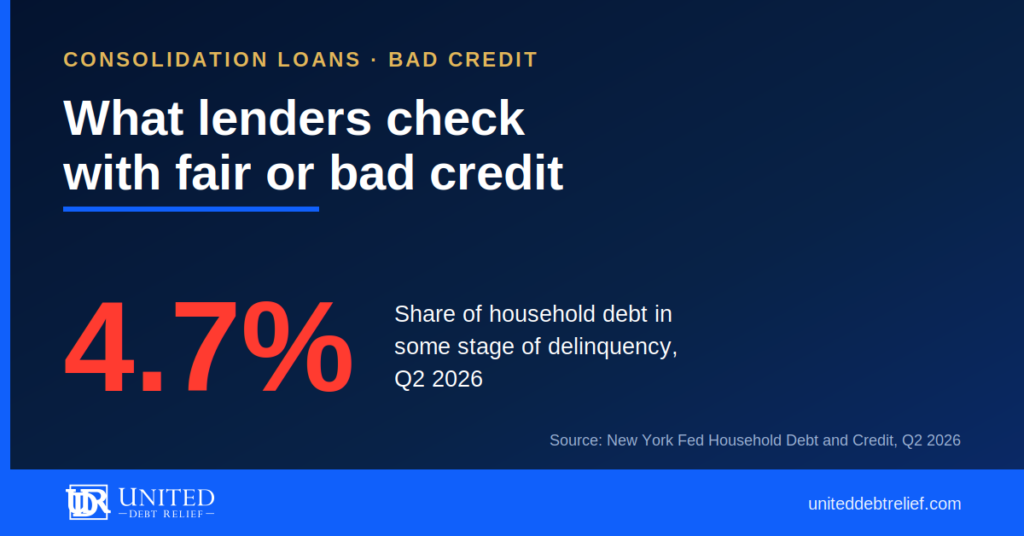
A debt consolidation loan with fair or bad credit may be possible, and lenders decide based on credit history, income, and debt-to-income ratio. This explainer is for borrowers with late payments, collections, or high balances who are comparing consolidation offers. It matters now because 4.7% of outstanding household debt was in some stage of delinquency in Q2 2026, according to the New York Fed.
Key Takeaways
- Credit card accounts assessed interest averaged a 22.15% APR in Q2 2026, according to the Federal Reserve G.19 release.
- The CFPB defines debt-to-income ratio as monthly debt payments divided by gross monthly income, so $2,000 in payments on $6,000 of income is 33%.
- Under the Fair Credit Reporting Act, a credit bureau must generally investigate a disputed item within 30 days, according to the FTC.
- The FTC lists 3 warning signs of advance-fee loan scams: promises regardless of credit history, fees not disclosed before you apply, and loan offers by phone.
Can You Get a Debt Consolidation Loan With Fair or Bad Credit?
A debt consolidation loan with fair or bad credit may be available, but each lender sets its own approval rules, rate, and terms. The useful question is whether any offer beats the APR on the borrower’s current cards; the average on card accounts assessed interest was 22.15% (Federal Reserve G.19, Q2 2026).
The checklist in is a debt consolidation loan a good idea covers how to compare offers. Results vary.
What Do Lenders Check on a Consolidation Loan Application?
Lenders check credit history and scores, income, and debt-to-income ratio on a consolidation loan application. Legitimate lenders check the credit report, confirm the application, and decide whether the borrower is likely to repay before a firm offer, according to the FTC. The CFPB defines debt-to-income ratio as monthly debt payments divided by gross monthly income, so $2,000 in payments on $6,000 of income is 33%.
| What lenders review | What you can check first |
|---|---|
| Credit history and scores | Request your own credit reports, which is a soft inquiry that does not affect scores (CFPB). Dispute errors; the bureau must generally investigate within 30 days (FCRA). |
| Income | Gather pay stubs or tax returns so the income on the application can be confirmed. |
| Debt-to-income ratio | Add up monthly debt payments and divide by gross monthly income (CFPB). |
| Collateral, for secured loans | Know what property is pledged; the lender can take it if the loan is not repaid (CFPB). |
| A co-signer, if one is offered | Read the FTC notice to cosigners: the co-signer may have to pay the full debt. |
| The type of credit inquiry | Ask whether prequalification uses a soft inquiry before submitting a full application (CFPB). |
Should You Pledge Collateral or Add a Co-Signer?
Pledging collateral or adding a co-signer shifts risk onto property or another person. With a secured loan, the lender can take the collateral if the loan is not repaid, according to the CFPB, and an unpaid home equity loan used to consolidate could lead to foreclosure. Card debt is generally unsecured, so moving it into a secured loan changes what is at stake.
A co-signer may have to pay up to the full amount of the debt, plus late fees or collection costs, according to the FTC notice to cosigners. The creditor can collect from the co-signer without first trying the borrower. The honest worst case: a borrower pledges a car to get a loan, a job loss follows, and the car is repossessed while a relative who co-signed is pursued for the balance.
Does Prequalifying for a Loan Hurt Your Credit?
Prequalifying generally does not hurt credit when the lender uses a soft inquiry. Soft inquiries, including prescreening by prospective lenders and your own requests for your credit reports, will not affect credit scores, according to the CFPB. Hard inquiries follow an application and can affect scores, the CFPB notes.
Ask each lender which type of inquiry its prequalification uses. Credit decisions depend on your full financial picture, so confirm any offer’s terms before signing.
How Do You Spot an Advance-Fee Loan Scam?
An advance-fee loan scam can be spotted by a promise of a loan regardless of credit history and a request for money before the loan arrives. Real lenders may charge an application or appraisal fee, the FTC notes, but no legitimate lender says a fee secures the loan. The FTC lists these warning signs:
- Pitches such as “Bad credit? No problem” that promise a loan without checking credit.
- Fees that are not disclosed before you apply, followed by a demand for payment before funds arrive.
- Loan offers by phone. The FTC says it is illegal under the Telemarketing Sales Rule for telemarketers to promise a loan and ask for payment before they deliver.
- Requests to pay by cryptocurrency, wire transfer, or gift card.
The FTC advises checking whether a lender is registered with the state attorney general or banking regulator, and reporting scams at ReportFraud.ftc.gov. More screening steps are in how to tell if a debt relief company is legitimate.
What Are the Options if a Consolidation Loan Is Not Available?
If a consolidation loan is not available at a rate below current card APRs, the main options are Debt Settlement, Debt Validation for disputed accounts, and card issuer hardship programs. Under 15 U.S.C. 1692g(b), a timely written dispute within 30 days requires a collector to stop collecting the disputed debt until it mails verification.
Card hardship programs are set by each issuer, and hardship programs for credit cards explains what to ask. Compare paths in consolidation loan or debt settlement for $20,000.
How Does United Debt Relief Approach a Bad Credit Consolidation Question?
United Debt Relief approaches a bad credit consolidation question by reading the credit report and the budget before discussing any loan. When someone tells us a lender turned them down, the first thing we check is the credit report for errors and collection accounts that may need verifying, then we calculate debt-to-income ratio together. Only then do we look at which program fits.
United Debt Relief is a national debt relief company serving all 50 states, offering five programs: Debt Settlement, Debt Validation, Debt Consolidation Loans, Tax Resolution, and Credit Repair & Builder. Its specialists consult with consumers, determine which program fits, and handle enrollment. United Debt Relief is not a lender: loans are made by providers, who set approval, rate, and terms. See the Debt Consolidation Loans program.
Frequently Asked Questions About Bad Credit Consolidation Loans
Can I get a debt consolidation loan with bad credit?
A consolidation loan with fair or bad credit may be possible, but each lender sets its own rules, rate, and terms. An offer is worth comparing only if its APR beats the current cards, which averaged 22.15% on accounts assessed interest in Q2 2026 per the Federal Reserve. Results vary.
What debt-to-income ratio do lenders look for?
Lenders set their own limits, so there is no single cutoff. The CFPB defines debt-to-income ratio as monthly debt payments divided by gross monthly income.
Does prequalifying for a loan hurt my credit score?
Soft inquiries, including prescreening by lenders and requests for your own credit reports, do not affect credit scores according to the CFPB. A full application usually leads to a hard inquiry, so ask the lender which type its prequalification step uses.
Is a co-signer responsible if the borrower misses payments?
Yes. The FTC notice to cosigners says a co-signer may have to pay up to the full amount of the debt, plus late fees or collection costs, and the creditor can collect from the co-signer without first trying the borrower.
What are the signs of a loan scam aimed at bad credit borrowers?
The FTC warns about lenders that promise a loan regardless of credit history, do not disclose fees before you apply, or ask for payment before the loan is delivered. Requests to pay by wire transfer, gift card, or cryptocurrency are another warning sign.
Schedule a free consultation with United Debt Relief or call 1 (888) 802-2092 to review your options. Free consultation, no obligation. Results vary.
Sources: Federal Reserve G.19 · New York Fed, Q2 2026 · CFPB, DTI · CFPB, inquiries · CFPB, secured loans · FTC, cosigning · FTC, advance-fee loans · FCRA (FTC)