

By Nick Avila, Founder, United Debt Relief · Last updated September 23, 2026
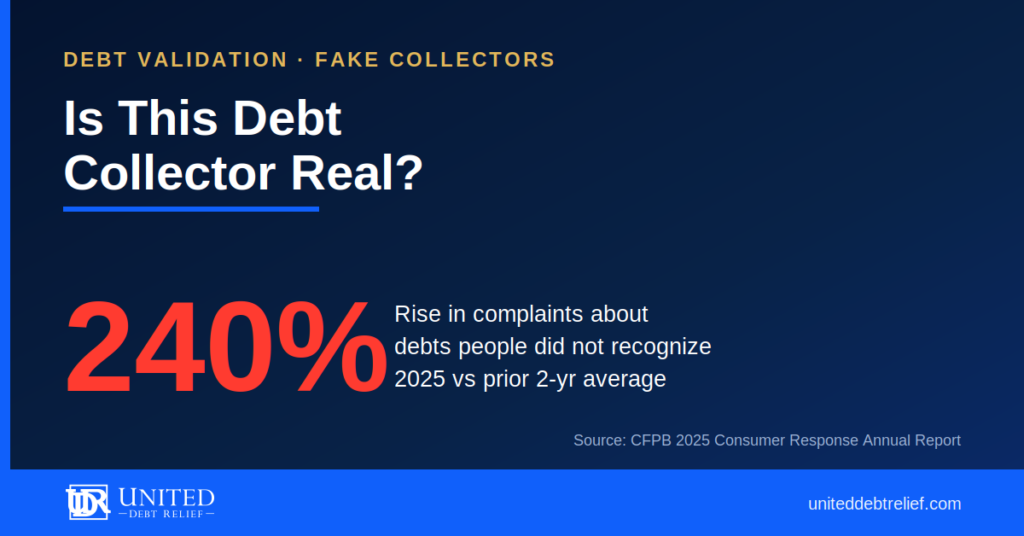
Checking whether a debt collector is real takes three steps: get the collector’s name, company, mailing address and phone number, wait for the written validation notice federal rules require, and compare the creditor it names with your credit reports before paying. These steps are for anyone contacted about a debt they do not recognize. Complaints about debts consumers did not recognize rose 240% in 2025 compared with the prior two-year monthly average, according to the Consumer Financial Protection Bureau’s 2025 Consumer Response Annual Report.
Key Takeaways
- The CFPB received about 387,400 debt collection complaints in 2025; the most common issue was attempts to collect debt not owed.
- Under 15 U.S.C. 1692g(a), a collector must send validation information within 5 days of first contact.
- Regulation F, 12 CFR 1006.34, requires the validation notice to name the current creditor and, for consumer financial debts, the original creditor.
- A written dispute sent within 30 days pauses collection of the disputed debt until verification is mailed, under 15 U.S.C. 1692g(b).
- All 3 nationwide credit bureaus offer a free credit report once a week at AnnualCreditReport.com, according to the FTC.
What Is a Collection Agency?
A collection agency is a business whose principal purpose is collecting debts, which is how the Fair Debt Collection Practices Act describes a debt collector at 15 U.S.C. 1692a(6). It may collect for the original lender or a later owner of the account. The CFPB logged about 387,400 debt collection complaints out of roughly 6,635,400 in 2025.
How Can You Tell If a Debt Collector Is Legit?
You can tell a debt collector is legit when it identifies itself fully, puts the debt in writing, and lets you verify before paying. The FTC advises getting the collector’s name, company, address and phone number, then confirming the debt with the original creditor directly.
The FTC lists three signs of a fake collector: the caller wants payment on a debt you do not recognize, refuses to give a mailing address or phone number, or threatens arrest or law enforcement. The FTC says to hang up and report threats like these.
| Checkpoint | Real collector | Red flag |
|---|---|---|
| Identity | Gives its name, company, address and phone number | Refuses to give a mailing address or phone number |
| Paperwork | Sends a validation notice at first contact or within 5 days | Says the paperwork comes after you pay |
| Ownership | Names the current and original creditor | Cannot say who owns the debt |
| Pressure | States when your validation period ends | Threatens arrest if you do not pay today |
| Payment | Pauses collection after a timely written dispute | Wants bank or card details on the first call |
What Does a Legitimate Debt Collector Have to Send You?
A legitimate debt collector has to send a validation notice at first contact or within 5 days, under 15 U.S.C. 1692g(a). Regulation F, 12 CFR 1006.34, requires the notice to show the collector’s name and dispute address, the current creditor, the account number, the original creditor for consumer financial debts, and an itemization date with the amount owed then.
It must also itemize interest, fees, payments and credits since that date, state the current amount, and give the validation period end date with dispute instructions. Under Regulation F, the validation period ends 30 days after you receive the notice, and a collector may assume receipt 5 business days after sending it.
How Do You Find Out Which Collection Agency You Owe?
You find out which collection agency you owe by reading the current and original creditor on the validation notice, then comparing those names with your credit reports. All 3 nationwide credit bureaus offer free weekly reports at AnnualCreditReport.com, the only site the FTC says is authorized to fill orders for the free reports the law provides.
If a collection entry looks wrong, the Fair Credit Reporting Act, 15 U.S.C. 1681i, requires the bureau to investigate a dispute, generally within 30 days, and delete or modify information that is inaccurate, incomplete or unverifiable. See how to read a credit report.
Should You Pay a Caller You Have Not Verified?
You should not give payment details to a caller you have not verified, even one who knows part of your account number. The FTC advises against paying on the spot when threatened; get the notice in writing and pay only through a channel you have checked. Next step: should you pay a collection agency.
What Happens When You Dispute a Debt in Writing?
When you dispute a debt in writing within 30 days, the collector must stop collecting the disputed debt until it obtains verification or a copy of a judgment and mails it to you, under 15 U.S.C. 1692g(b). Under 1692g(c), choosing not to dispute is not an admission that you owe the debt. See our debt validation letter template.
The honest worst case: the collector mails verification, resumes collecting, and the debt is still owed. A dispute does not erase a valid balance, and ignoring a verified debt can lead to a lawsuit. A balance is a claim, not a fact.
How Do You Report a Fake Debt Collector?
You report a fake debt collector to the FTC at ReportFraud.ftc.gov and to your state attorney general, as the FTC recommends. You can also file with the CFPB at consumerfinance.gov/complaint, and the CFPB says companies generally respond within 15 days.
What Do We Check First on a Collection Notice?
When a client brings us a collection letter, the first thing we check is whether the current and original creditor on the notice line up with an account on the client’s credit reports. Next we compare the itemization date and amount with the client’s last statements and find the validation period end date so any dispute goes out on time. A caller with no written notice stays unverified until one arrives.
How Does the Debt Validation Program Help?
The Debt Validation program helps by putting a collector’s claim through the written verification process federal law provides. United Debt Relief is a national debt relief company serving all 50 states, offering five programs: Debt Settlement, Debt Validation, Debt Consolidation Loans, Tax Resolution, and Credit Repair & Builder. Its specialists consult with consumers, determine which program fits, and handle enrollment. Program services are performed by stringently vetted in-network providers and law firms, each BBB Accredited with an A rating.
Some collectors mail full verification, and some debts are valid. Results vary. Confirm your state’s statute of limitations before acting. Learn how the Debt Validation program works, or start with what debt validation is and your FDCPA rights.
Frequently Asked Questions About Verifying a Debt Collector
How do I find out which collection agency I owe?
Read the validation notice, which must name the current creditor and, for consumer financial debts, the original creditor. Then compare it with your free credit reports from AnnualCreditReport.com.
How do I know if a debt collector is legit?
A legitimate collector gives its name, address and phone number and sends a validation notice within 5 days of first contact. The FTC says refusing to share an address or phone number, or threatening arrest, are signs of a fake.
What is a collection agency?
A collection agency is a business whose principal purpose is collecting debts, often for the original lender or a later owner of the account. The Fair Debt Collection Practices Act governs how it contacts consumers.
Should I give my bank details to a debt collector on the phone?
Do not give bank, card or Social Security details to a caller you have not verified. Get the validation notice in writing and confirm the debt with the original creditor first.
Where do I report a fake debt collector?
Report it to the FTC at ReportFraud.ftc.gov, to your state attorney general, and to the CFPB through its online complaint portal.
Not sure a collector is real? A United Debt Relief specialist can review the notice with you. Schedule a free consultation or call 1 (888) 802-2092. Free consultation, no obligation. Results vary.
Sources: CFPB 2025 Consumer Response Annual Report · FTC, Fake Debt Collectors · FTC alert on unrecognized debts · FTC Debt Collection FAQs · 12 CFR 1006.34 · FDCPA · 15 U.S.C. 1692a · FTC, Free Credit Reports · FCRA · CFPB complaints