

By Nick Avila, Founder, United Debt Relief · Last updated October 13, 2026
A $20,000 credit card balance can go to a debt consolidation loan or to debt settlement, and the deciding facts are whether the borrower qualifies for a loan APR below the card rate and whether the accounts are already behind. Card accounts assessed interest carried an average APR of 22.15% in the second quarter of 2026, according to the Federal Reserve G.19 release. This worked scenario is for anyone carrying about $20,000 across cards. It matters now because card balances rose to $1.263 trillion in the second quarter, up $21 billion, according to the New York Fed.
Key Takeaways
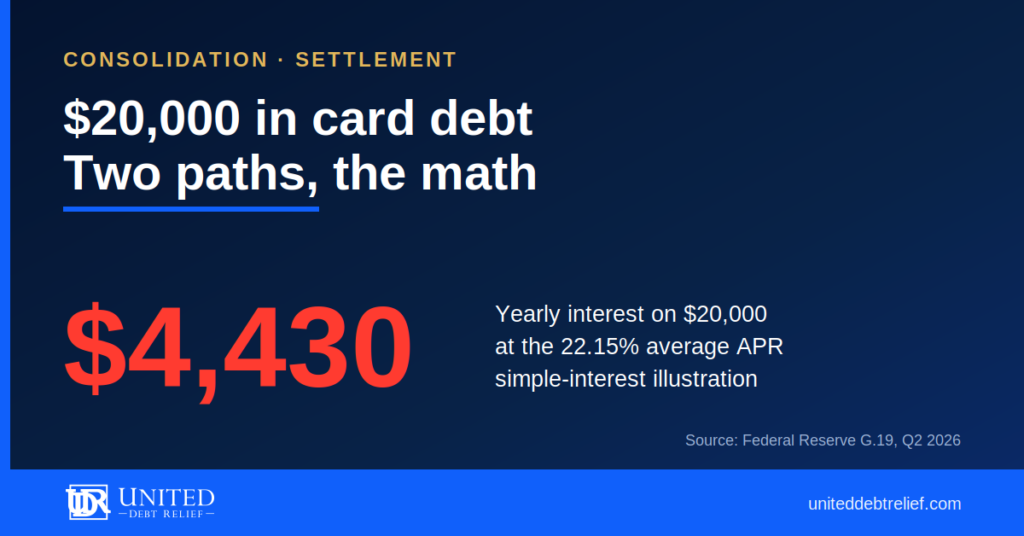
- At the 22.15% average APR in the Federal Reserve G.19, $20,000 costs about $4,430 a year, or about $369 a month, in simple interest.
- The Truth in Lending Act requires a lender to disclose 4 figures before signing: APR, finance charge, amount financed and total of payments, according to the CFPB.
- Under the FTC Telemarketing Sales Rule, a debt settlement company may not collect a fee until at least 1 debt is settled and at least 1 payment is made under that agreement.
- The IRS says a creditor files Form 1099-C when $600 or more of debt is canceled, and canceled debt is generally taxable income.
What Does $20,000 in Credit Card Debt Cost at 22.15%?
$20,000 in credit card debt costs about $4,430 a year in interest at 22.15%, or about $369 a month, as a simple-interest illustration. The Federal Reserve G.19 puts the Q2 2026 average at 22.15% on accounts assessed interest and 20.94% on all accounts.
Shortcut: every 1 point of APR on $20,000 is about $200 a year, so multiply the gap between two APRs by $200.
What Does a Debt Consolidation Loan Require?
A debt consolidation loan requires the borrower to qualify for a new loan, and the lender sets the APR. Before signing, the Truth in Lending Act and Regulation Z require the lender to disclose the APR, finance charge, amount financed and total of payments, according to the CFPB.
The CFPB adds three cautions: some low rates are teaser rates that last only for a certain time, a lower payment may come from a longer term that costs a lot more overall, and new debt used to pay old debt may just be kicking the can down the road unless spending changes. More in is a debt consolidation loan a good idea.
How Should You Compare a Consolidation Loan Offer on $20,000?
A consolidation loan offer on $20,000 should be compared by APR and total of payments, because the payment hides the term. Compare the APR, not the payment. These hypothetical figures assume fixed rates, no fees and no new charges, using payment = balance × r ÷ (1 – (1 + r)^-n), where r is the APR divided by 12 and n is the number of months.
- The card itself, paid off over 36 months at 22.15%: about $765.36 a month, $27,553.03 in total.
- Hypothetical Loan A, 15% APR, 36 months: about $693.31 a month, $24,959.04 total of payments.
- Hypothetical Loan B, 18% APR, 60 months: about $507.87 a month, $30,472.11 total of payments.
Loan B has the smallest payment and the largest total, $2,919.08 above the 36-month card payoff. Loan A sits 7.15 points below 22.15%, about $1,430 a year in simple interest on $20,000 (7.15 × $200) before fees. No lender has to offer either rate; these are illustrations, not quotes.
What Does Debt Settlement Involve for a $20,000 Balance?
Debt settlement involves negotiating with creditors to accept less than the full balance, and the accounts are typically delinquent. The CFPB says settlement companies typically encourage consumers to stop paying their card bills, which usually brings late fees, penalty interest and other charges. At 22.15%, interest alone on $20,000 runs about $369 a month while an account goes unpaid.
What a creditor will accept is unknowable in advance, so no settlement amount is assumed here. The FTC Telemarketing Sales Rule (16 CFR 310.4(a)(5)) bars a fee until a debt is settled or changed under an agreement the customer accepts, the customer has made at least one payment under it, and the fee is proportional to the debt settled or a set share of the amount taken off. See how much debt settlement costs.
What Are the Tax and Credit Report Effects of Settling?
Settling can create taxable canceled debt and up to 7 years of negative credit reporting. Canceled debt is generally taxable income, per the IRS, and a creditor files Form 1099-C at $600 or more canceled, a filing threshold, not a tax floor. The insolvency exclusion (IRS Publication 4681, Form 982) may exclude some or all of it.
Tax outcomes depend on your full financial picture; a licensed tax professional can confirm yours. Under the FCRA, charge-offs and collections can report up to 7 years from the original delinquency; settling does not restart that clock. See is settled debt taxable.
How Do the Two Paths Compare Side by Side?
The two paths differ in who qualifies, how cost builds, and what follows; see debt consolidation vs debt settlement.
| $20,000 at 22.15% | Consolidation loan | Debt settlement |
|---|---|---|
| Starting point | Qualify; the lender sets the APR | Accounts typically delinquent (CFPB) |
| Card interest | Replaced by the loan APR; each 1 point is about $200 a year | Keeps accruing, about $369 a month, plus late fees |
| What to compare | APR and total of payments (Truth in Lending) | Fee terms (FTC Telemarketing Sales Rule) and each agreement |
| Taxes | Paid in full, nothing canceled | $600 or more canceled triggers Form 1099-C |
| Credit reporting | Cards are paid, not settled | Negative items up to 7 years (FCRA) |
What Is the Worst Case on Each Path?
The worst case for a consolidation loan is a long term that costs more than the cards it replaced, with new card balances on top. The worst case for debt settlement is a creditor that sues instead of settling while fees build; the CFPB lists a lawsuit and credit score harm as risks. Results vary, and neither path fits everyone.
How Does United Debt Relief Assess Which Path Fits?
United Debt Relief assesses the fit by reading the accounts before discussing any program. When someone brings us $20,000 across several cards, we first ask for each card APR and whether any payment is already late, because those two facts decide which path is open. Then we test whether a loan payment fits income.
United Debt Relief is a national debt relief company serving all 50 states, offering five programs: Debt Settlement, Debt Validation, Debt Consolidation Loans, Tax Resolution, and Credit Repair & Builder. Its specialists consult with consumers, determine which program fits, and handle enrollment. Program services are performed by stringently vetted in-network providers and law firms, each BBB Accredited with an A rating.
Frequently Asked Questions About Consolidation Loans and Debt Settlement
How much interest does $20,000 in credit card debt cost at 22.15%?
About $4,430 a year, or about $369 a month, as a simple-interest illustration based on the Federal Reserve G.19 average APR for Q2 2026.
Is a debt consolidation loan cheaper than debt settlement?
Neither is cheaper by default. A loan costs less only if its total of payments is lower; settlement cost depends on creditor terms, fees and taxes. Results vary.
Do accounts have to be behind to settle debt?
Debt settlement typically involves delinquent accounts. The CFPB says missed payments usually bring late fees, penalty interest and other charges.
Is settled credit card debt taxable?
Canceled debt is generally taxable income, according to the IRS. A creditor files Form 1099-C when $600 or more is canceled, and the insolvency exclusion may apply.
What should a borrower compare on a consolidation loan offer?
The APR and the total of payments, which the Truth in Lending Act requires the lender to disclose before signing. A lower payment can come from a longer term that costs more overall.
Schedule a free consultation or call 1 (888) 802-2092. Free consultation, no obligation. Results vary. Debt settlement carries no upfront fees.
Sources: Federal Reserve G.19 · New York Fed HHDC · CFPB, consolidation · CFPB, debt settlement · CFPB, Regulation Z · FTC Telemarketing Sales Rule · IRS Publication 4681 · FTC, Fair Credit Reporting Act