

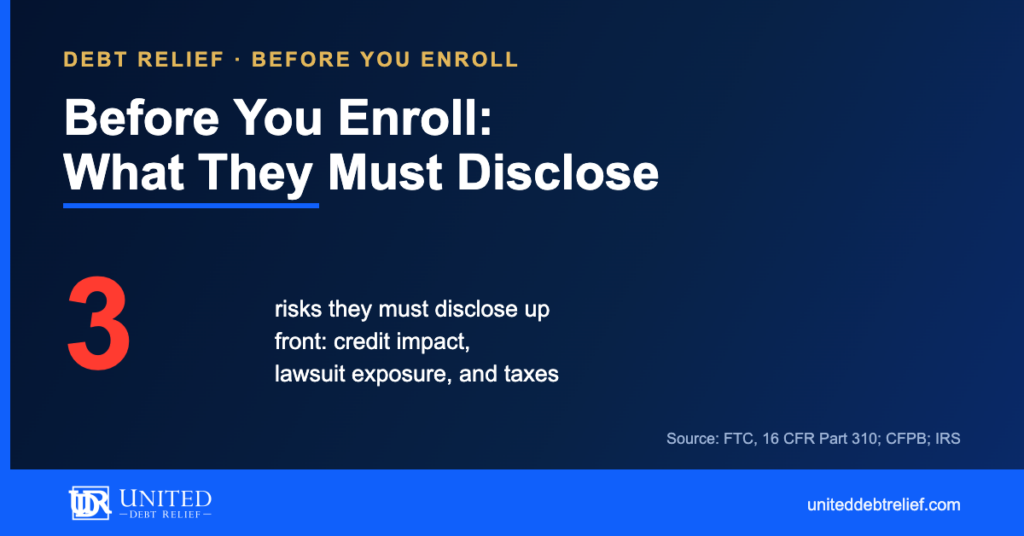
Once you have shortlisted a debt relief company, the decision stops being about reputation and becomes a question of paperwork. Federal law already dictates what a compliant company can charge, when it can charge it, who holds your money, and what it must tell you about the consequences before you sign. Under the Federal Trade Commission Telemarketing Sales Rule at 16 CFR 310.4(a)(5), a for-profit debt relief company cannot collect any fee until it has settled at least one of your debts and you have made a payment on that settlement. Six disclosures separate a compliant enrollment from a costly one, and the last of them, the credit, lawsuit, and tax consequences a company should volunteer without being asked, is the one most people never hear on a first call.
By Nick Avila, Founder, United Debt Relief
Disclosures 1 to 3: what federal law requires before you sign
The Telemarketing Sales Rule sets a floor any compliant company already meets.
1. No fee before an account is settled and paid
Under 16 CFR 310.4(a)(5)(i), effective October 27, 2010, a fee may only be collected after the company settles at least one debt, you make a payment under that agreement, and the fee is either a consistent percentage of the amount saved or proportional to that debt’s share of enrolled balance.
2. The dedicated account has to be yours
Under 16 CFR 310.4(a)(5)(ii), your funds sit at an insured financial institution, you own the funds and any interest, the company may not control the account or be affiliated with its administrator, and you can withdraw any time without penalty.
3. The pre-enrollment disclosures
Under 16 CFR 310.3(a)(1)(viii), you must be told before signing how long until an offer goes to each creditor, how much you must accumulate first, that not paying creditors brings collection activity, lawsuits, and growing balances, and that the account money is yours.
Disclosures 4 and 5: the agreement and the fee math, in writing
Nothing moves before you hold a written agreement you have read.
4. The written agreement
It should name every enrolled account, the fee formula, the timeline, who holds the dedicated account, and what happens if you withdraw. The FTC advises never paying by wire transfer or gift card.
5. The fee structure, in percentages and dollars
Ask which lawful structure applies: a consistent percentage of the amount saved, or a share proportional to enrolled debt. Get the percentage and the dollar total, and ask the account administrator’s monthly charge. Results vary by situation.
Disclosure 6: the risks they should volunteer
The strongest signal in a first call is what they tell you unasked.
- Credit damage. They should say plainly that accounts go delinquent, and that under the FCRA negative marks can stay up to seven years from first delinquency.
- Lawsuit risk. They should say creditors keep the right to sue, and that the CFPB warns an unanswered lawsuit can end in a default judgment leading to garnishment or a bank levy.
- Taxes. They should mention that a creditor canceling $600 or more files an IRS Form 1099-C, that canceled debt is usually taxable under IRS Topic No. 431, and that Publication 4681’s insolvency exclusion is claimed on Form 982.
If the first conversation is all upside, that is the tell.
A note on accreditation and complaint history
Accreditation is a private-sector rating of business conduct, not a government license. No federal agency approves, certifies, or endorses debt relief companies, so verify any accreditation on the accrediting organization’s own site and ask which entity holds it, since the company you speak with and the firm performing the work may differ. At United Debt Relief, program services are performed by stringently vetted in-network providers and law firms, each BBB Accredited with an A rating. Our 2026 legitimacy checklist walks through verifying credentials step by step.
Complaint history is public and free to search by company name at consumerfinance.gov and ftc.gov, and your state attorney general can confirm licensing. Our guide to avoiding debt settlement scams covers the warning signs and how to report one.
The six disclosures at a glance
| Disclosure | What to verify | What a failing answer sounds like |
|---|---|---|
| 1. Fee timing | No fee until a debt settles and you pay | Enrollment fee or retainer now |
| 2. Dedicated account | You own it, withdraw anytime | Company controls or limits it |
| 3. Pre-enrollment disclosures | Timeline and savings target up front | Vague answers, no numbers |
| 4. Written agreement | Accounts, fees, timeline, exit | Verbal promises, paperwork later |
| 5. Fee structure | Percentage and dollars, both | Cannot name the lawful structure |
| 6. Risk disclosure | Credit, lawsuits, 1099-C, unasked | All upside, no downside |
Questions to ask before you enroll
- Which entity performs the work, and what is its accreditation?
- When is my first fee charged, and what triggers it?
- Is my fee a percentage of enrolled debt or of savings, and what is that in dollars?
- Who holds the dedicated account, and can I withdraw my funds at any time?
- Will I receive a 1099-C, and how does the insolvency exclusion work?
- If I stop, what do I get back and what do I lose?
Educational information, not advice. These disclosures describe federal rules and general practice. They are not individual financial, legal, or tax advice, and no outcome is promised. Confirm your situation with a licensed professional. Results vary by situation.
Frequently asked questions
When exactly is my first fee charged, and what triggers it?
Under 16 CFR 310.4(a)(5), a fee may only be collected after the company has settled at least one enrolled debt and you have made a payment under that settlement agreement. Nothing earlier is lawful for a for-profit company that enrolled you by phone. Ask for the trigger in writing, and ask separately whether the dedicated account administrator charges a monthly fee.
Who owns the money in the dedicated account?
You do. Under 16 CFR 310.4(a)(5)(ii), the funds sit at an insured financial institution, you own the funds and any interest they earn, the debt relief company may not control the account or be affiliated with its administrator, and you can withdraw your money at any time without penalty.
Does accreditation mean a company is government approved?
No. Accreditation is a private-sector rating of business conduct. No federal agency approves or certifies debt relief companies. Verify it with the accrediting organization, and check licensing through your state attorney general.
Will I owe taxes on debt that gets settled?
Possibly. A creditor that cancels $600 or more generally files an IRS Form 1099-C, and canceled debt is usually treated as taxable income under IRS Topic No. 431. IRS Publication 4681 describes an insolvency exclusion, claimed on Form 982, that can reduce or eliminate that income. Confirm your own situation with a licensed tax professional.
What should I consider before hiring a settlement company?
Consider whether you could repay the balance in about five years at a lower rate. If you can, a repayment path is usually cheaper and easier on your credit, and our consolidation and settlement comparison lays out the trade-offs. If not, weigh timeline, credit impact, lawsuit risk, and the possible 1099-C against what settlement would save. Our debt validation guide covers a lower-cost first step.
For a company that answers all six disclosures on the first call, get your free consultation. We explain every option, including ones we do not sell, and enroll you only where the numbers fit: Debt Settlement, Debt Validation, a consolidation loan, Tax Resolution, or Credit Repair.
About the author. Nick Avila is the Founder of United Debt Relief, a national debt relief company serving all 50 states with five programs spanning settlement, validation, consolidation loans, tax resolution, and credit repair.