

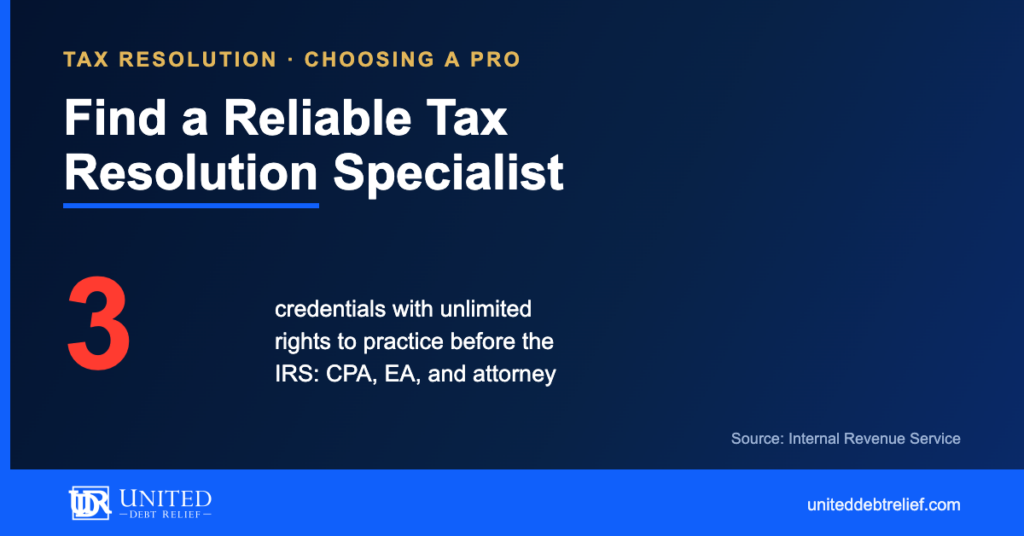
Finding a reliable tax resolution specialist comes down to one question you can verify in minutes: does this person hold credentials to represent you before the IRS? Only three categories of professionals have unlimited practice rights before the IRS, according to the IRS: attorneys, certified public accountants, and enrolled agents. Everyone else has limited representation rights or none at all. You can confirm a preparer’s credentials for free in the IRS Directory of Federal Tax Return Preparers with Credentials and Select Qualifications on IRS.gov. Tax outcomes depend on your complete financial picture, so review your situation with a licensed tax professional before committing to any program.
By Nick Avila, Founder, United Debt Relief
The Three Credentials With Unlimited IRS Representation Rights
Tax resolution is one of the few consumer categories where the qualification standard is federally defined and publicly searchable. Practice before the IRS is governed by Treasury Department Circular No. 230, and the IRS Office of Professional Responsibility enforces it. That gives you a hard line to check against.
| Credential | Who licenses it | What it requires | IRS representation rights |
|---|---|---|---|
| Enrolled agent (EA) | The IRS, federally, valid in all 50 states | Pass the three-part Special Enrollment Examination or qualify through former IRS employment, plus 72 hours of continuing education every three years | Unlimited |
| Certified public accountant (CPA) | A state board of accountancy | State examination and licensing requirements, plus state continuing education | Unlimited |
| Attorney | A state bar | Law license in good standing | Unlimited |
| Annual Filing Season Program participant | Voluntary IRS program, not a license | Annual continuing education and a record of completion | Limited |
| Preparer with a PTIN only | No licensing body | PTIN registration with the IRS | Very limited or none |
Three facts make this table worth acting on. Every paid preparer must have a Preparer Tax Identification Number and must sign the return they prepare, according to the IRS. The enrolled agent credential is the only one on the list issued by the IRS itself. And the IRS publishes the searchable directory of credentialed preparers at no cost, which means verification is free and takes about two minutes.
Before you act: This article is general consumer education, not tax or legal advice. Eligibility for any IRS program depends on your specific income, expenses, assets, and filing history. Review your situation with a licensed tax professional before you apply for or agree to anything.
The Two Forms That Show Who Actually Represents You
This is the single most useful thing to understand before you sign a service agreement, and it is where a lot of confusion lives. The IRS distinguishes between someone who can see your tax information and someone who can act on your behalf.
- Form 2848, Power of Attorney and Declaration of Representative. This authorizes an eligible representative to act for you before the IRS, including speaking with the IRS, negotiating, and signing certain agreements. Only individuals eligible to practice before the IRS may be named.
- Form 8821, Tax Information Authorization. This allows a designated person to inspect or receive your confidential tax information, but it does not grant authority to represent you or advocate on your behalf.
- Ask which one you are signing. If a company is putting a Form 8821 in front of you and describing it as representation, that is a conversation worth having before you pay anything.
Seven Checks Before You Hire Anyone
Each of these is verifiable by you, without special knowledge, and most take under five minutes.
- Look up the individual, not just the company. Use the free IRS Directory of Federal Tax Return Preparers on IRS.gov to confirm the credential of the specific person who will handle your case.
- Confirm they will sign your return. The IRS requires paid preparers to sign returns they prepare and include their PTIN. A preparer who declines to sign is a documented warning sign in IRS guidance.
- Reject fees based on a percentage of your refund. The IRS specifically cautions taxpayers against preparers who base their fee on a percentage of the refund.
- Get the fee agreement in writing before you pay. The scope of work, the total cost, and what happens if the IRS declines an application should all be on paper.
- Be cautious of a promised outcome before anyone reviews your finances. The Federal Trade Commission warns consumers about companies that promise to reduce tax debt without first evaluating the taxpayer’s financial situation. No one can responsibly quote you a result before reviewing your income, expenses, and assets.
- Ask about Circular 230 standing. Practice before the IRS is governed by Circular 230 and enforced by the IRS Office of Professional Responsibility, which can sanction practitioners.
- Confirm they handle state tax authorities too. State agencies run their own programs and deadlines. If you owe both, you want one plan covering both.
Questions Worth Asking on the First Call
- Which credential do you hold, and can I verify it in the IRS directory?
- Will you pull my IRS transcripts before recommending a program?
- Am I signing a Form 2848 or a Form 8821?
- Do I have unfiled returns, and does that have to be resolved first?
- What is the total fee, and what is included if the IRS declines the application?
That fourth question matters more than it sounds. The IRS generally requires filing compliance before it will consider most relief programs, so a specialist who does not ask about missing returns on the first call is skipping the step that determines everything else. Our guide to unfiled tax returns covers what that process involves.
Important: No article can tell you which IRS program you qualify for, or whether a specific balance can be reduced. Those determinations depend on IRS formulas applied to your own numbers. Bring your notices and transcripts to a licensed tax professional.
How United Debt Relief’s Tax Resolution Program Works
United Debt Relief is a debt relief company that enrolls clients in its own five programs, one of which is Tax Resolution. Casework is handled by licensed tax professionals, and the process starts with a free consultation and a review of your IRS transcripts rather than a quoted outcome. Fees are disclosed before you enroll. Results vary by situation, and eligibility for any IRS program is determined by the IRS.
If you want the mechanics of the programs themselves before you talk to anyone, start with how tax resolution services work and who qualifies for the IRS Fresh Start Program.
Frequently Asked Questions
How do I know if a tax resolution company is legitimate?
Verify the individual handling your case in the free IRS Directory of Federal Tax Return Preparers with Credentials and Select Qualifications. Confirm they hold an unlimited-practice credential, meaning attorney, CPA, or enrolled agent. Get the fee in writing, and be cautious of any promise of a specific result made before anyone has reviewed your financial information, which the FTC identifies as a warning sign.
What is the difference between a CPA, an enrolled agent, and a tax attorney?
All three hold unlimited practice rights before the IRS. An enrolled agent is licensed federally by the IRS and must pass the three-part Special Enrollment Examination or qualify through IRS employment, then complete 72 hours of continuing education every three years. A CPA is licensed by a state board of accountancy. An attorney is licensed by a state bar. Which fits depends on whether your issue is primarily procedural, accounting-driven, or legal.
Can a tax resolution specialist settle my IRS debt for less than I owe?
The IRS Offer in Compromise program allows qualifying taxpayers to resolve a balance for less than the full amount, and the IRS accepts only a portion of the offers it receives each year. Eligibility is driven by the IRS Reasonable Collection Potential calculation based on your income, expenses, and asset equity. No company can promise a specific outcome, and results vary by situation. Our Offer in Compromise pre-qualifier walkthrough explains the formula.
How much should tax resolution cost?
Fees vary with case complexity, the number of years involved, and which program is pursued. What matters more than the number is that the scope and total are disclosed in writing before you pay, and that the fee is not tied to a percentage of a refund, which the IRS cautions against.
Do I need to have filed all my tax returns first?
The IRS generally requires filing compliance before it will approve an installment agreement, an Offer in Compromise, or Currently Not Collectible status. In practice, preparing and filing missing returns is usually the first step in any resolution plan, not something handled later.
Can someone represent me before the IRS without a Power of Attorney?
Representation before the IRS requires a Form 2848, Power of Attorney and Declaration of Representative, filed by someone eligible to practice before the IRS. A Form 8821, Tax Information Authorization, only allows a person to inspect or receive your tax information. Ask which form you are signing.
What if I owe both back taxes and credit card debt?
They are separate problems with separate rules and often need to be sequenced rather than tackled at once. Our guide to IRS back taxes and the relief programs available covers the tax side, and a free consultation can map how the two interact in your situation.
Your Next Step
Verify the credential first, then have someone read your transcripts before anyone quotes you a program. United Debt Relief offers a free consultation, where a specialist reviews your situation, explains the options, and helps you determine the fit. Licensed tax professionals perform the casework, and every in-network provider is Better Business Bureau Accredited with an A rating and is stringently vetted. Results vary by situation, and eligibility for any IRS program is determined by the IRS.