

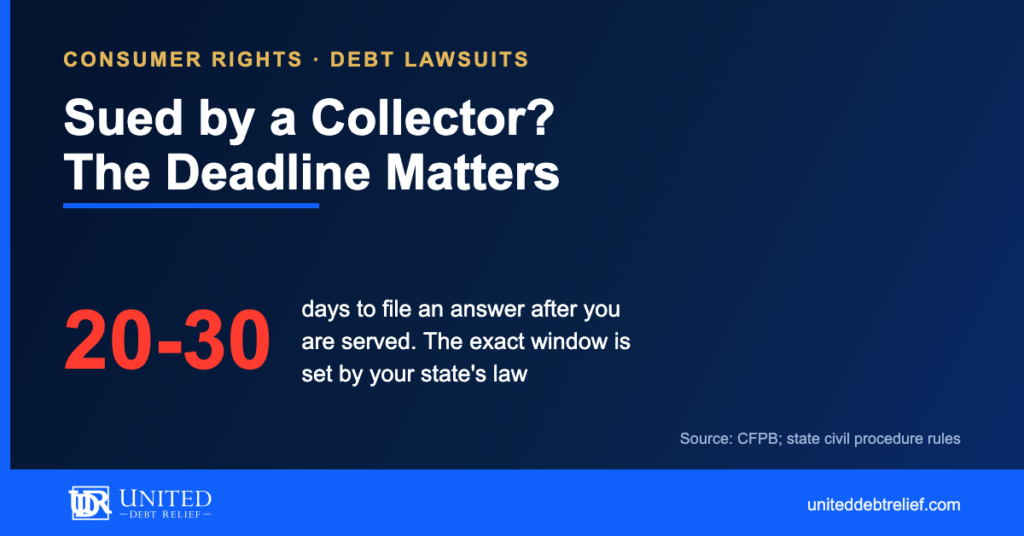
If a debt collector sues you, the most important step is to respond in writing to the court before your deadline runs out, because a lawsuit you ignore is what becomes a judgment against you. Deadlines to file an answer commonly run 20 to 30 days from the day you were served, and the exact window is set by state law. Americans carried $1.263 trillion in credit card balances in the second quarter of 2026, according to the Federal Reserve Bank of New York. A lawsuit is a legal proceeding with real consequences, so review your summons and complaint with a licensed attorney in your state before you file anything.
By Nick Avila, Founder, United Debt Relief
The Response Deadline Is the Whole Ballgame
Almost everything that goes wrong in a debt collection lawsuit traces back to one thing: the defendant did not respond. Responding does not mean you agree to pay, and it does not mean you lose. It means the case proceeds on the merits instead of being decided without you.
- Your answer deadline is printed on the summons. Response windows are set by each state’s rules of civil procedure and commonly run 20 to 30 days from the date of service. Read the document you were handed rather than relying on a general rule.
- Collectors cannot sue you just anywhere. Section 1692i of the Fair Debt Collection Practices Act requires a debt collector to bring suit only in the judicial district where you signed the underlying contract or where you live.
- Suing on a time-barred debt is prohibited. Under Regulation F, 12 CFR 1006.26, which took effect November 30, 2021, a debt collector must not sue or threaten to sue on a debt the collector knows or should know is beyond the statute of limitations, according to the Consumer Financial Protection Bureau.
- You have your own clock too. Section 1692k of the FDCPA gives consumers one year from the date of a violation to bring a claim, with statutory damages of up to $1,000 plus actual damages and attorney fees.
What Being Served Actually Means
Service is the formal delivery of the summons and complaint. The summons tells you which court, which case number, and how long you have. The complaint states what the collector claims you owe and why. Those two documents, not a phone call and not a letter, are what start the clock. If you are unsure whether you were properly served, that is a question for a licensed attorney, because improper service can matter to how a case proceeds.
Before you act: This article is general consumer education, not legal advice. Court rules, deadlines, and defenses differ by state and by court. Consult a licensed attorney in your state about your specific case before you file, sign, or agree to anything.
What Happens If You Do Not Respond
When a defendant does not answer, the plaintiff can ask the court to enter a default judgment for the amount claimed, and that judgment unlocks enforcement tools a collector does not otherwise have.
| Enforcement tool | What it does | Key federal limit |
|---|---|---|
| Wage garnishment | Sends part of each paycheck to the creditor until the judgment is satisfied | For ordinary consumer debts, federal law caps garnishment at the lesser of 25% of disposable earnings or the amount above 30 times the federal minimum wage per week, which is $217.50 at $7.25 per hour |
| Bank account levy | Freezes and pulls funds directly from a deposit account | Federal rules require banks to review accounts and protect two months of directly deposited federal benefits such as Social Security and VA benefits, according to CFPB guidance |
| Property lien | Attaches a claim to real property that must be cleared before sale or refinance | Availability, duration, and homestead protections are set entirely by state law |
| Post-judgment interest | Adds interest to the judgment balance until it is paid | The rate is set by state law, so the balance can keep growing after the case ends |
For the mechanics of how garnishment works after a judgment, see our guide on how much a creditor can take from your paycheck.
Five Things to Check on the Complaint
A complaint is a set of claims, not a set of established facts. Collectors are required to be able to back up what they file. These are the items a licensed attorney will typically look at first.
- Who actually owns the debt. Accounts are frequently sold and resold, and the paperwork tracking each transfer does not always follow. If you do not know who holds your account, start with our guide on how to find out who owns your debt.
- Whether the amount matches your records. Attempting to collect a debt the consumer says is not owed is consistently among the most common debt collection complaint categories reported by the CFPB.
- Whether the statute of limitations has run. Limitations periods are set by state law and commonly run in the range of three to six years for written contracts. In most jurisdictions this is an affirmative defense that can be waived if it is not raised, which is precisely why an attorney matters here. Our state-by-state statute of limitations guide covers how the clock works.
- Whether the venue is correct. FDCPA Section 1692i limits where a collector may file.
- Whether you ever received a validation notice. FDCPA Section 1692g requires a collector to provide validation information within five days of its initial communication, and you have 30 days from receipt to dispute it in writing.
Important: No article can tell you whether a particular debt is or is not legally collectible in your case. That determination depends on your state, your documents, and your timeline, and it belongs with a licensed attorney.
Where Debt Validation Fits Once a Lawsuit Exists
Validation and litigation are two different tracks that often intersect. Debt validation is your federal right under the FDCPA to require a collector to verify that a debt is accurate and legally theirs to collect. It is most powerful early, but the underlying documentation questions do not disappear once a case is filed.
- Under FDCPA Section 1692g(b), if you dispute in writing during the 30-day validation period, the collector must cease collection until it mails verification.
- Regulation F, effective November 30, 2021, standardized the validation notice and the information a collector must provide, according to the CFPB.
- If a collector cannot verify the debt, our guide covers what happens when a collector cannot validate your debt, and you can use our free debt validation letter template to draft your request.
United Debt Relief is a debt relief company that enrolls clients in its own five programs, including Debt Validation. If you are facing active collection activity, a free consultation will tell you which of our programs, if any, fits your situation. Results vary by situation, and enrolling in a program is not a substitute for legal representation in an active lawsuit.
Frequently Asked Questions
I just got served with papers from a debt collector. What is the first thing I should do?
Read the summons and write down the response deadline printed on it, then contact a licensed attorney in your state. Do not throw the papers away and do not assume a phone call to the collector counts as a response. Only a filing with the court preserves your position in the case.
What happens if I ignore a debt collection lawsuit?
The plaintiff can ask the court to enter a default judgment for the amount claimed. A judgment can then be enforced through wage garnishment, a bank account levy, or a property lien, depending on your state. This is the single most common way a manageable dispute turns into an unmanageable one.
Can a debt collector sue me for a debt that is too old?
Under Regulation F, 12 CFR 1006.26, a debt collector must not sue or threaten to sue on a debt it knows or should know is time-barred. Whether a specific debt is time-barred depends on your state’s limitations period and on events that can restart the clock, so have a licensed attorney review the dates in your case.
Can they garnish my wages if they win?
A judgment can lead to wage garnishment. For ordinary consumer debts, federal law under Title III of the Consumer Credit Protection Act caps garnishment at the lesser of 25% of disposable earnings or the amount by which weekly disposable earnings exceed 30 times the federal minimum wage, which is $217.50 per week at $7.25 per hour. Many states protect more.
Do I need a lawyer to answer a debt collection lawsuit?
Court rules allow individuals to represent themselves, but debt collection defense involves procedural deadlines and affirmative defenses that are easy to waive by accident. Because the consequences run to your paycheck and your bank account, this is a situation where a consultation with a licensed attorney is worth the call.
Can I still settle a debt after a lawsuit has been filed?
Negotiation is often still possible after filing, and cases are frequently resolved before a hearing. Any agreement should be in writing and reviewed by a licensed attorney before you sign, because how a settlement is documented affects what happens to the case and to your credit reporting. If you are already enrolled in a settlement program, see our guide on what a lawsuit means inside a program, including the 1099-C tax side. Results vary by situation.
What should I do first if I am behind on several accounts at once?
Start by understanding the full picture rather than reacting to whichever collector called last. Our guide on how to get out of collections walks through validating, negotiating, and settling, and how to decide which comes first.
Your Next Step
If a collection lawsuit has already been filed against you, your first call is to a licensed attorney in your state. Your second call can be to us. United Debt Relief offers a free consultation, where an advisor will review your situation, explain your options, and help you determine whether one of our programs fits. Ready to look at your options? Start with a free consultation. Results vary by situation.