

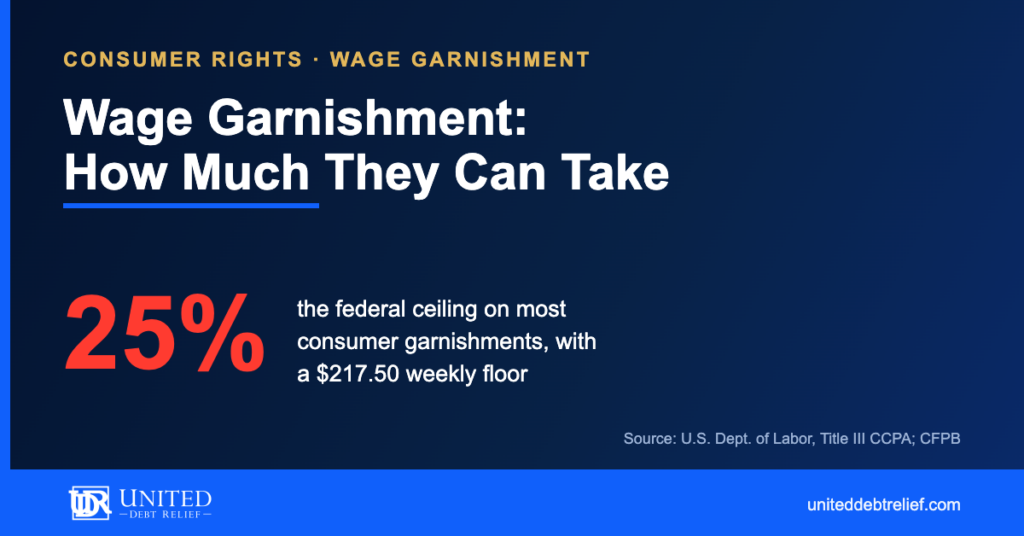
Wage garnishment is a court-ordered deduction that routes part of your paycheck straight to a creditor, and for ordinary consumer debts federal law caps it at the lesser of 25% of your disposable earnings or the amount by which those earnings exceed 30 times the federal minimum wage each week. At the federal minimum wage of $7.25 per hour, that protected weekly floor works out to $217.50 under Title III of the Consumer Credit Protection Act. Many states protect more of your pay than federal law does, so confirm the rules where you live with a licensed attorney.
By Nick Avila, Founder, United Debt Relief
How Much of Your Paycheck a Creditor Can Actually Take
The federal cap is not a single number. It changes depending on what kind of debt is being collected, and the differences are large enough that knowing which category you are in changes the entire picture.
| Type of debt | Federal limit on disposable earnings | What to know |
|---|---|---|
| Most consumer debts after a judgment (credit cards, medical bills, personal loans) | The lesser of 25%, or the amount above 30 times the federal minimum wage per week | At $7.25 per hour, the first $217.50 of weekly disposable earnings is protected outright |
| Child support or alimony | Up to 50% if you are supporting another spouse or child, up to 60% if you are not | An additional 5 percentage points may apply when payments are more than 12 weeks in arrears |
| Federal student loans | A separate federal administrative garnishment framework applies, not the 25% consumer cap | No court judgment is required first; confirm the current limit with a licensed attorney |
| Unpaid federal taxes (IRS levy) | No percentage cap; the IRS instead leaves you an exempt amount | The exempt amount is set by filing status and number of dependents under IRS Publication 1494 |
Three details do most of the work here. First, the caps apply to disposable earnings, meaning pay left after legally required deductions such as federal, state, and local taxes and Social Security, not after rent or car payments. Second, where state law protects more of your wages, the more protective rule generally applies. Third, the IRS operates on an entirely different footing from a credit card creditor, which is why our guide to wage garnishment for back taxes is a separate walkthrough.
Before you act: This is general consumer education, not legal or tax advice. Exemption amounts, filing procedures, and deadlines vary by state and by court. Talk with a licensed attorney about your specific garnishment, and a licensed tax professional about anything involving the IRS.
Income a Creditor Generally Cannot Reach
Not every dollar that lands in your account is fair game, and the protections are stronger than most people assume.
- Federal benefits carry automatic bank protection. Federal rules require a bank that receives a garnishment order to review the account and protect two months of directly deposited federal benefits, including Social Security, Supplemental Security Income, and VA benefits, according to Consumer Financial Protection Bureau guidance.
- The weekly floor is absolute for ordinary consumer debts. Under Title III of the Consumer Credit Protection Act, disposable earnings at or below 30 times the federal minimum wage per week, which is $217.50 at $7.25 per hour, cannot be garnished for a consumer debt at all.
- Your job is protected from a single garnishment. Section 1674 of the Consumer Credit Protection Act prohibits an employer from firing you because your earnings were garnished for one indebtedness.
- State exemptions stack on top. Many states exempt a larger share of wages, and some protect additional categories of income entirely. These are claimed through a filing with the court, and missing the window can forfeit the protection.
How a Garnishment Actually Starts
For ordinary consumer debts, garnishment is not the first step. It is close to the last one, and each earlier stage is an opportunity to intervene.
- The account goes delinquent and is placed or sold. Once a third-party collector is involved, the Fair Debt Collection Practices Act applies in full.
- You receive a validation notice. FDCPA Section 1692g requires the collector to provide validation information within five days of its initial communication, and you have 30 days from receipt to dispute in writing.
- The collector files suit. This is the decisive moment. Our guide on what to do if a debt collector sues you covers the response deadline and what a default judgment unlocks.
- A judgment is entered. Only now can a consumer creditor seek a garnishment order against your employer.
The IRS is the notable exception. It does not need to sue you first, but it must issue a Final Notice of Intent to Levy and Notice of Your Right to a Hearing, which generally gives you 30 days to request a Collection Due Process hearing before a levy proceeds.
Five Ways a Garnishment Can Stop
Garnishment is not permanent, and several of these routes work even after deductions have already started. Which one fits depends on your situation, and results vary by situation.
- Satisfy or resolve the underlying balance. A garnishment ends when the judgment is paid or the debt is otherwise resolved. Negotiating a payoff is often still possible after judgment.
- Claim an exemption. If the garnished income is protected, or the amount exceeds the federal or state cap, exemptions are asserted by filing with the court within a deadline set by state rules.
- Challenge the judgment itself. Where a default judgment was entered without proper service, a licensed attorney may be able to ask the court to set it aside. This is fact-specific and time-sensitive.
- Enter an agreement with the taxing authority. For an IRS levy, entering an installment agreement, qualifying for Currently Not Collectible status, or submitting an accepted Offer in Compromise can release the levy. Our guide to IRS back taxes and the relief programs available covers each option.
- Address the debt before it reaches court. Validating a debt a collector cannot verify, or resolving it through a structured program, removes the path to garnishment entirely. See how to get out of collections.
Important: No article can tell you whether a specific garnishment is valid, whether a particular exemption applies to you, or whether a judgment in your case can be set aside. Those are legal determinations. Bring your paperwork to a licensed attorney in your state.
Where United Debt Relief Fits
United Debt Relief is a debt relief company that enrolls clients in its own five programs, including Debt Validation and Tax Resolution. Garnishment is usually the end of a long road, and the earlier a balance is addressed the more options remain. A free consultation will tell you which of our programs, if any, fits your situation. Enrolling in a program is not a substitute for legal representation, and results vary by situation.
Frequently Asked Questions
How much of my paycheck can they take?
For most consumer debts after a judgment, federal law caps garnishment at the lesser of 25% of your disposable earnings or the amount by which your weekly disposable earnings exceed 30 times the federal minimum wage. At $7.25 per hour that protected floor is $217.50 per week. Child support, federal student loans, and IRS levies follow different rules, and many states protect more.
Can they garnish my wages without telling me?
For ordinary consumer debts, a creditor generally has to sue you and obtain a judgment first, which means you should have received a summons and complaint. If a garnishment appeared with no lawsuit that you know of, that is a specific reason to speak with a licensed attorney promptly, because it may point to a default judgment or a service problem.
Can they garnish my Social Security?
Social Security, Supplemental Security Income, and VA benefits carry significant federal protection from ordinary consumer creditors, and federal rules require banks to protect two months of directly deposited federal benefits when they receive a garnishment order, according to CFPB guidance. Different rules can apply to certain federal obligations such as child support and federal taxes.
Can I be fired because my wages are being garnished?
Section 1674 of the Consumer Credit Protection Act prohibits an employer from discharging an employee because earnings have been garnished for one indebtedness. The protection is tied to a single debt, so speak with a licensed attorney if multiple garnishments are involved.
How do I stop a garnishment that has already started?
The common routes are resolving the underlying balance, filing a claim of exemption with the court, challenging a default judgment that was improperly entered, or, for an IRS levy, entering a qualifying agreement. Each has its own deadline, and exemption windows in particular are short. Results vary by situation.
Can a debt collector take money from my bank account too?
A judgment can also support a bank levy, which freezes and pulls funds directly from a deposit account. Directly deposited federal benefits carry the two-month protection described above, and states add their own exemptions. Because levies move quickly, this is worth raising with a licensed attorney as soon as you are aware of a judgment.
Does wage garnishment show up on my credit report?
The garnishment order itself is a court enforcement action rather than a tradeline. The delinquency and charge-off history behind it is what appears on your credit report, and that history is what drives the score impact. Our guide on removing charge-offs under the FCRA covers what can and cannot be disputed.