

Completing a debt settlement program is a real accomplishment, you’ve resolved accounts that once felt unmanageable. But settlement does affect your credit along the way, and the natural next question is: now what? The encouraging news is that credit is built to recover. With consistent, intentional habits, many people see meaningful improvement in the months and years after settling. Results vary, but the path is well understood.
The average U.S. FICO Score sits at 714 as of Spring 2026 (FICO). For consumers just out of a settlement program, the typical starting point is closer to 540 to 600. Closing that gap is not a single move, it is a dual-track 12 to 24 month plan that runs accuracy disputes alongside fresh positive credit building. Both tracks are covered below. Results vary by individual credit profile.
Here’s a practical, step-by-step plan for rebuilding after debt settlement.
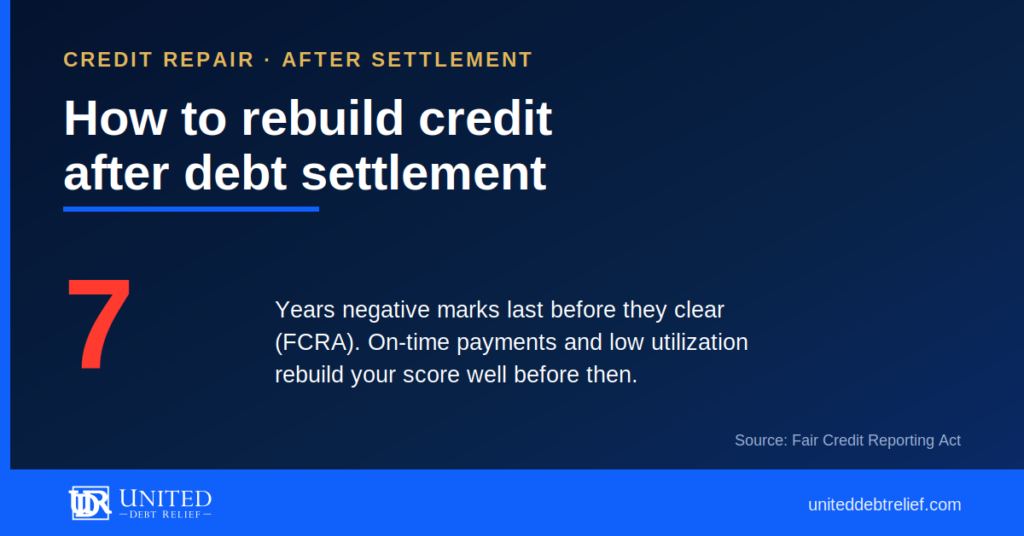
Quick answer: Rebuilding after debt settlement takes roughly 12 to 24 months of consistent effort, and it works by adding positive history on top of negative marks you cannot remove. On-time payments and low utilization do most of the work. Settling does not restart the seven-year reporting clock, so the negative history ages off from the original delinquency date, not from your settlement date.
Where does your credit stand after debt settlement?
Where your credit stands after debt settlement starts with the reports themselves, so read them before you change a single habit. Before rebuilding, get an accurate picture. Pull your credit reports from all three bureaus, you’re entitled to free copies, and confirm that every settled account is reported correctly, ideally as “settled” or “paid,” with a zero balance. Errors are common, and an account still showing a balance or wrong status is worth disputing right away.
This baseline matters because rebuilding is about adding positive history on top of an accurate foundation. You can’t fix what you can’t see.
What settlement leaves on your reports
Settlement resolves the underlying debt, but it does leave marks behind:
- A settled for less than the full balance status, which generally remains for about seven years from the original delinquency
- Late payment marks from the pre-settlement period, typically seven years
- Charge-off status on any accounts that charged off before they settled
- Collection account entries if any of the debts went to third-party collectors
When do settlement marks come off your credit reports?
The seven-year FCRA reporting limit decides when settlement marks come off your credit reports, and it runs from the original delinquency date, not from the date you settled. Pull your free reports at annualcreditreport.com and note each negative item’s date of first delinquency. That date is your countdown clock. Reporting dates and dispute timelines can differ by furnisher and by state, so confirm the dates on your own reports before you act on them.
Here is the encouraging part: every month that passes from the original delinquency weakens those negative marks, while every on-time payment you make starting today builds new positive history that compounds.
The dual-track plan: repair and build at the same time
The dual-track plan works because you repair and build at the same time, so old damage ages off your reports while new positive payment history accumulates underneath it. The core idea is simple: do not choose between repairing and building, run both.
Track 1: accuracy disputes under the FCRA
- Dispute inaccurate settlement-mark reporting, such as wrong dates, wrong balances, or duplicate entries
- Dispute outdated items that have passed the seven-year limit
- Dispute unverifiable items, especially older collection accounts
- Track responses, since bureaus generally work on 30 to 45 day investigation windows
- Escalate to the CFPB if a bureau stonewalls a legitimate dispute
Track 2: new positive history
- Open a credit-builder loan or secured credit card within 30 to 60 days of finishing settlement
- Make 100% on-time payments every single month
- Keep utilization on any new revolving account at or below 10%
- Add yourself as an authorized user on a trusted family member’s older, well-managed account
Running both tracks in parallel is what compounds the recovery. The five steps below are how you actually execute them.
Step 1: Make on-time payments your non-negotiable
Making on-time payments your non-negotiable is the highest-impact rebuilding move after settlement, and it costs you nothing extra to start. Payment history is the single largest factor in most credit scores. Going forward, every payment you make on time is a brick in your new credit foundation. Set up autopay or reminders for any remaining obligations, utilities, a phone bill, a car payment, rent if it can be reported. A clean, unbroken streak of on-time payments is the most powerful thing you can build.
Step 2: Use a secured card or credit-builder tool
Using a secured card or credit-builder tool gives you a low-risk way to report fresh positive payment history while your credit recovers. After settlement, you may not immediately qualify for traditional cards, and that’s fine. A secured credit card, backed by a small refundable deposit, lets you demonstrate responsible use. The strategy is simple: charge one small recurring expense, pay it in full every month, and let that positive history report. Over time, responsible use of a secured card can help you qualify for unsecured credit again.
Credit-builder loans work similarly: you make fixed payments that are reported to the bureaus, building history as you go.
Credit-builder loan vs secured card vs UDR’s credit builder trade line
Credit-builder loans, secured cards, and UDR’s credit builder trade line all add new positive history, but they differ in how they work, what they cost, and how quickly they show up on your reports.
| Tool | How it works | Typical cost | Time to score impact |
|---|---|---|---|
| Credit-builder loan | You pay a small fixed amount monthly, the lender holds the funds, and you receive the lump sum at the end | $0 to $15 per month in fees | 6 to 12 months |
| Secured credit card | You place a refundable deposit and your credit limit matches that deposit | $0 to $50 annual fee | 3 to 6 months |
| UDR credit builder trade line | A reported trade line bundled with credit repair, built specifically for post-settlement consumers | Included in the program | 60 to 180 days |
These timeframes are typical ranges, not promises. Results vary by individual credit profile.
Step 3: Keep utilization low
As your available credit returns, keep your credit utilization ratio low, generally under 30%, and lower is better. Charging a small amount and paying it off keeps utilization minimal while still showing activity. This is one of the fastest-moving factors, so it rewards discipline quickly.
Step 4: Be patient with new credit and inquiries
Being patient with new credit and inquiries protects the progress you are making, because applications you do not need can set your score back. It’s tempting to apply for several cards to rebuild faster, but each application triggers a hard inquiry and can ding your score temporarily. Space out applications, and only apply for credit you have a good chance of getting. Rebuilding is a marathon of consistency, not a sprint of applications.
Step 5: Let time do its work
Negative marks carry less weight as they age, and positive history accumulates month over month. The combination, old negatives fading, new positives building, is what drives recovery. Many people see their scores climb steadily over 12 to 24 months of consistent habits, though the exact pace depends on your full credit profile. Results vary.
A realistic 12-month trajectory: 580 to 680
The trajectory from 580 to 680 moves in stages, with small early gains and the largest cumulative jump landing between months six and twelve.
- Month 0: 540 to 600
- Month 3: +20 to 40 points (560 to 640)
- Month 6: +30 to 60 cumulative (570 to 660)
- Month 12: +60 to 100 cumulative (600 to 700)
- Month 18 to 24: 650 to 720 typical
580 to 680 in 12 to 24 months is a realistic target for someone running both tracks consistently. These are observed ranges across credit profiles, not a guaranteed outcome, and results vary.
Common mistakes that delay the rebuild
The common mistakes that delay the rebuild share one root cause: moving too fast on new credit, or disputing items that are actually accurate.
- Opening too many new credit lines too fast. Limit yourself to one or two new accounts in the first six months.
- Closing old paid-off accounts. Account age works in your favor, so keep them open.
- Maxing out a new secured card. Utilization above 30% on a secured card actively works against the rebuild.
- Ignoring authorized-user opportunities. A trusted family member’s older account can add history you cannot build any other way.
- Disputing accurate items frivolously. Disputes are for inaccurate items only, and scattershot disputes waste your time and credibility with the bureaus.
Watch out for “credit repair” promises
Be cautious of anyone promising to instantly “delete” accurate negative items or guarantee a specific score jump. Legitimate credit work focuses on disputing genuine errors, which you have the right to do under the Fair Credit Reporting Act, and building positive history. No one can legally erase accurate, timely information, and anyone claiming otherwise is a red flag.
How United Debt Relief helps
Rebuilding doesn’t have to be guesswork. United Debt Relief is a nationwide debt relief company serving all 50 states: through a free consultation, we enroll you with stringently vetted, BBB Accredited, A-rated specialists in our Credit Repair & Builder program who help with both legitimate error disputes and a structured rebuilding plan. We don’t promise a specific number, no one honestly can, but we can help you build the right habits in the right order.
Frequently asked questions
How long does it take to rebuild credit after settlement?
It varies by individual. Many people see steady improvement over 12 to 24 months of on-time payments, low utilization, and responsible new credit. Results vary.
Will settled accounts stay on my report forever?
No. Negative information generally ages off your report over time, and its impact lessens as it gets older and as you add positive history.
Should I get a secured card right after settling?
For many people, yes, it’s one of the most effective rebuilding tools. Use it for one small recurring charge and pay it in full each month.
When do “settled for less than the full balance” marks come off?
Generally seven years from the original delinquency date, not from the date you settled. Check the date of first delinquency listed on each report.
Should I open new credit immediately after settlement?
Within 30 to 60 days, yes, but limit yourself to one or two new accounts. Opening several at once sets the rebuild back.
What is a credit builder trade line?
It is a reported account designed to add positive payment history to your credit file. UDR’s is bundled into the Credit Repair and Builder program.
How long does 580 to 680 realistically take?
Typically 12 to 24 months for consumers running accuracy disputes and new positive history at the same time. Results vary.
Should I dispute the settlement marks themselves?
Only if they are inaccurate, meaning a wrong date, a wrong amount, or a duplicate entry. Disputing accurate marks rarely succeeds and uses up time you could spend building.
Start your next chapter
Settling your debt was the hard part. Rebuilding is the rewarding part, and you don’t have to do it alone. Get your free consultation and we’ll help you build a plan to move forward. Results vary by individual circumstances.