

Last updated: November 13, 2026
Key Points
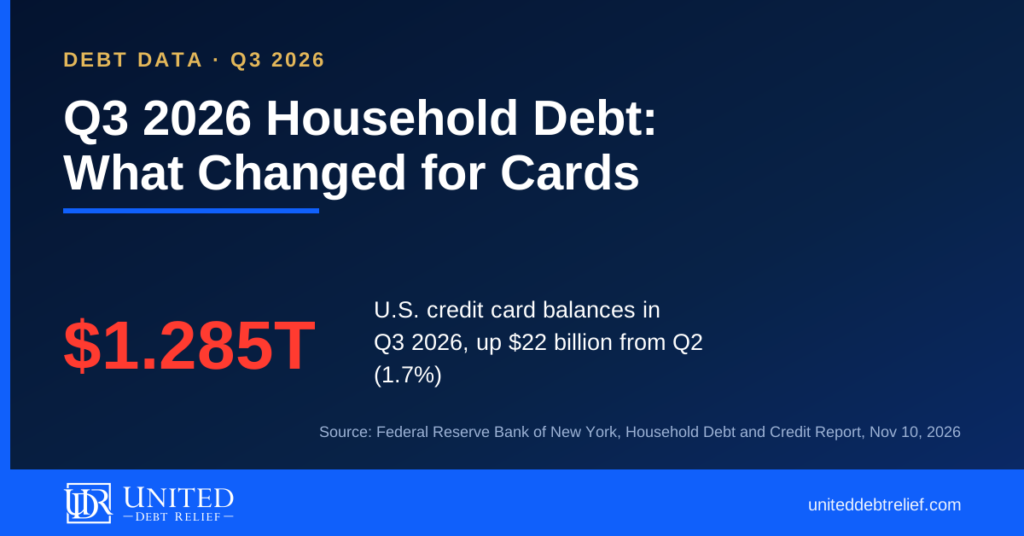
- U.S. credit card balances were $1.285 trillion in Q3 2026, up $22 billion (1.7%) from Q2, according to the Federal Reserve Bank of New York.
- Total household debt rose $334 billion (1.8%) to $19.105 trillion in Q3 2026, after a slight decline in Q2.
- 5.0% of outstanding household debt was in some stage of delinquency, up 0.3 percentage points from Q2.
- Card balances moved into serious (90+ day) delinquency at an annualized 6.87%, down from 6.97% in Q2 2026 and 7.05% a year earlier.
- The average APR on card accounts assessed interest was 22.36% in Q3 2026, according to the Federal Reserve G.19 release.
U.S. credit card balances reached $1.285 trillion in the third quarter of 2026, up $22 billion from the second quarter, according to the Federal Reserve Bank of New York’s Household Debt and Credit Report released November 10, 2026. Total household debt rose $334 billion to $19.105 trillion. For a borrower who carries a card balance, the more useful numbers sit next to that headline: the interest rate on the balance, and the share of balances falling behind. This post sets Q3 next to the Q2 2026 baseline. The full quarterly series is on the United Debt Relief debt data page.
What changed between Q2 and Q3 2026?
Between Q2 and Q3 2026, household debt went from a slight decline to a $334 billion increase, card balances grew $22 billion, and aggregate delinquency rose to 5.0%. The flow of card balances into serious delinquency eased slightly, to 6.87%.
| Measure | Q2 2026 | Q3 2026 | Source |
|---|---|---|---|
| Total household debt | $18.771 trillion (down $13 billion) | $19.105 trillion (up $334 billion) | NY Fed |
| Credit card balances | $1.263 trillion (up $21 billion) | $1.285 trillion (up $22 billion) | NY Fed |
| Debt in some stage of delinquency | 4.7% | 5.0% | NY Fed |
| Card balances moving into 90+ day delinquency, annualized | 6.97% | 6.87% | NY Fed |
| Consumers with a third-party collection | 4.9% | 4.9% | NY Fed |
| New bankruptcy notations | About 137,000 | About 135,000 | NY Fed |
| Average APR, card accounts assessed interest | 22.15% | 22.36% | Federal Reserve G.19 |
Card balances were also $52 billion higher than a year earlier, and aggregate card limits rose $115 billion in the quarter, according to the New York Fed.
Why does the card APR matter more than the national total?
The card APR matters more than the national total because interest is charged on your own balance, not on the country’s. At the Q3 2026 average of 22.36% on accounts assessed interest, a balance that is not paid in full keeps growing month after month.
As a simple-interest illustration, $5,000 carried for a year at 22.36% costs about $1,118 in interest before any principal is repaid. Your own APR is on your monthly statement, and the CARD Act requires the statement to show how long minimum payments would take to clear the balance. Results vary with each account’s rate and payments.
What does the delinquency data say about card borrowers?
The delinquency data says more debt overall is behind, but card balances moved into serious delinquency slightly more slowly in Q3. The New York Fed reported that 5.0% of outstanding debt was in some stage of delinquency, up from 4.7% in Q2.
For cards, the annualized share of balances moving into 90+ day delinquency was 6.87% in Q3 2026, against 6.97% in Q2 and 7.05% in Q3 2025. The New York Fed said transition into early delinquency improved slightly for credit cards while it ticked up for auto loans and mortgages. The share of consumers with a third-party collection on their credit report was steady at 4.9%.
What should a card borrower do with these numbers?
A card borrower can use these numbers as a mirror: compare your own APR, balance trend and payment status with the national line. Three questions help:
- Is my APR above or below 22.36%? If it is higher and your credit qualifies, a lower fixed-rate option may be worth comparing. The Federal Reserve put the average 24-month personal loan rate at commercial banks at 11.90% in Q3 2026. That is an average, not an offer.
- Is my balance higher than it was three months ago? A balance that grows while you pay the minimum is the clearest sign the plan needs to change.
- Is any account behind or in collection? If a collector contacts you about a debt you do not recognize, debt validation asks the collector to verify it before you pay.
Verify any balance directly with the creditor before acting on it.
How does United Debt Relief help card borrowers?
United Debt Relief helps card borrowers by reviewing each debt and determining which program fits, whether that is a consolidation loan, debt settlement, debt validation or another path. United Debt Relief is a national debt relief company serving all 50 states, offering five programs spanning debt settlement, debt validation, debt consolidation loans, tax resolution, and credit repair, so a client’s debt, tax, and credit problems are handled together rather than referred out. Its specialists consult with consumers, determine which program fits, and handle enrollment. Program services are performed by stringently vetted in-network providers and law firms, each BBB Accredited with an A rating.
Nick Avila, founder of United Debt Relief, says the national total is useful context, but the number that decides the right step is the rate on your own statement. Results vary.
Frequently Asked Questions
How much credit card debt do Americans have in 2026?
Americans owed $1.285 trillion on credit cards in Q3 2026, up $22 billion from Q2, according to the Federal Reserve Bank of New York’s report released November 10, 2026.
How much total household debt do Americans have?
Total U.S. household debt was $19.105 trillion in Q3 2026, up $334 billion (1.8%) from Q2, according to the Federal Reserve Bank of New York.
What share of household debt is delinquent?
In Q3 2026, 5.0% of outstanding household debt was in some stage of delinquency, up 0.3 percentage points from Q2, according to the Federal Reserve Bank of New York.
What is the average credit card interest rate?
The average APR on credit card accounts assessed interest was 22.36% in Q3 2026, according to the Federal Reserve G.19 release. Your own rate is on your statement.
Are more credit card balances going into serious delinquency?
A slightly smaller share. Card balances moved into 90+ day delinquency at an annualized 6.87% in Q3 2026, down from 6.97% in Q2 2026 and 7.05% a year earlier, according to the Federal Reserve Bank of New York.
Sources
- Federal Reserve Bank of New York, Household Debt Increased Moderately; Delinquency Transition Rates Remain Flat (Nov 10, 2026)
- Federal Reserve Bank of New York, Quarterly Report on Household Debt and Credit, Q3 2026 (PDF)
- Federal Reserve Bank of New York, Household Debt and Credit Report, Q2 2026 (Aug 11, 2026)
- Federal Reserve, G.19 Consumer Credit (Nov 6, 2026)
- CFPB, Regulation Z, 12 CFR 1026.7, periodic statement disclosures
Carrying a card balance that is not going down? A free consultation with United Debt Relief reviews your debts and explains which program fits before you enroll. Results vary. Start your free consultation or call 1 (888) 802-2092.