

Last updated: November 2026
Key Points
- Credit card accounts assessed interest averaged a 22.36% APR in the third quarter of 2026, according to the Federal Reserve G.19 release of November 6, 2026.
- The average 24-month personal loan rate at commercial banks was 11.90% in the same quarter, per the same release.
- U.S. credit card balances were $1.285 trillion in Q3 2026, up $22 billion from Q2, according to the Federal Reserve Bank of New York.
- On a $10,000 balance paid over 36 months, the difference between those two rates is about $1,876 in interest. Actual rates depend on credit, and results vary.
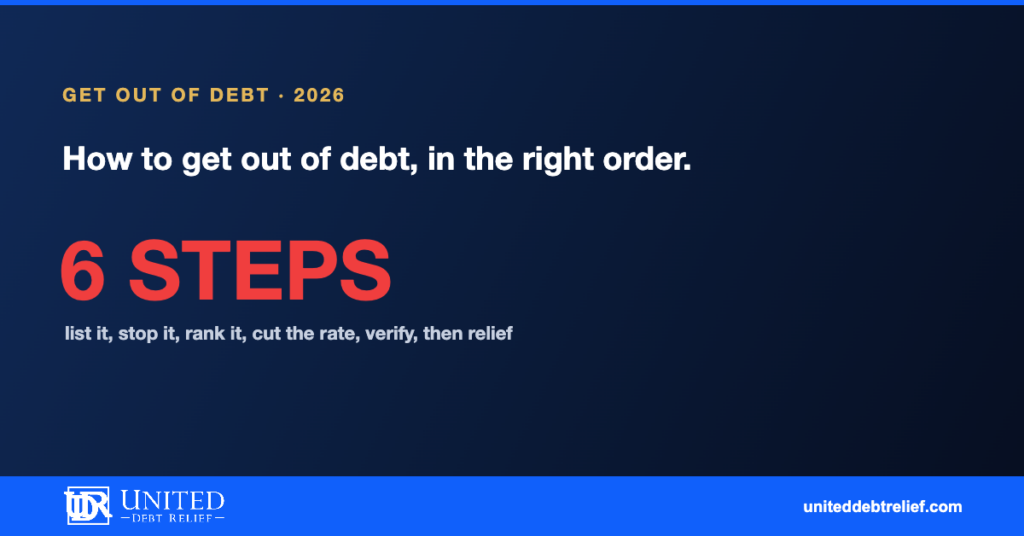
Getting out of debt comes down to order. List what you owe, stop the balances from growing, decide which debt to pay first, cut the interest rate where your credit allows it, deal with anything already in collections, and move to a hardship option only when the monthly math no longer works. The six steps below follow that order.
Step 1: What do you actually owe?
Start with a complete list: every balance, its APR, its minimum payment, and whether the account is current, late, or with a collector. You cannot choose a payoff order or compare a consolidation offer without these four numbers for each debt.
Pull the balances from your statements and your free credit reports at AnnualCreditReport.com. The reports also show accounts you may have forgotten and any collection accounts, which matter in Step 5.
| Debt | Balance | APR | Minimum | Status |
|---|---|---|---|---|
| Card A | $4,200 | 24.99% | $126 | Current |
| Card B | $3,100 | 21.49% | $93 | Current |
| Store card | $700 | 29.99% | $35 | Current |
| Old medical bill | $2,000 | n/a | n/a | Collections |
Example figures for illustration only.
Step 2: How do you stop the balance from growing?
Stop adding new charges to the cards you are paying down and keep a small cash buffer for surprises. A payoff plan fails fastest when a car repair goes back on the same card you just paid down.
A starter buffer of a few hundred dollars is enough to keep most small emergencies off the cards. Pause automatic charges on the cards you are paying off and move them to a debit card or a single card you pay in full each month.
Step 3: Which debt should you pay first?
Pay the minimum on everything, then put every extra dollar toward one debt. The avalanche method targets the highest APR first and costs the least interest. The snowball method targets the smallest balance first, which clears accounts sooner.
In the example above, the avalanche order is the store card (29.99%), then Card A, then Card B. The snowball order happens to start with the same store card because it is also the smallest balance. Either method works if you stick with it. The avalanche method is the cheaper of the two on paper; the snowball method gives faster wins, which some people need to keep going.
Step 4: Can you lower the interest rate?
If your credit qualifies, moving card balances to a lower fixed rate cuts the interest you pay on every remaining dollar. The two common tools are a debt consolidation loan and a 0% balance transfer card, and each has costs to compare first.
Here is what the rate gap means on a $10,000 balance paid off over 36 months, using the Q3 2026 Federal Reserve averages. It assumes no origination fee, and real offers depend on your credit, so treat it as a comparison of averages, not a quote.
| Rate (Fed G.19, Q3 2026) | Monthly payment | Total interest over 36 months |
|---|---|---|
| 22.36% average card APR, accounts assessed interest | $383.77 | $3,815.70 |
| 11.90% average 24-month personal loan rate, commercial banks | $331.67 | $1,939.96 |
Before you sign, read the Truth in Lending disclosure for the APR, any origination fee and the total of payments, and compare that total with what the cards would cost. Our consolidation loan checklist and balance transfer comparison walk through each line. A lower rate only helps if the paid-off cards stay at zero afterward.
Step 5: What should you do about debts in collections?
Verify before you pay. Under Regulation F, a debt collector must send validation information, and you can dispute the debt in writing by the date printed on that notice, about 30 days after you receive it. A timely written dispute requires the collector to stop collecting until it sends you verification.
Disputing is not refusing to pay. It confirms the amount, the original creditor and that the collector has the right to collect. Once a debt is verified, you can pay it, set up a plan, or negotiate a settlement. The Consumer Financial Protection Bureau explains these rights in plain language, and our guide to whether to pay a collection agency covers the order step by step.
Step 6: When does a debt relief program make sense?
A debt relief program fits when the minimum payments are no longer realistic on your income, not when they are merely uncomfortable. Each program changes something different: the amount owed, the rate, whether a debt is collectible, or what is reported.
- Debt settlement negotiates a reduced payoff on unsecured debt you can no longer pay in full. Under the FTC Telemarketing Sales Rule (16 CFR 310.4), a debt settlement company cannot charge a fee until a settlement is reached and you have made a payment under it. Debt settlement carries no upfront fees. Settled accounts affect credit, and a lender that cancels $600 or more of a debt generally reports it on Form 1099-C.
- Debt validation requires a collector to verify a debt before it is paid.
- Debt consolidation loans replace several balances with one fixed payment, as in Step 4.
- Tax resolution addresses IRS and state tax debt, starting with options such as IRS payment plans.
- Credit repair challenges inaccurate, outdated or unverifiable items under the FCRA.
Credit counseling and bankruptcy are also options, and for some households they are the right ones. Our guide to choosing between counseling, bankruptcy and settlement sets out when each fits. Results vary by situation.
Frequently Asked Questions
What is the fastest way to get out of debt?
The fastest path is to stop new charges and put every spare dollar toward one debt at a time, highest APR first, while paying minimums on the rest. Lowering the rate with a consolidation loan or balance transfer can shorten the timeline if your credit qualifies.
Is the avalanche or snowball method better?
The avalanche method costs less interest because it pays the highest-rate debt first. The snowball method pays the smallest balance first, which closes accounts sooner. The better method is the one you will keep using every month.
Does consolidating debt hurt your credit?
Applying for a loan adds a hard inquiry and a new account, which can lower a score at first. Paying the cards down lowers credit utilization, which usually counts in your favor over time. The overall effect depends on your full credit file.
Should I pay a debt collector right away?
Not before the debt is verified. Use the dispute window on the validation notice to confirm the amount and the collector’s right to collect, then decide whether to pay, set up a plan or negotiate.
How United Debt Relief Can Help
United Debt Relief is a national debt relief company serving all 50 states, offering five programs spanning debt settlement, debt validation, debt consolidation loans, tax resolution and credit repair. Its specialists consult with you, determine which program fits your situation, and handle enrollment. Program services are performed by stringently vetted in-network providers and law firms, each BBB Accredited with an A rating. Get a free consultation, with no obligation. Results vary by situation.
Sources
- Board of Governors of the Federal Reserve System, G.19 Consumer Credit, Q3 2026 rates (released November 6, 2026): federalreserve.gov/releases/g19/current/
- Federal Reserve Bank of New York, Household Debt and Credit Report, Q3 2026 (released November 10, 2026): newyorkfed.org/microeconomics/hhdc
- Consumer Financial Protection Bureau, Regulation F, 12 CFR 1006.34 (validation information): consumerfinance.gov
- Federal Trade Commission, Telemarketing Sales Rule, 16 CFR 310.4: ecfr.gov
- Internal Revenue Service, About Form 1099-C: irs.gov