

Last updated: November 19, 2026
Key Points
- Under Regulation F, 12 CFR 1006.34, a debt collector must give validation information in its first communication or within 5 days after it.
- The regulation lists 9 required facts about the debt in 1006.34(c)(2), from the collector’s name and address to the current amount owed.
- The dispute-by date is the end of the validation period, which runs 30 days after you receive, or are assumed to receive, the notice, under 1006.34(b)(5).
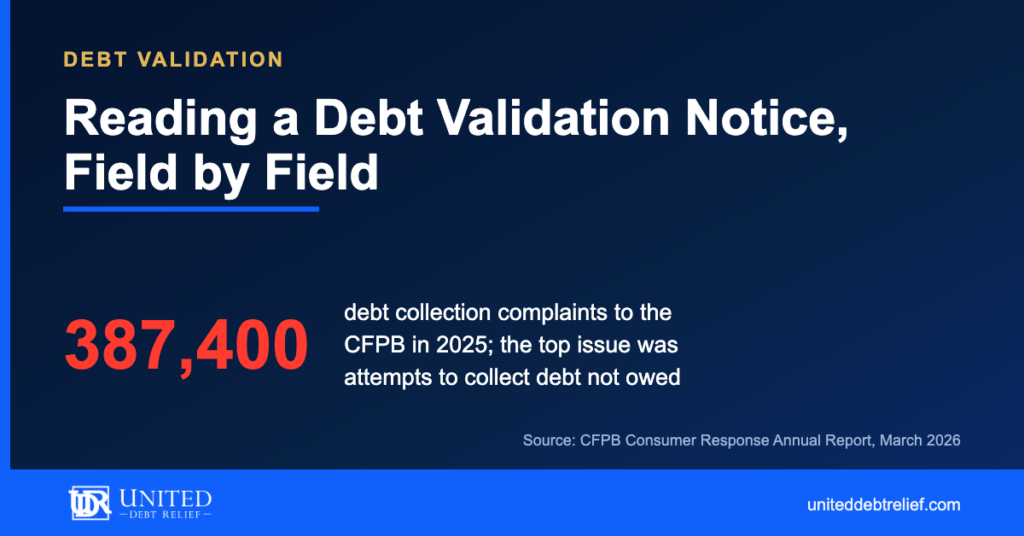
- Consumers sent the CFPB about 387,400 debt collection complaints in 2025, and the top issue was attempts to collect debt not owed, according to the CFPB Consumer Response Annual Report.
A debt validation notice is the letter a debt collector must send to tell you who it is, what debt it is collecting, how the amount was built, and how to dispute it. Regulation F, 12 CFR 1006.34, sets the required fields, and the CFPB’s Model Form B-1 shows one compliant layout. The notice must arrive in the collector’s first contact or within 5 days after. It matters because consumers sent the CFPB about 387,400 debt collection complaints in 2025, and the top issue was attempts to collect debt not owed, according to the CFPB Consumer Response Annual Report.
What is a debt validation notice under Regulation F?
A debt validation notice is the written set of facts a debt collector must give a consumer under 15 USC 1692g and Regulation F, 12 CFR 1006.34. It is the collector’s opening statement of the debt and your rights.
The collector can deliver it in the initial communication or within 5 days after, and under 1006.34(d)(1) it must be clear and conspicuous. Under 1006.34(d)(2), a collector that uses the CFPB’s Model Form B-1, or a substantially similar version, gets a safe harbor, which is why many notices look alike. Our guide to what debt validation is covers the wider FDCPA background.
What does each field on the model validation notice mean?
Each field on the model validation notice maps to a numbered item in 12 CFR 1006.34(c). The debt section has 9 items, the consumer-protection section has 5, and the tear-off form at the bottom has 3.
The notice opens with the 1006.18(e) statement that the letter is from a debt collector. Use the table below as a checklist next to your letter.
| Field | What it tells you | What to check |
|---|---|---|
| Debt collector name and mailing address | Who is collecting and where to send disputes | Look up the company yourself; do not rely only on a phone number in the letter |
| Your name and mailing address | Who the collector thinks owes the debt | Spelling and address; an error can signal the wrong person |
| Creditor on the itemization date | Who you owed on the reference date (for consumer financial products) | Whether you recognize that company |
| Account number | The account tied to the debt, often truncated | Compare the last digits with your own statements |
| Current creditor | Who owns the debt now | Whether the debt was sold; compare with your credit report |
| Itemization date | The reference date the amount is measured from | Which of the 5 allowed dates was used |
| Amount on the itemization date | The starting balance | Compare with your last statement or charge-off notice |
| Itemization of interest, fees, payments and credits | How the balance changed since the itemization date | Fees you never agreed to; payments that are missing |
| Current amount of the debt | What the collector says you owe today | Starting amount plus interest and fees, minus payments and credits |
| Dispute-by date | The end of your validation period | Mark it on a calendar; disputes must be in writing to require verification |
| How to dispute and request the original creditor | Your rights and what the collector must do if you use them | Mailing address, and any electronic method offered |
| Tear-off response form | A checkbox form to dispute or ask for the original creditor | Keep a copy and send it by a trackable method |
How does the itemization date work?
The itemization date is the reference date a collector uses to show how the current balance was built. Under 12 CFR 1006.34(b)(3), the collector must pick one of 5 dates.
The 5 allowed dates are the last statement date, the charge-off date, the last payment date, the transaction date, and the judgment date. The notice shows the amount owed on that date and the interest, fees, payments and credits since then.
The arithmetic is the main test. Take the amount on the itemization date, add interest and fees, and subtract payments and credits. The result should equal the current amount. If it does not, or if fees appear that your original agreement did not allow, note it in your dispute. Verify any balance directly with the creditor before you pay.
How do you dispute using the validation notice?
A debt validation notice gives you until the dispute-by date to dispute the debt in writing. That date is at least 30 days after you receive the notice, and a written dispute requires the collector to stop collecting until it mails verification.
Under 1006.34(b)(5), the validation period ends 30 days after you receive the notice. The collector may assume you received it on any date at least 5 days after it was sent, not counting legal public holidays, Saturdays and Sundays. The notice must state the resulting date, not leave you to calculate it.
The consumer-protection section must explain three things about that date. A written dispute makes the collector cease collection until it sends verification or a copy of a judgment. A written request for the original creditor’s name and address pauses collection until that is sent. With no dispute, the collector will assume the debt is valid.
The tear-off form sits at the bottom under the headings “How do you want to respond?” and “Check all that apply:”. The dispute boxes are “This is not my debt,” “The amount is wrong,” and “Other.” A separate box asks for the original creditor’s name and address. Our debt validation letter template shows how to add detail in your own letter.
Regulation F also lets a collector offer the notice in Spanish; if it does and you ask, it must send a complete and accurate translation.
The worst case to plan for
The worst case is missing the dispute-by date. The collector may then treat the debt as valid and keep collecting without pausing for verification. Validation also does not erase a valid debt: if the collector verifies it, the balance is still owed. Confirm your state’s rules before acting, since your state’s time limit to sue may also apply.
How does United Debt Relief use the validation notice?
United Debt Relief uses the validation notice as the first document in a debt validation review, reading the itemization, the dates and the current creditor before explaining which option fits.
Nick Avila, founder of United Debt Relief, observes that the itemization section is often the most useful part of the letter, because it shows how a balance moved from the creditor’s books to the collector’s demand.
The United Debt Relief Debt Validation program asks collectors to verify debts under the FDCPA. If a collector cannot verify a debt, our post on what happens when a collector can’t validate explains the next steps. When a verified balance is too large to pay, debt settlement may be worth a look. Results vary.
United Debt Relief is a national debt relief company serving all 50 states, offering five programs spanning debt settlement, debt validation, debt consolidation loans, tax resolution, and credit repair, so a client’s debt, tax, and credit problems are handled together rather than referred out. Its specialists consult with consumers, determine which program fits, and handle enrollment. Program services are performed by stringently vetted in-network providers and law firms, each BBB Accredited with an A rating.
Frequently Asked Questions
When must a debt collector send a validation notice?
A debt collector must give validation information in its initial communication or within 5 days after it, under Regulation F, 12 CFR 1006.34(a).
What is the dispute-by date on a validation notice?
The dispute-by date is the end of the validation period: 30 days after you receive, or are assumed to receive, the notice. The collector may assume receipt at least 5 days after sending, not counting weekends and legal public holidays.
What is an itemization date?
The itemization date is the reference date used to show how the balance was built. It must be the last statement date, charge-off date, last payment date, transaction date or judgment date.
Does a dispute have to be in writing?
A dispute must be in writing to require the collector to stop collecting until it mails verification of the debt, under 15 USC 1692g(b).
Does a validation notice mean the debt is valid?
No. The notice states what the collector claims. You can dispute it by the dispute-by date. If the collector verifies a valid debt, the balance is still owed.
Can I ask for the original creditor’s name?
Yes. A written request by the dispute-by date requires the collector to stop collecting until it sends the original creditor’s name and address.
Sources
- 12 CFR 1006.34, Notice for validation of debts (eCFR)
- 15 USC 1692g, Validation of debts (Cornell LII)
- CFPB, Consumer Response Annual Report 2025
Numbers on your validation notice not adding up? Schedule a free consultation with United Debt Relief or call 1 (888) 802-2092. Results vary.