

Last updated: November 22, 2026
Key Points
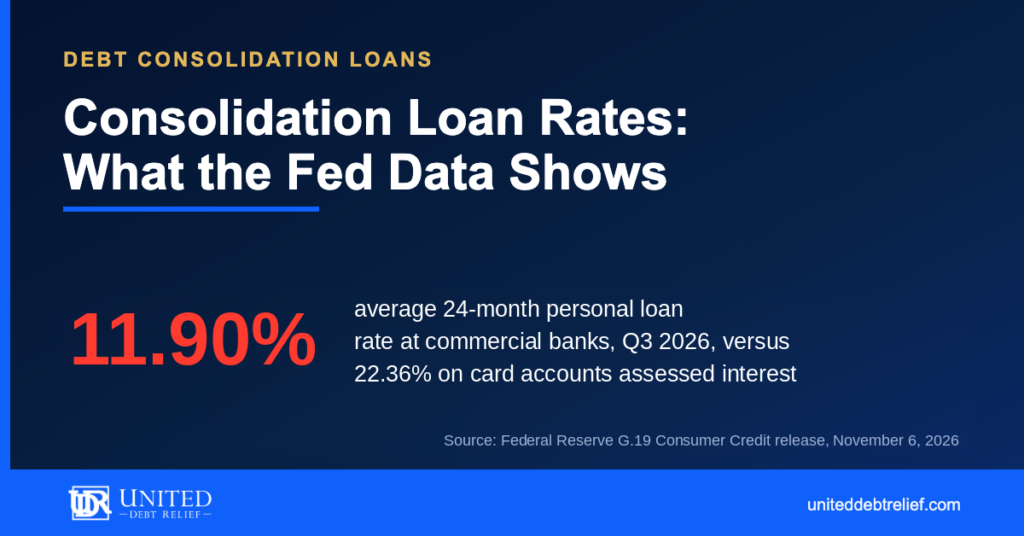
- The average 24-month personal loan rate at commercial banks was 11.90% in the third quarter of 2026, up from 11.86% in the second quarter, according to the Federal Reserve G.19 release.
- The average credit card APR on accounts assessed interest was 22.36% in the third quarter of 2026, according to the same Federal Reserve G.19 release.
- In an illustrative example, $15,000 repaid over 24 months costs about $3,740.20 in interest at 22.36% and about $1,929.64 at 11.90%, using a standard amortization formula.
- Card issuers charged $160 billion in interest in 2024, according to the CFPB credit card market report.
- 45% of credit card owners carried a balance at least once in the prior 12 months, according to the Federal Reserve SHED survey.
Debt consolidation loan rates in 2026 start from a simple benchmark: the Federal Reserve’s average 24-month personal loan rate at commercial banks was 11.90% in the third quarter of 2026, according to the G.19 Consumer Credit release. The same release put the average card APR on accounts assessed interest at 22.36%. That gap is why consolidation can lower interest cost for some borrowers. Both figures are averages, not offers. A lender sets your rate from your own credit, income and debt, and results vary.
What are debt consolidation loan rates in 2026?
Debt consolidation loan rates in 2026 have no single official average; the closest Federal Reserve benchmark, the G.19 average for 24-month personal loans at commercial banks, was 11.90% in the third quarter. That figure was 11.86% in the second quarter of 2026.
A debt consolidation loan is usually an unsecured personal loan used to pay off several balances, so the G.19 personal loan series is the closest public benchmark. The table shows the Federal Reserve figures side by side.
| Federal Reserve G.19 measure | Period | Value |
|---|---|---|
| 24-month personal loan rate, commercial banks | Q2 2026 | 11.86% |
| 24-month personal loan rate, commercial banks | Q3 2026 | 11.90% |
| Credit card APR, accounts assessed interest | Q3 2026 | 22.36% |
| Credit card APR, all accounts | Q3 2026 | 21.19% |
| Revolving credit outstanding | September 2026 (preliminary) | $1,368.5 billion |
These are bank averages for one loan term. Other lenders, longer terms and weaker credit profiles can carry higher rates. Some borrowers are offered a loan APR above their card APR, and then consolidation does not lower interest cost.
What moves the rate a lender offers you?
The rate a lender offers on a debt consolidation loan depends mainly on credit history, income, debt-to-income ratio, loan term and fees. Each lender weighs these factors its own way.
- Credit history. Late payments, collections and high card use usually push a quoted rate up.
- Income. Lenders check that the payment fits your verified income.
- Debt-to-income ratio. This compares monthly debt payments with gross monthly income. A high ratio can raise the rate or lead to a denial.
- Term. Longer terms lower the payment but usually add total interest.
- Fees. An origination fee is often taken out of the loan amount, which is why the APR can sit above the interest rate.
The Truth in Lending Act helps here. Under Regulation Z, 12 CFR 1026.18, a lender must disclose the APR, finance charge, amount financed and total of payments before you sign. Compare the APR and total of payments, not only the monthly payment. Our guide to consolidation loans with fair or bad credit covers what lenders check.
How much can a lower rate save? A worked example
A lower rate on a debt consolidation loan can cut total interest, and in this illustration $15,000 over 24 months costs about $1,810.56 less at 11.90% than at 22.36%. Your own numbers will differ.
Assumptions. A $15,000 balance paid in equal monthly payments over 24 months. No new charges and no fees. Rates are the Q3 2026 G.19 averages. The formula is the standard amortization formula: payment = P x r / (1 – (1 + r)^(-n)), where P is the balance, r is the APR divided by 12, and n is the number of months.
| Scenario (illustrative) | Monthly payment | Total paid | Total interest |
|---|---|---|---|
| $15,000 at 22.36% card APR, 24 months | $780.84 | $18,740.20 | $3,740.20 |
| $15,000 at 11.90% loan rate, 24 months | $705.40 | $16,929.64 | $1,929.64 |
| Difference | $75.44 | $1,810.56 | $1,810.56 |
This is an illustration, not a quote. An origination fee, a higher offered rate or a longer term would shrink the gap. Results vary. Verify every figure on the lender’s Truth in Lending disclosure before you sign.
Does checking consolidation loan rates hurt your credit?
Checking debt consolidation loan rates through prequalification usually uses a soft inquiry, which does not affect credit scores. A full application usually triggers a hard inquiry, which can lower a score slightly for a time.
Ask each lender which type of inquiry it uses before you share your information. Gather quotes within a short window so you compare like with like. A new loan also adds a new account and changes your credit mix, so short-term score movement is common. Our post on whether a debt consolidation loan is a good idea has a full checklist.
When is a consolidation loan the wrong tool?
A debt consolidation loan is the wrong tool when the offered APR does not beat your current rates, the payment does not fit your budget, or spending has not changed. Credit card balances stood at $1.285 trillion in Q3 2026, up $22 billion, according to the New York Fed.
- The offered APR is close to your card APR. Fees and a longer term can erase the savings.
- The cards get used again. Paid-off cards with open limits can fill back up.
- The balance can be cleared in a few months. A focused payoff plan may cost less.
- You cannot qualify, or accounts are already behind. Other options, such as debt settlement, carry different trade-offs, including credit damage and possible tax on canceled debt.
A balance transfer card is another route for smaller balances. Our balance transfer or consolidation loan comparison walks through both.
The worst case to plan for
The worst case is taking a consolidation loan, paying off the cards, and then building new card balances on top of the loan payment. That leaves more total debt than before. The CFPB reports that card issuers charged $160 billion in interest in 2024, so a second round of balances is costly. Close or lock cards you do not need, and confirm your budget before acting.
How does United Debt Relief review consolidation loan rates?
United Debt Relief reviews consolidation loan rates by comparing a borrower’s current card APRs and payments against what a loan would cost in total. A specialist explains whether the United Debt Relief Debt Consolidation Loans program fits or another option fits better.
Nick Avila, founder of United Debt Relief, notes that people often compare monthly payments first, while the total of payments on the loan disclosure tells the fuller story.
United Debt Relief is a national debt relief company serving all 50 states, offering five programs spanning debt settlement, debt validation, debt consolidation loans, tax resolution, and credit repair, so a client’s debt, tax, and credit problems are handled together rather than referred out. Its specialists consult with consumers, determine which program fits, and handle enrollment. Program services are performed by stringently vetted in-network providers and law firms, each BBB Accredited with an A rating.
Frequently Asked Questions
What is the average debt consolidation loan rate in 2026?
The Federal Reserve G.19 average 24-month personal loan rate at commercial banks was 11.90% in Q3 2026 and 11.86% in Q2 2026. These are averages, not offers.
How does the loan rate compare with credit card APRs?
The average card APR on accounts assessed interest was 22.36% in Q3 2026, and 21.19% across all accounts, according to the Federal Reserve G.19.
Will checking my rate hurt my credit?
Prequalification usually uses a soft inquiry, which does not affect scores. A full application usually triggers a hard inquiry. Ask each lender which it uses.
What raises the rate a lender offers?
Credit history, income, debt-to-income ratio, loan term and fees all affect the offered rate. An origination fee can push the APR above the interest rate.
How do I compare two consolidation loan offers?
Compare the APR and the total of payments on each Truth in Lending disclosure, not only the monthly payment. Results vary by lender and borrower.
Sources
- Federal Reserve, G.19 Consumer Credit release
- Federal Reserve Bank of New York, Household Debt and Credit Report, Q3 2026
- CFPB, The Consumer Credit Card Market report
- Federal Reserve, Economic Well-Being of U.S. Households in 2025: Credit
- 12 CFR 1026.18, Content of disclosures (eCFR)
Want to see how a consolidation loan compares with what your cards cost today? Schedule a free consultation with United Debt Relief or call 1 (888) 802-2092. Results vary.