

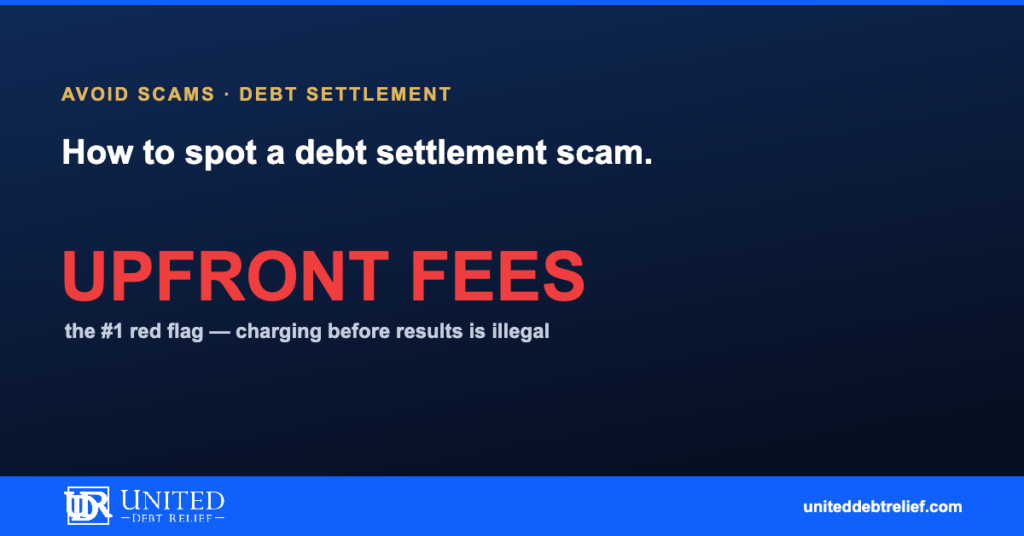
Quick answer: To avoid a debt settlement scam, never pay a fee before a debt is actually settled, the FTC’s Telemarketing Sales Rule bans advance fees. Walk away from anyone who guarantees results, claims a secret government program, or pressures you to enroll on the spot, and verify a company’s accreditation, licensing, and complaint history before sharing any personal information.
The FTC actively pursues debt relief scammers, and in 2025 and 2026, the agency took enforcement action against multiple operations charging illegal upfront fees, making false promises, and impersonating government programs. If you are searching for debt settlement help in 2026, knowing exactly what distinguishes a legitimate debt relief organization from a scam is the most important due diligence you can do before sharing any personal or financial information.
Quick answer: The single clearest sign of a debt settlement scam is a fee charged before any debt is actually settled. Under the FTC’s Telemarketing Sales Rule, a company that enrolls you by phone cannot collect a fee until it has settled at least one debt, you have agreed to the terms, and you have made a payment toward it. Guaranteed results, pressure to stop talking to your creditors, and any mention of a government grant program are the next three red flags.
The seven red flags, at a glance
| Red flag | What a legitimate company does instead |
|---|---|
| Charges a fee before settling anything | Charges only after a debt is settled and you have paid toward it |
| Guarantees a specific result or percentage | Explains that results vary and gives ranges, not promises |
| Claims a special government or grant program | Names the actual programs, all of which are public and free to look up |
| Will not put fees and timelines in writing | Provides written terms before you enroll |
| Pressures you to decide on the call | Gives you the terms and lets you think |
| Tells you to stop all contact with creditors | Explains what to expect from creditors, including lawsuit risk |
| Cannot show accreditation or a verifiable network | Names the provider network and its accreditation |
What Are the Clearest Warning Signs of a Debt Settlement Scam?
The clearest warning signs of a debt settlement scam are fees charged before a settlement is completed, guaranteed results, claimed secret government programs, and high-pressure enrollment tactics.
Are There Upfront Fees Before Any Settlement Is Completed?
Charging upfront fees before any settlement is completed is the most important red flag and the most common violation. The FTC’s Telemarketing Sales Rule explicitly prohibits debt relief companies from charging fees before a debt is actually settled. Any company asking you to pay a monthly fee, an enrollment fee, or any charge before a settlement is completed on your behalf is violating federal law. Legitimate debt settlement programs, including United Debt Relief’s done-for-you network, collect fees only after a settlement is successfully completed and you authorize it. No exceptions.
Guaranteed results or specific percentage promises
No legitimate debt relief company can guarantee results or promise a specific percentage of savings. Settlement results depend on your specific creditors, your account history, your financial situation, and negotiation outcomes, none of which can be predetermined. Any company promising “we will settle your debt for 30 cents on the dollar” or “guaranteed 50% reduction” is making a legally prohibited claim.
Is There a Secret Government Program That Erases Credit Card Debt?
There is no government debt forgiveness program for consumer credit card debt. There is no federal stimulus that eliminates personal debt. Any company claiming access to a special government program to wipe out your debt is lying. Government debt relief programs exist specifically for student loans, IRS obligations, and VA debt, not for private consumer credit card or medical debt.
Pressure to decide immediately
Pressure to decide immediately is a warning sign in itself, because legitimate companies want you to make an informed decision. Scammers use high-pressure tactics because they do not want you to research them. Any company that pressures you to enroll today, that creates artificial urgency, or that discourages you from taking time to research is a red flag.
Asking you to stop communicating with creditors immediately
Being told to stop communicating with creditors immediately is a red flag: some scam companies advise clients to ignore all creditor communication and stop making payments, without enrolling them in any actual program, then collect fees while doing nothing. Legitimate settlement programs communicate transparently about what to expect during the process, including how to handle creditor contact.
How the FTC’s Advance-Fee Ban Protects You
The FTC’s advance-fee ban protects you by making it illegal for a debt relief company to collect any fee until one of your debts has actually been settled. The advance-fee ban took effect on October 27, 2010 as part of the FTC’s Telemarketing Sales Rule, and it remains the brightest line between a legitimate provider and a scam. Under the rule, a for-profit debt relief company that sells its services over the phone cannot collect a fee until three things have happened: it has renegotiated, settled, or otherwise changed the terms of at least one of your debts; there is a written settlement agreement between you and your creditor; and you have made at least one payment toward that settlement. The same rule bars these companies from misrepresenting their services and requires them to disclose key terms up front, how long the program takes, how much it costs, how much money you must save before an offer is made, and the possible consequences of stopping payments to creditors. If a sales pitch conflicts with any of these federal protections, you have your answer.
How to Verify a Legitimate Debt Relief Company
To verify a legitimate debt relief company, check five things before sharing personal information: accreditation, complaint history, fee timing, state licensing, and the written contract.
- Check BBB accreditation: Look up the company at bbb.org. United Debt Relief operates through a BBB-accredited network of providers.
- Verify CFPB and FTC complaint history: Search the company name at consumerfinance.gov and ftc.gov complaint databases.
- Confirm no upfront fees in writing: Ask specifically: “Do you charge any fees before a settlement is completed?” The answer must be no.
- Check state licensing: Debt settlement companies must be licensed in most states. Verify your state’s licensing requirements through your state attorney general’s office.
- Read the contract before signing anything: A legitimate company provides a written agreement before enrollment that clearly states fee structure, program terms, and your right to cancel.
What United Debt Relief’s Legitimate Program Looks Like
United Debt Relief is a national debt relief company serving all 50 states. Our specialists consult with you, determine which program fits your situation, and handle enrollment. The program work itself is performed by in-network certified debt negotiators, attorneys, and financial professionals. Our network operates under these standards: no upfront fees, ever; fees collected only after a settlement is completed and you authorize it; free, no-obligation consultation; full written disclosure of all terms before enrollment; BBB-accredited network of providers; licensed professionals in all 50 states. You can check these details for yourself on our United Debt Relief company facts page, which states the official company name, founding year, the five programs, and service area in one place.
United Debt Relief’s done-for-you Debt Settlement program requires a minimum of $10,000 in unsecured debt and is available to clients across all 50 states. Savings depend on your creditors, your balances, your account history, and negotiation outcomes. Results vary by individual situation.
Here is how the legitimate process actually works. It begins with a free, no-obligation consultation that reviews your total debt and goals and confirms whether settlement, or another debt relief option such as consolidation or credit repair, is the better fit for your situation. Enrolled funds go into a dedicated account that you control; as the balance builds, negotiators work to settle each debt, and a fee is collected only after a settlement is completed and you approve it. Results vary by individual situation, and most programs run roughly two to four years. For context on the scale of the problem scammers exploit, U.S. credit card balances stood at $1.263 trillion in the second quarter of 2026 (Federal Reserve Bank of New York), which is exactly why fraudulent operators target people searching for relief.
Frequently Asked Questions, Avoiding Scams
These answers cover what to do if you have already lost money to a scam, where to report one, and what honest pricing and timelines look like in a legitimate program.
Q: How do I report a debt settlement scam?
Report to the FTC at reportfraud.ftc.gov, the CFPB at consumerfinance.gov/complaint, and your state attorney general’s consumer protection office. If you paid money to a scammer, also contact your bank or credit card company to dispute the charge.
Q: Is debt settlement itself legal?
Yes. Debt settlement is a legal, regulated industry governed by the FTC’s Telemarketing Sales Rule and state-specific licensing requirements. The industry itself is legitimate, the scams arise from specific companies violating federal rules. Choosing an accredited, transparent provider protects you.
Q: What if I already paid upfront fees to a company, what should I do?
Stop making additional payments immediately. Report the company to the FTC and CFPB. Contact your bank to dispute charges where possible. Then consult with a legitimate debt relief organization about your remaining options for addressing the underlying debt.
Q: How much should debt settlement cost?
Fees vary by provider and the amount of debt you enroll, and they must be disclosed in writing before you sign. The rule that protects you: you should owe nothing until a settlement is actually completed and you authorize it.
Q: How long does a debt settlement program take?
Most programs run about two to four years, depending on how much you owe and how quickly you can fund settlements. A legitimate provider gives you a realistic timeline up front instead of promising a fast or guaranteed result.
Work with a legitimate, BBB-accredited network. Call United Debt Relief at 1 (888) 802-2092 or start a free consultation. Debt settlement carries no upfront fees. All 50 states.
For the latest numbers on what Americans owe, credit card balances, average APRs, and delinquency trends, see our regularly updated Debt Data page. Further reading from official sources: the CFPB’s consumer tools and the Federal Reserve’s G.19 consumer credit report.