

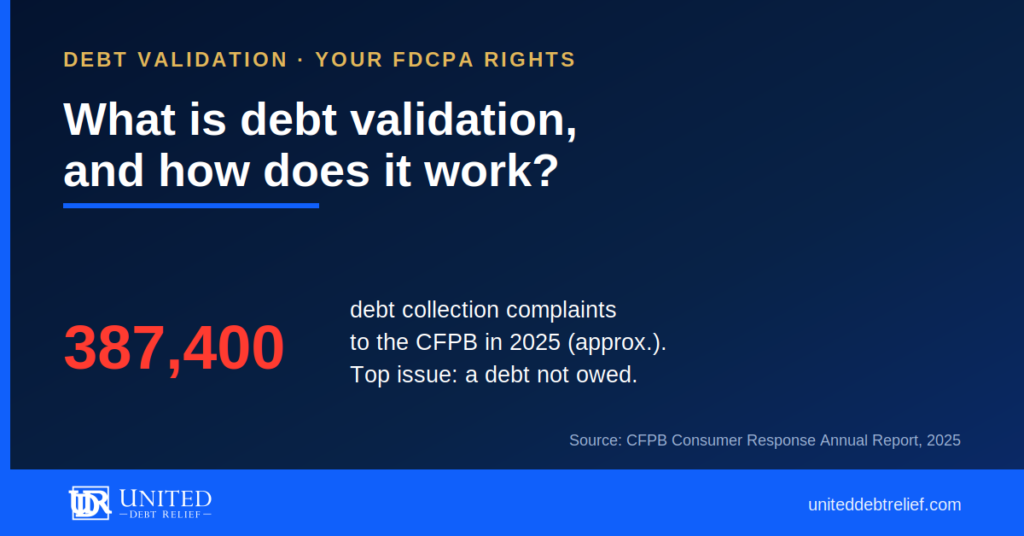
Debt validation is the process under the Fair Debt Collection Practices Act (FDCPA) that requires a third-party debt collector to give a consumer written details of a debt and, if the consumer disputes it in writing within 30 days, to stop collecting until it mails verification. It applies to anyone contacted by a collector about a debt they do not recognize, cannot confirm, or believe is wrong. It matters because the Consumer Financial Protection Bureau received about 387,400 debt collection complaints in 2025, and the most common issue was attempts to collect a debt not owed.
Key Takeaways
- A debt collector must send validation information within 5 days of its first communication, under 15 U.S.C. 1692g(a).
- A consumer has 30 days after receiving that notice to dispute the debt in writing, according to the Federal Trade Commission.
- A written dispute inside that window requires the collector to stop collecting the disputed debt until it mails verification, under 15 U.S.C. 1692g(b).
- Debt validation runs against the collector under the FDCPA, while a credit report dispute runs through the credit bureaus under the Fair Credit Reporting Act (FCRA).
- The CFPB received about 387,400 debt collection complaints in 2025, and attempts to collect a debt not owed was the top issue, according to its 2025 Consumer Response Annual Report.
What Does a Debt Collector Have to Send You?
A debt collector has to send a validation notice either in its first communication or within 5 days after it, under 15 U.S.C. 1692g(a). The Consumer Financial Protection Bureau’s Regulation F (12 CFR 1006.34) sets out what that notice must contain.
- The name of the creditor the debt is currently owed to, and the account number
- For consumer financial debts, the name of the original creditor
- An itemization date and the amount owed on that date
- An itemization of interest, fees, payments and credits since the itemization date
- The current amount of the debt
- The date the validation period ends, and how to dispute the debt or request the original creditor’s name and address
Regulation F defines the validation period as ending 30 days after the consumer receives the notice, and a collector may assume receipt at least 5 business days after sending it. The itemization matters most in practice, because it shows exactly how a balance grew from the itemization date to the amount being demanded now.
How Do You Dispute a Debt and Ask for Verification?
A consumer disputes a debt by writing to the collector at the dispute address on the validation notice before the validation period ends. The Federal Trade Commission advises sending the dispute letter within 30 days and keeping a copy. A debt validation letter is the usual format, and certified mail with a return receipt gives proof of the date it arrived.
Once a written dispute arrives inside the window, the collector must stop collecting the disputed debt, or the disputed portion, until it obtains verification of the debt or a copy of a judgment and mails it to the consumer, under 15 U.S.C. 1692g(b). Not disputing a debt is not an admission of owing it; the statute says a court may not treat a failure to dispute as an admission of liability, under 15 U.S.C. 1692g(c).
What Is the Difference Between Debt Validation and Debt Verification?
Debt validation is the collector’s duty to disclose the debt, debt verification is the collector’s answer to a written dispute, and a credit report dispute is a separate process that runs through the credit bureaus. The three are often used interchangeably, but they are triggered by different events and governed by different laws.
| Step | Who acts | Law | What triggers it | What has to happen |
|---|---|---|---|---|
| Validation notice | The debt collector | FDCPA, 15 U.S.C. 1692g(a); Regulation F | The collector’s first communication | Written details of the debt within 5 days, including the itemization and the end of the validation period |
| Debt verification | The debt collector | FDCPA, 15 U.S.C. 1692g(b) | A written dispute sent inside the validation period | Collection of the disputed debt stops until verification or a copy of a judgment is mailed |
| Credit report dispute | The credit bureau, with the company that reported the item | FCRA, 15 U.S.C. 1681i | A dispute filed with a credit bureau, at any time | A reasonable investigation, generally within 30 days; information that cannot be verified must be deleted or corrected |
The two routes can run side by side. A written dispute to the collector tests whether the collector can support the debt, and a dispute with each credit bureau tests whether the account is being reported accurately. Under 15 U.S.C. 1692e(8), a collector that reports a debt it knows is disputed must report it as disputed.
Why Can Some Collection Accounts Not Be Verified?
Some collection accounts cannot be verified because the debt has changed hands, aged, or grown in ways the current collector cannot document.
- Gaps in the chain of ownership. A debt sold from the original creditor to one or more debt buyers needs records for each transfer, and those records are sometimes incomplete.
- Balances that do not match the itemization. Interest or fees added after the itemization date have to be shown, and an unexplained increase is worth disputing.
- Old debts. Every state sets a statute of limitations on lawsuits over debt. A debt past that limit may still be reported or requested, but a collector generally cannot win a lawsuit over it.
- Outdated reporting. Under the FCRA, 15 U.S.C. 1681c, most negative items can stay on a credit report for no more than 7 years.
What Happens If a Collector Cannot Verify the Debt?
A collector that receives a timely written dispute and cannot verify the debt may not resume collecting it, under 15 U.S.C. 1692g(b). If the same account is disputed with a credit bureau and cannot be verified, the bureau must delete or correct it, under 15 U.S.C. 1681i(a)(5)(A). A collector that breaks these rules can be sued for actual damages, statutory damages of up to $1,000 per action, and attorney’s fees, under 15 U.S.C. 1692k. Outcomes depend on the facts of each account, and results vary.
How Does United Debt Relief Approach a Collection Account?
When a client brings us a collection letter, the first thing we compare is the itemization date and the amount on that date against the client’s own statements. The mistake we see most often is a consumer paying, or promising to pay, before the validation period has run, which gives up the pause that a timely written dispute would have triggered.
United Debt Relief specialists review the notice, explain the consumer’s options, determine whether the Debt Validation program fits, and handle enrollment. Program services are performed by stringently vetted in-network providers and law firms, each BBB Accredited with an A rating. When a debt is verified and owed, Debt Settlement or a Debt Consolidation Loan may be the better next step. Results vary.
Frequently Asked Questions About Debt Validation
What is debt validation?
Debt validation is the process under the Fair Debt Collection Practices Act that requires a debt collector to give a consumer written details of a debt and, if the consumer disputes it in writing within 30 days, to stop collecting until it mails verification of the debt.
Can I request debt validation after 30 days?
Yes. A consumer can dispute a debt at any time, but a written dispute sent inside the validation period is what requires the collector to stop collecting until it mails verification. A later dispute does not trigger that pause, so sending it early gives the strongest protection.
Does sending a debt validation letter hurt my credit score?
No. Sending a debt validation letter is not a credit event and does not by itself change a credit score. If a collector reports a debt it knows is disputed, federal law requires it to report the debt as disputed.
What is the difference between debt validation and debt verification?
Debt validation is the notice a collector must send about a debt. Debt verification is the documentation a collector must mail after a timely written dispute. A credit report dispute is a separate process under the Fair Credit Reporting Act that runs through the credit bureaus.
How is debt validation different from debt settlement?
Debt validation asks whether a debt is accurate and collectible before any payment. Debt settlement negotiates a reduced payoff on a debt that is owed. United Debt Relief offers both programs, and a consultation determines which one fits.
Received a collection letter? Find out whether Debt Validation fits.
Call 1 (888) 802-2092 or visit uniteddebtrelief.com/debt-validation/. Free consultation, no obligation. Results vary.
Sources: FTC, Debt Collection FAQs · CFPB, Regulation F, 12 CFR 1006.34 · CFPB, 2025 Consumer Response Annual Report · FTC, Fair Debt Collection Practices Act · FTC, Fair Credit Reporting Act. For the latest figures on what Americans owe, see our regularly updated Debt Data page.