

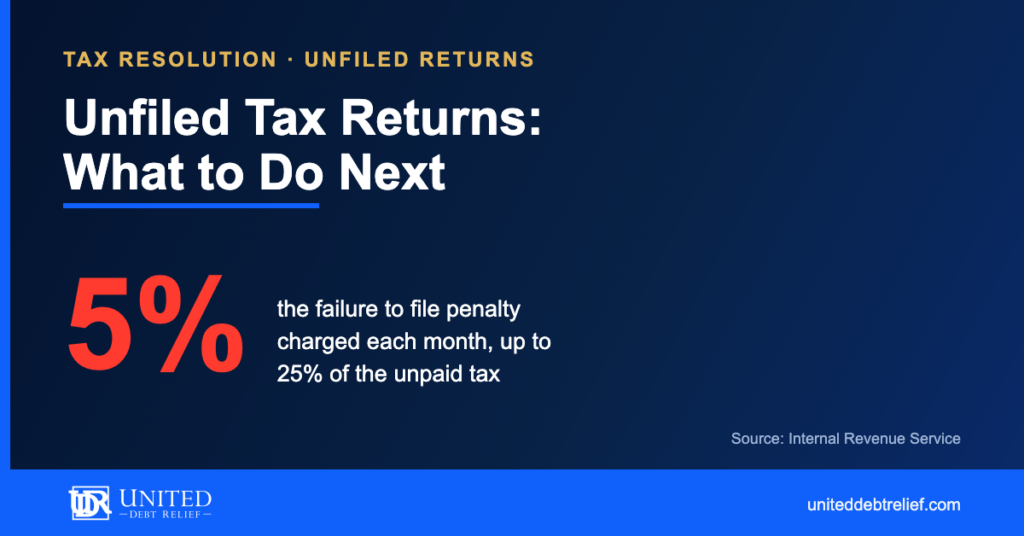
If you have unfiled tax returns, the first move is to file the missing years, because the IRS generally requires filing compliance before it will approve an installment agreement, an Offer in Compromise, or Currently Not Collectible status. The IRS failure-to-file penalty is 5% of the unpaid tax for each month or part of a month a return is late, capped at 25%. You also generally have only three years from the original due date to claim a refund before it is forfeited to the Treasury. Every tax situation differs, so work through your specific years with a licensed tax professional.
By Nick Avila, Founder, United Debt Relief
What the Penalties Actually Cost
Most people assume the penalty for not filing and the penalty for not paying are the same thing. They are not, and the gap between them is the reason filing matters even when you cannot pay.
| IRS penalty | Rate | Maximum |
|---|---|---|
| Failure to file | 5% of unpaid tax per month or part of a month the return is late | 25% of the unpaid tax |
| Failure to pay | 0.5% of unpaid tax per month or part of a month | 25% of the unpaid tax |
| Both applying in the same month | The failure-to-file penalty is reduced by the failure-to-pay penalty, for a combined 5% that month | Each keeps its own 25% cap |
| Minimum penalty, returns over 60 days late | The lesser of an inflation-adjusted dollar amount or 100% of the tax owed | Applies even to small balances |
The failure-to-file penalty runs ten times faster than the failure-to-pay penalty, according to IRS penalty rules. On top of both, interest compounds daily on unpaid tax, and the rate for individual underpayments is set quarterly at the federal short-term rate plus three percentage points. Filing a return you cannot pay stops the larger of the two penalties from accruing.
Before you act: This article is general consumer education, not tax or legal advice. Penalty relief, filing requirements, and criminal exposure all depend on your specific facts. Work with a licensed tax professional, and consult a licensed attorney if you have concerns about anything beyond civil penalties.
What Happens If You Never File: The Substitute for Return
Not filing does not make a tax year disappear. If the IRS has income information reported to it under your Social Security number and no return arrives, it can prepare one for you.
- The IRS can file for you under Internal Revenue Code Section 6020(b). This is called a Substitute for Return, and it is built from third-party information such as W-2s and 1099s.
- A Substitute for Return is rarely in your favor. It generally does not include deductions, credits, or a filing status you might otherwise claim, which means the assessed balance is typically higher than a return you file yourself would show.
- You can still file your own return afterward. Submitting an accurate original return can replace the IRS figures, and in many cases that alone reduces the balance.
- The collection clock does not start until assessment. The IRS generally has 10 years from the date of assessment to collect. An unfiled year has no assessment, which means the clock has not begun running at all. Our guide on whether back taxes expire explains how the collection statute works and what pauses it.
How Many Years Back Do You Have to File
There is no statute of limitations on filing a return that was never filed, but the IRS has a working standard for what it takes to be considered compliant.
- Six years is the usual benchmark. Under IRS Policy Statement 5-133, reflected in the Internal Revenue Manual, enforcement of delinquent return filing generally covers the last six years, though the IRS retains discretion to require more.
- Three years is the refund window. A refund claim generally must be filed within three years of the original due date. After that the refund is forfeited, which is why unfiled years with withholding can cost real money by doing nothing.
- Filing compliance gates everything else. An installment agreement, an Offer in Compromise, and Currently Not Collectible status all generally require you to be current on filing first.
How to Reconstruct Records You No Longer Have
Missing paperwork is the most common reason people stall, and it is the most solvable part of the problem. The IRS already has most of what you need.
- Pull your Wage and Income Transcript. It shows the W-2, 1099, and other information returns reported to the IRS for a given year, which is usually enough to reconstruct a return.
- Use your IRS Individual Online Account. Transcripts, balances, and notices are available there at no cost.
- Request transcripts by form if you prefer. Form 4506-T requests a transcript, and it can be used to obtain wage and income data for prior years.
- Check your Account Transcript for Substitute for Return activity. It will show whether the IRS has already assessed a balance for a year you did not file.
Important: No article can tell you how many years you personally need to file, whether penalty relief applies to you, or what your balance will be. Those answers come from your transcripts and your facts. Have a licensed tax professional review them before you file.
What Becomes Available Once You Are Compliant
Filing is not the finish line. It is the gate. Once you are current, the IRS relief programs open up, and results vary by situation.
- Installment agreement. A structured monthly payment plan that keeps you in good standing and stops enforced collection while it is in place.
- Penalty relief. The IRS offers First Time Abate for taxpayers with a clean prior compliance history, and reasonable cause relief where circumstances support it. Penalty relief can matter even when the underlying tax cannot change.
- Offer in Compromise. Qualifying taxpayers may resolve a balance for less than the full amount owed, based on the IRS Reasonable Collection Potential calculation. The IRS accepts only a portion of the offers it receives each year, and eligibility is determined by the IRS. Our pre-qualifier walkthrough covers the formula.
- Currently Not Collectible status. A temporary designation that pauses collection when paying would prevent you from meeting basic living expenses.
For the full stage-by-stage picture of what the IRS does when a balance goes unaddressed, see IRS back taxes and what happens if you ignore them, and who qualifies for the IRS Fresh Start Program.
Where United Debt Relief Fits
United Debt Relief is a debt relief company that enrolls clients in its own five programs, including Tax Resolution. Licensed tax professionals handle the casework, starting with pulling your transcripts to establish how many years are actually missing and what the IRS has already assessed. The consultation is free, fees are disclosed before you enroll, and results vary by situation. If you are unsure how to evaluate any provider, our guide on how to find a reliable tax resolution specialist covers the credentials to verify first.
Frequently Asked Questions
How many years of unfiled tax returns do I need to file?
Under IRS Policy Statement 5-133, enforcement of delinquent returns generally covers the last six years, though the IRS can require more depending on the facts. There is no deadline that eliminates the obligation to file a return that was never filed. A licensed tax professional can pull your transcripts and confirm which specific years the IRS is looking for.
Can I go to jail for not filing my taxes?
Willful failure to file is a misdemeanor under Internal Revenue Code Section 7203, but the overwhelming majority of non-filers face civil penalties and interest rather than criminal charges. Criminal cases generally involve willful conduct and are a small fraction of enforcement. If you have any concern about criminal exposure, speak with a licensed attorney before filing anything.
What if I do not have my W-2s or 1099s from those years?
The IRS already holds copies of the information returns filed under your Social Security number. Request a Wage and Income Transcript through your IRS Individual Online Account or by filing Form 4506-T, and in most cases that is enough to reconstruct the return accurately.
Will I still get my refund if I file late?
Only if you file within roughly three years of the original due date. A refund claim filed after that window is generally forfeited to the Treasury. This is why unfiled years that had withholding are worth checking quickly rather than eventually.
The IRS already filed a return for me. Can I still file my own?
Yes. A Substitute for Return prepared by the IRS under Section 6020(b) generally does not include deductions or credits you may be entitled to, so filing an accurate original return can replace those figures. In many cases the balance drops as a result, though outcomes vary by situation.
Do I have to file everything before I can get on a payment plan?
The IRS generally requires filing compliance before approving an installment agreement, an Offer in Compromise, or Currently Not Collectible status. Filing the missing years is normally the first step in a resolution plan rather than something handled after.
Should I file even if I cannot pay what I owe?
The failure-to-file penalty accrues at 5% of unpaid tax per month while the failure-to-pay penalty accrues at 0.5%, according to IRS penalty rules. Filing stops the larger penalty from building even when payment is not possible yet, and it is what makes relief programs available.
Your Next Step
If you have unfiled years, the fastest way to learn what the IRS is actually looking for is to pull your transcripts and read them with someone who does this daily. United Debt Relief offers a free consultation, where a specialist reviews your situation, explains the options, and helps you determine the fit. Licensed tax professionals perform the program work, and every in-network provider is Better Business Bureau Accredited with an A rating and is stringently vetted. Results vary by situation, and eligibility for any IRS program is determined by the IRS.