

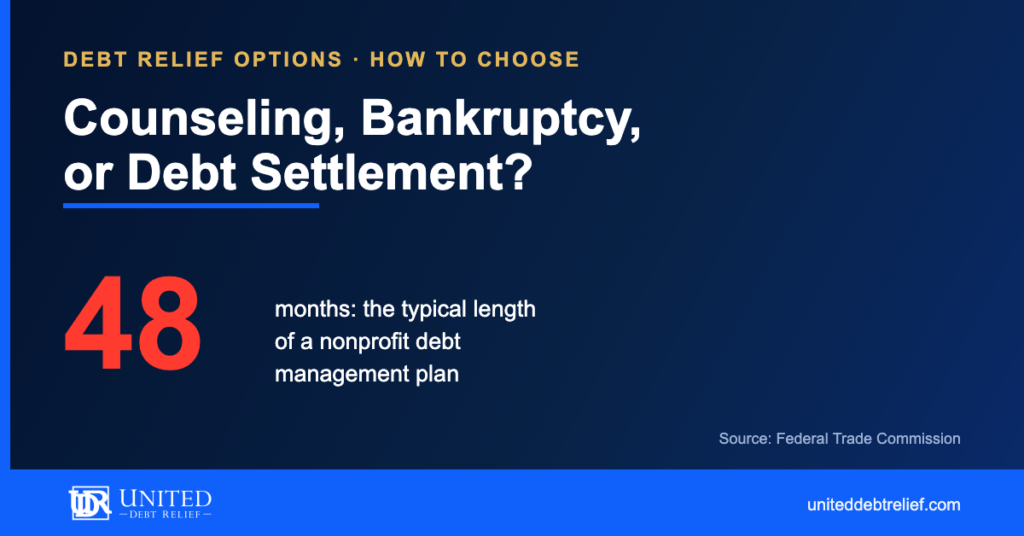
Choosing between debt settlement, a debt consolidation loan, a nonprofit debt management plan, and bankruptcy comes down to one question: can you repay the full balance within about five years on the income you actually have? If yes, budgeting, credit counseling, or a consolidation loan usually fit. If no, settlement or bankruptcy usually fit. The Federal Trade Commission notes that a nonprofit debt management plan commonly takes 48 months or more, so even structured full repayment is a multi-year commitment before you begin. Here is the honest map of debt relief options, including the paths United Debt Relief does not sell.
By Nick Avila, Founder, United Debt Relief
The one question that sorts every debt relief option
The sorting question is whether you can clear the full balance in about five years at your current income. Three numbers frame it.
- The average APR on cards assessed interest is 22.15%, per the Federal Reserve G.19 report for the second quarter of 2026, so minimum payments move little against principal.
- Credit card balances rose $21 billion to $1.263 trillion in the second quarter of 2026, inside $18.771 trillion of household debt, per the Federal Reserve Bank of New York.
- The Federal Trade Commission notes a nonprofit debt management plan commonly takes 48 months or more. If structured full repayment still runs past four years, full repayment may not be your path.
When a nonprofit debt management plan is the better choice
A nonprofit debt management plan is the better choice when you can afford full repayment and need a lower rate plus one structured payment. Generically: a nonprofit credit counseling agency requests concessions from your card issuers, you make one monthly payment, and the agency distributes it. Concessions are usually a lower rate and waived fees, not reduced principal.
- Timeline. The FTC notes these plans commonly run 48 months or more.
- Cost. Agencies typically charge a setup fee plus a monthly fee, and the FTC advises confirming both in writing.
- Credit. Milder than settlement because you keep paying, though enrolled cards are usually closed, which lifts utilization. Amounts owed is roughly 30% of a FICO score.
If that describes you, that path beats anything we sell, and our specialists say so on the call.
When bankruptcy is the better choice
Bankruptcy is the better choice when no repayment plan and no negotiated reduction can realistically clear the debt, or when wage garnishment has started. It is a legal remedy, not a moral verdict.
- Under the Fair Credit Reporting Act a Chapter 7 can stay on your credit report 10 years from the filing date, while a Chapter 13 generally comes off after 7.
- Federal law requires credit counseling from a government-approved agency within 180 days before you file, plus a debtor education course before discharge.
- Debt discharged in bankruptcy is excluded from cancellation-of-debt income under IRS Publication 4681. Settled debt generally is not, a real cost difference.
We do not file bankruptcies. When the numbers point there we say so and suggest a licensed attorney in your state. See when to consider bankruptcy and the alternatives first, and our side-by-side look at debt settlement vs. bankruptcy.
When budgeting on your own is the better choice
Budgeting on your own is the better choice when your accounts are current and the balance is small next to your income. Nobody should pay for help they do not need.
- At the 22.15% average APR on cards assessed interest reported by the Federal Reserve, paying the highest-rate balance first saves the most.
- Card issuers run hardship programs that can cut a rate or pause payments, and asking is free. See credit card hardship programs.
- Payment history is roughly 35% of a FICO score, so staying current is your best move. The CFPB publishes free budgeting and payoff tools at consumerfinance.gov.
When our five programs fit
United Debt Relief runs five programs, so no specialist is forced to sell the only product on the shelf: debt settlement for unsecured balances you cannot repay in full, debt validation for collection accounts that look inaccurate, debt consolidation loans for borrowers whose credit still earns a rate below their cards, tax resolution for IRS or state tax debt that settlement and consolidation cannot touch, and credit repair for inaccurate, unverifiable, or outdated report items. Program services are performed by stringently vetted in-network providers and law firms, each BBB Accredited with an A rating, and under 16 CFR 310.4(a)(5) no settlement fee is charged until an account settles and you pay on it. For the full breakdown of who each program fits and what it costs, read our five debt reduction programs compared. If your decision is narrower than that, see debt consolidation vs. debt settlement. Results vary by situation.
Debt relief options compared side by side
Typical ranges, not promises. Results vary by situation.
| Option | Who it suits | Typical timeline | Cost structure | Credit impact |
|---|---|---|---|---|
| Budgeting, hardship plans | Current accounts, small balance | 1 to 3 years | Free | None if you stay current |
| Nonprofit debt management plan | Can repay in full at a lower rate | 48 months or more | Setup fee plus monthly fee | Mild; cards closed |
| Debt consolidation loan | Credit beats the card rate | 2 to 5 year term | Interest plus any origination fee | Small dip, then usually helps |
| Debt validation | Collections that look wrong | Weeks to months | Program fee; DIY free | Neutral to positive |
| Debt settlement | Balances you cannot repay | 2 to 4 years | Fee only after each account settles | Significant; 7 year marks |
| Bankruptcy, Chapter 7 or 13 | No plan clears it | Months, or 3 to 5 years | Filing fee plus attorney fees | Heaviest; 10 or 7 years |
Why we tell people when another path fits better
A program someone cannot afford helps nobody. We run five programs, so there is somewhere real to point you. Under 16 CFR 310.4(a)(5) no fee is collected before an account settles and you pay, so a consultation that ends in “this is not for you” costs you nothing.
Educational information, not advice. This article explains general rules and typical ranges. It is not individual financial, legal, or tax advice, and no outcome is promised. Confirm your situation with a licensed professional.
Frequently asked questions
Can a nonprofit credit counseling agency reduce what I owe?
Usually not the principal. A nonprofit credit counseling agency requests concessions from your card issuers, and those concessions are typically a lower interest rate and waived fees rather than a reduced balance. You still repay the full amount owed, which is why the Federal Trade Commission notes these plans commonly run 48 months or more.
What are the most effective alternatives to filing for bankruptcy?
A creditor hardship program, a nonprofit debt management plan, a consolidation loan, debt validation, and debt settlement. Which works depends on whether you can repay in full in about five years. If garnishment has started, bankruptcy may still be cheaper.
Is a nonprofit debt management plan better than debt settlement?
Better when you can afford full repayment and mainly need a lower rate, because you avoid delinquency reporting and the 1099-C question. Not better when the balance is unaffordable, because a plan you cannot finish leaves you worse off.
Will any of these options stop a lawsuit or wage garnishment?
Only a bankruptcy filing triggers an automatic stay halting most collection. Settlement, consolidation, and debt management plans do not stop a creditor from suing. The CFPB warns that ignoring a lawsuit can produce a default judgment leading to garnishment or a levy.
How do I know which debt relief option I qualify for?
Qualification turns on your income, total unsecured balance, how delinquent your accounts are, and your credit. A free consultation reviews all four. See our debt data center.
To run this against your actual accounts, get your free consultation. We explain every option and enroll you only where the numbers fit.
About the author. Nick Avila is the Founder of United Debt Relief, a national debt relief company serving all 50 states with five programs spanning settlement, validation, consolidation loans, tax resolution, and credit repair. Results vary by situation.