

Tax debt relief calls happen mostly because tax liens are public record and robocalling technology is cheap enough to dial millions of numbers a day, not because a specific caller has special knowledge of your account. This explanation is for anyone who has started receiving unsolicited calls, texts, or voicemails about back taxes and wants to know what is real, what is not, and how to tell the difference. It matters now because the IRS’s own 2026 Dirty Dozen list flags AI-generated phone impersonation as an active, growing threat, and the calls tend to spike as new lien filings become public each quarter.
Key Takeaways
- The IRS Dirty Dozen list for 2026 names AI-enabled phone impersonation as an active scam category, according to the IRS (IR-2026-30, March 5, 2026).
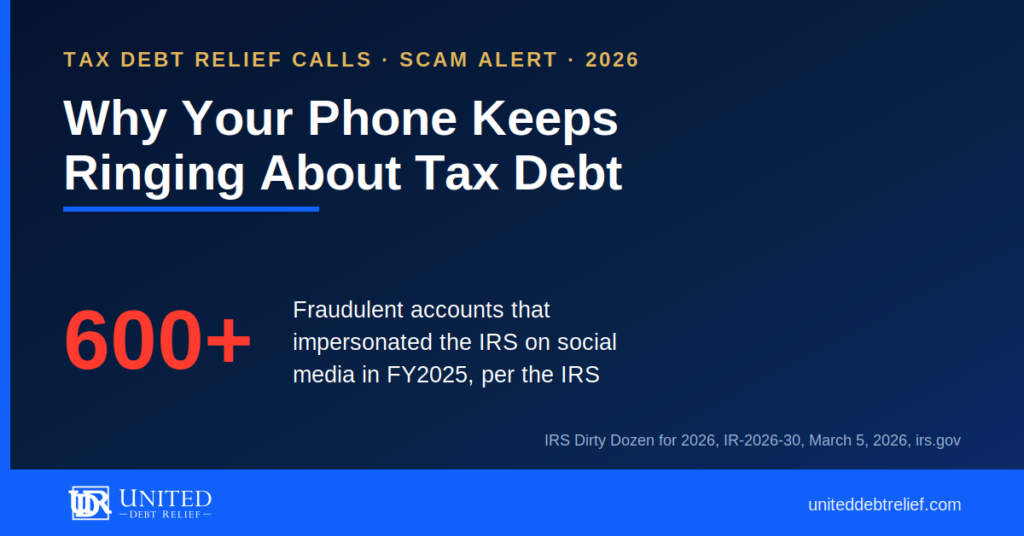
- More than 600 fraudulent accounts impersonated the IRS on social media in fiscal year 2025, according to the IRS (IR-2026-30, March 5, 2026).
- US phone numbers received close to 4 billion robocalls per month in 2020, according to the FCC.
- Under the FTC’s Telemarketing Sales Rule, a debt relief company may collect a fee only after it has renegotiated or settled at least one debt under an agreement the customer signed, and only after the customer has made at least one payment toward it, according to 16 CFR 310.4(a)(5)(i).
- Suspected IRS impersonation can be reported to the Treasury Inspector General for Tax Administration at 1-800-366-4484, according to TIGTA.
- General fraud, including telemarketing and tax debt relief scams, can be reported at ReportFraud.ftc.gov, according to the FTC.
Why Do Tax Debt Relief Calls Happen in the First Place?
A federal tax lien becomes a matter of public record once the IRS files a Notice of Federal Tax Lien, and county and state filing offices routinely make those records searchable. Marketing lists built from lien filings, property records, and other public data are a normal and legal part of how tax resolution companies, including United Debt Relief, generate outreach lists.
Autodialing software lets a caller reach thousands of numbers an hour at a marginal cost near zero, which is why the volume of these calls can feel constant rather than occasional. Caller ID spoofing, where the displayed number is faked to look local or official, adds to the sense that a specific caller already knows your situation, according to the FCC.
Does the IRS Actually Call or Text You First?
The IRS states plainly that it normally contacts a taxpayer “the first time by mail delivered by the U.S. Postal Service,” according to IRS guidance on how to know it’s the IRS. Phone contact can happen later in a case, including when a taxpayer has an overdue bill, but it follows written notices rather than replacing them, according to the IRS.
The IRS does not send unsolicited text messages about a personal tax bill, and it does not initiate contact by email to request personal or financial information, according to the IRS. A text or email demanding tax payment is a scam indicator on its own.
What Are the Tells of a Scam Call?
A legitimate tax resolution conversation and a scam call can sound similar for the first thirty seconds. The difference shows up in what the caller asks you to do next. The CFPB flags a similar tell for debt contacts generally: a caller who won’t share a verifiable name, address, or license.
| Signal | What a Scam Call Does | What the IRS Actually Does |
|---|---|---|
| Payment method | Demands payment by gift card, wire transfer, or cryptocurrency | Never demands a specific payment method by phone, according to IRS Fact Sheet FS-2022-33 |
| Threats | Threatens immediate arrest or police action during the call | Does not threaten to bring in local police to arrest a taxpayer, according to IRS Fact Sheet FS-2022-33 |
| Fees | Asks for payment before any settlement work has been done | A telemarketer may collect a fee only after settling a debt and the customer has made a payment, according to 16 CFR 310.4(a)(5)(i) |
| Guarantees | Promises a specific settlement amount before reviewing your file | Outcomes depend on a full financial and tax review; no legitimate reviewer promises a number sight unseen |
| Paperwork | Refuses to send terms, fee schedules, or agreements in writing | A written notice with an end date to dispute or respond is standard IRS and FTC practice |
What Rule Stops a Company From Charging You Before It Does Anything?
The FTC’s Telemarketing Sales Rule sets three conditions a debt relief telemarketer must meet before it can collect any fee, according to 16 CFR 310.4(a)(5)(i). First, the debt must actually be renegotiated, settled, reduced, or otherwise altered under an agreement the customer signed. Second, the customer must have made at least one payment under that new agreement. Third, the fee itself must bear a reasonable, proportional relationship to the results, rather than being a flat charge collected regardless of outcome.
A caller who asks for a card number or a retainer before any of that has happened is describing a fee structure the rule does not allow. Confirm the timing of any fee against these three conditions before agreeing to anything, since state rules can add further restrictions on top of the federal floor.
Why Do the Calls Feel So Relentless?
US phone numbers received close to 4 billion robocalls per month in 2020, according to the FCC, and the underlying economics have not gotten more expensive since. Advances in autodialing and caller ID spoofing make it “cheap and easy” to place massive volumes of calls and to disguise the true origin of the call, according to the FCC.
The IRS’s 2026 Dirty Dozen list specifically calls out AI-generated voice technology as a newer layer on top of that volume, describing computer-generated calls with spoofed caller ID designed to sound convincing, according to the IRS (IR-2026-30, March 5, 2026). The same list also names “aggressive Offer in Compromise marketing,” sometimes called OIC mills, as a distinct scam pattern in which promoters push taxpayers toward a settlement product regardless of whether they actually qualify, according to the IRS.
Where Should You Report a Suspected Scam Call?
Three federal channels cover most of these calls, and using the right one helps investigators route the report correctly.
- General fraud and telemarketing scams: ReportFraud.ftc.gov, the FTC’s central complaint intake.
- Calls or messages that specifically impersonate the IRS or an IRS employee: the Treasury Inspector General for Tax Administration (TIGTA) at 1-800-366-4484, according to TIGTA.
- Unwanted or spoofed robocalls generally: the FCC Consumer Complaint Center, selecting “phone” and then “unwanted calls,” according to the FCC.
Your state Attorney General’s consumer protection division is also a valid reporting channel, particularly if you lost money, and many states share data with the FTC’s Consumer Sentinel network. Verify any dollar amount, deadline, or lien detail a caller cites directly against IRS.gov or a notice you have in hand before acting on it, since a caller can quote a real-sounding figure incorrectly.
How Does United Debt Relief Approach These Calls Differently?
When United Debt Relief’s Tax Resolution team opens a new file, we start with what the IRS has actually sent in writing, such as a CP notice or a Notice of Federal Tax Lien, rather than a figure a caller mentioned. That written record, not a phone script, is what determines whether an Offer in Compromise, an installment agreement, or another path is realistic for that taxpayer’s situation.
United Debt Relief handles enrollment directly and offers a free, no-obligation consultation to review your notices before you commit to any program. Results vary by situation, and eligibility for any tax resolution option depends on your full financial picture, so confirm your own numbers against the IRS before making a decision based on a call alone.
Frequently Asked Questions
Why am I getting tax debt relief calls if I already paid what I owe?
Public lien and property records do not always reflect a recent payment right away, and marketing lists are often built weeks or months before they are used. A call referencing an old balance does not necessarily mean the balance is still open. Verify your actual account status directly with the IRS.
Does the IRS call taxpayers about back taxes?
The IRS can call later in a collection case, but it “normally” makes first contact by mail, according to IRS guidance. It does not open a case with a phone call demanding immediate payment, and it does not text or email you first about a personal balance.
What is an “OIC mill” and is it different from a legitimate Offer in Compromise?
An Offer in Compromise is a real IRS program that can settle a tax liability for less than the full amount owed, based on the taxpayer’s Reasonable Collection Potential, according to IRS Topic no. 204. The IRS’s 2026 Dirty Dozen list warns about “OIC mills” that market the product aggressively to taxpayers who are unlikely to qualify, according to the IRS.
Is it always a scam if a caller asks for payment by gift card or wire transfer?
The IRS states it never demands a specific payment method such as a gift card by phone, according to IRS Fact Sheet FS-2022-33, and legitimate debt relief fees are also restricted by the FTC’s advance-fee rule. A gift card or wire demand on an unexpected call is a strong scam indicator either way.
How do I report a scam tax debt relief call?
Report general fraud at ReportFraud.ftc.gov, report suspected IRS impersonation specifically to TIGTA at 1-800-366-4484, and report unwanted robocalls to the FCC Consumer Complaint Center. Your state Attorney General’s office is also a valid channel, especially if you sent money.
Can a legitimate company call me first about tax debt relief?
Yes, outbound marketing calls are legal, and receiving one does not by itself mean a company is illegitimate. What matters is what happens next: whether the caller demands payment before doing any work, refuses to put terms in writing, or guarantees a specific outcome before reviewing your file.
United Debt Relief offers a free consultation with no obligation to review any notice you have received and confirm what, if anything, actually needs a response. Results vary by situation. Call (888) 802-2092 or visit uniteddebtrelief.com to get started.
Sources
- IRS, “Dirty Dozen tax scams for 2026” (IR-2026-30, March 5, 2026)
- IRS, “How to know it’s the IRS”
- IRS Fact Sheet FS-2022-33, “Understanding how the IRS contacts taxpayers”
- IRS Topic no. 204, Offers in Compromise
- eCFR, 16 CFR 310.4, Telemarketing Sales Rule, Abusive telemarketing acts or practices
- FTC, “Debt Relief Services & the Telemarketing Sales Rule: A Guide for Business”
- FTC, “What To Know About Advance-Fee Loans”
- FCC, “Spoofed Robocalls”
- CFPB, “How do I tell if a debt collector is legitimate or a scam?”
- FTC, ReportFraud.ftc.gov
- TIGTA, “Submit a Complaint”