

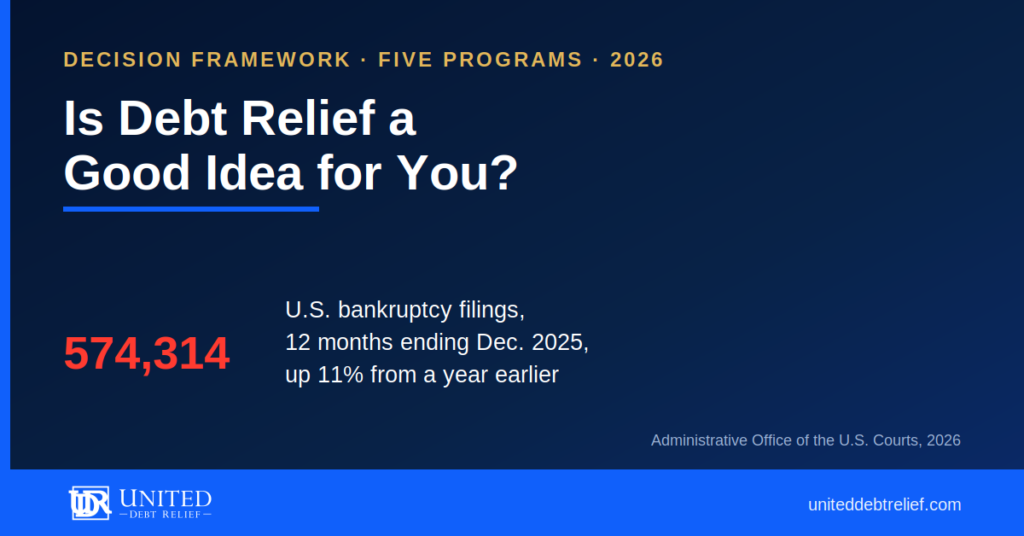
Debt relief is a good idea only when specific conditions line up: mainly unsecured debt, a troubled or worsening payment status, and no realistic structured payoff at current terms. This framework is for anyone deciding among debt settlement, a consolidation loan, credit counseling, tax resolution, credit repair, or bankruptcy who wants a repeatable set of gates rather than a pitch. It matters in 2026 because average credit card interest rates remain above 20% and U.S. bankruptcy filings rose 11% year over year, so more households face this decision with real money on the line.
Key Takeaways
- The average interest rate on credit card accounts assessed interest reached 22.15% in the second quarter of 2026, and 20.94% across all accounts, according to the Federal Reserve’s G.19 report.
- U.S. bankruptcy filings rose to 574,314 in the 12 months ending December 31, 2025, up from 517,308 the year before, an 11% increase, according to the Administrative Office of the U.S. Courts.
- Total household debt reached $18.8 trillion in the first quarter of 2026, a slight rise, according to the Federal Reserve Bank of New York.
- Canceled debt is generally taxable income, and a creditor must file a Form 1099-C for a canceled debt of $600 or more, according to the IRS.
- Secured debt is tied to an asset, such as a car or a house, while unsecured debt, including most credit card and medical debt, is not, according to the FTC.
What Kind of Debt Do You Actually Have?
The first gate is the debt itself. The FTC defines secured debt as debt tied to a specific asset, such as a car loan or a mortgage, where a lender can repossess the car or foreclose the house if payments stop. Unsecured debt, including most credit card balances, medical bills, and signature loans, is not tied to any asset a creditor can seize directly.
Debt settlement, the program most people mean by “debt relief,” generally applies to unsecured debt. It does not remove a lien on a car or a house. A balance that is mostly a car loan, a mortgage, or federal student loans sits largely outside what a settlement program can address, and needs a different gate, covered below.
Are You Current, or Already Behind?
The second gate is payment status. A consumer who is current on every account and can comfortably make minimum payments has options a delinquent consumer does not, starting with negotiating directly with a lender or working with a nonprofit credit counselor. Credit counseling organizations, usually nonprofits, build a debt management plan around a single monthly payment the counselor distributes to creditors, and the CFPB notes they never advise a client to stop paying a creditor.
Debt settlement works differently. Companies offering it “usually advise” a client to stop paying creditors while funds accumulate for a negotiated settlement, according to the CFPB, and the agency warns plainly that “debt settlement may well leave you deeper in debt than you were when you started.” Under the FTC’s Telemarketing Sales Rule, a debt relief company cannot collect a fee until it has settled a debt, the customer has agreed to the new terms in writing, and the customer has made at least one payment under that agreement, a structural check on being charged before anything is delivered. Falling further behind while a settlement is negotiated is a real risk, and it is why payment status belongs early in this framework.
Can Your Income Support a Structured Payoff?
The third gate is capacity. If income can support a full payoff on a longer or restructured schedule, options that preserve the full balance, credit counseling, a consolidation loan, or negotiating directly, generally cost less than a program built around reducing principal. A consolidation loan combines several balances into one new loan, and the CFPB warns that an initial teaser rate can expire, so the full terms deserve a careful read.
If income genuinely cannot support the debt on any realistic schedule, even after counseling or consolidation, that is the signal a principal-reduction approach, debt settlement or, for larger situations, bankruptcy, deserves a closer look. This gate is about math, not motivation.
What Would Forgiven Debt Cost You in Taxes?
The fourth gate is tax exposure, and it is the one people miss most often. Canceled or forgiven debt is generally treated as taxable income, according to the IRS, and a creditor must file a Form 1099-C for each debt of $600 or more that it cancels. That $600 figure is a filing threshold for the creditor’s paperwork, not a floor below which forgiven debt stops being taxable.
Real exclusions exist. A taxpayer can exclude canceled debt from income to the extent they were insolvent, meaning liabilities exceeded the fair market value of assets, immediately before the cancellation, according to IRS Publication 4681. Debt discharged in bankruptcy is also excluded. Neither applies automatically, so this gate deserves a conversation with a licensed tax professional before assuming a settled balance is tax-free.
What Would It Do to Your Credit?
The fifth gate is the credit report. Debt settlement can have a negative effect on credit scores, according to the CFPB, largely because of missed payments during negotiation rather than the settlement notation itself. A consolidation loan adds a new account and a hard inquiry. Bankruptcy is the longest-lasting mark of any of these paths: a Chapter 7 or Chapter 13 filing can remain on a credit report for up to 10 years, according to the FTC, versus roughly seven years for most other negative items.
No government source publishes a recovery timeline or a point value for any of these mechanisms, and a claim that promises one is unverifiable. Confirm your own current reports before choosing a path, since the starting point on each account changes the result.
When Is Debt Relief Probably the Wrong Call?
Debt relief is probably the wrong call in a few identifiable situations. A balance small enough to pay off within a year or two on a normal budget rarely needs a formal program. Income strong enough to support a full payoff, especially with a lower rate from consolidation or counseling, usually costs less than a program built around forgiving principal.
Debt that is primarily secured, a mortgage or an auto loan, generally sits outside what settlement, validation, or consolidation is built to address, since none of those programs removes a lender’s right to the collateral. Federal student loan debt has its own federal repayment, forgiveness, and hardship programs, and it is rarely dischargeable in ordinary bankruptcy without a separate showing of undue hardship, according to the Administrative Office of the U.S. Courts. In each case, a structured payoff, counseling, or the loan’s own federal programs is typically the better starting point.
Situation by Situation: What Tends to Fit
The table below is a starting map, not a diagnosis. It includes options United Debt Relief does not sell, credit counseling and bankruptcy, described fairly.
| Situation | Likely-Best Option | Why |
|---|---|---|
| Current on payments, manageable balance, high interest rate | Consolidation loan or direct negotiation | Preserves the full balance while lowering the rate or the number of payments |
| Current but overwhelmed by minimum payments across several cards | Nonprofit credit counseling / debt management plan | One monthly payment, no advice to stop paying, per the CFPB |
| Already behind, mostly unsecured debt, income cannot cover full balance | Debt settlement | Targets principal reduction on unsecured debt, with credit and tax tradeoffs to weigh first |
| Unfamiliar debt, wrong amount, or a collector that will not verify it | Debt validation | Uses FCRA and FDCPA rights to require verification before further collection |
| Specific inaccurate item on a credit report | Credit repair dispute | The FCRA gives a furnisher roughly 30 days to verify or the item is corrected |
| Back taxes, a lien, levy, or wage garnishment | Tax resolution | The IRS has its own programs, such as an Offer in Compromise, separate from consumer debt tools |
| Debt load or income instability that no repayment plan realistically resolves | Bankruptcy, with a licensed attorney | Chapter 7 or Chapter 13 exists for exactly this situation, with its own eligibility rules |
| Debt is primarily a mortgage, auto loan, or federal student loan | Loan-specific programs, not a general debt relief product | Secured debt keeps the collateral at risk regardless of a settlement; student loans have separate federal options |
Frequently Asked Questions
Is debt relief worth it for a small balance?
Usually not on its own. A balance a normal budget can retire within a year or two rarely justifies the fees, credit effect, or tax exposure of a formal program. Results vary by situation, so run the math first.
Should I use debt relief if I am current on all my payments?
Often not debt settlement specifically. Credit counseling or a consolidation loan generally fits a current, capable borrower better, since neither asks a client to stop paying, and settlement companies typically do, according to the CFPB.
What are the real pros and cons of debt settlement?
The potential upside is a reduced principal balance on unsecured debt. The documented downsides include a possible negative credit effect, taxable forgiven income above IRS exclusions, and, per the CFPB, a real risk of ending up deeper in debt if a settlement is not reached before fees and interest accumulate.
Is debt relief a good idea for credit card debt specifically?
It can be, since most credit card debt is unsecured under the FTC’s definition, the category debt settlement and consolidation are built for. Whether it is a good idea still depends on the delinquency, income, tax, and credit gates above.
Does debt relief work for federal student loans?
Not through debt settlement. Federal student loans carry their own repayment, hardship, and forgiveness programs and are rarely discharged in ordinary bankruptcy, according to the Administrative Office of the U.S. Courts, so they need a separate path.
United Debt Relief offers a free, no-obligation consultation to walk through these gates against a specific financial picture, across Debt Settlement, Debt Validation, Debt Consolidation Loans, Tax Resolution, and Credit Repair & Builder. Results vary by situation, and this article is general information, not individualized advice. Call (888) 802-2092 or visit uniteddebtrelief.com to get started.
Sources
- Federal Reserve, G.19 Consumer Credit release (current)
- Federal Reserve Bank of New York, “Household Debt Balances Rise Slightly as Delinquency Transition Rates Hold Steady,” May 12, 2026
- Administrative Office of the U.S. Courts, judiciary news release on bankruptcy filing statistics (February 4, 2026)
- Administrative Office of the U.S. Courts, “Chapter 7 – Bankruptcy Basics”
- IRS Publication 4681, Canceled Debts, Foreclosures, Repossessions, and Abandonments
- IRS, “About Form 1099-C, Cancellation of Debt”
- FTC, “Coping with Debt”
- FTC, “Debt Relief Services & the Telemarketing Sales Rule: A Guide for Business”
- CFPB, “What is a debt relief program and how do I know if I should use one?”
- CFPB, “What is the difference between credit counseling and debt settlement, debt consolidation, or credit repair?”