

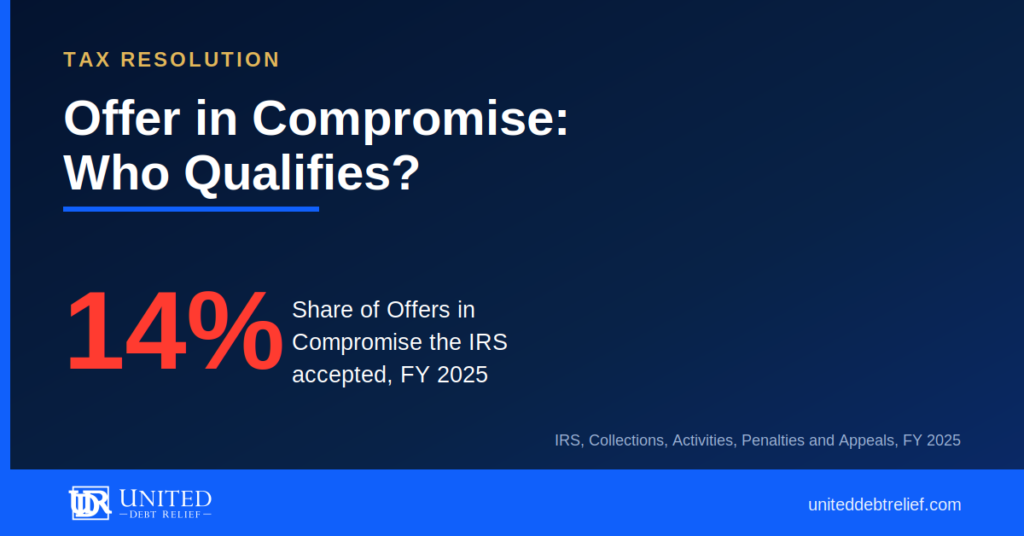
An IRS Offer in Compromise lets a taxpayer settle a federal tax debt for less than the full amount owed, and acceptance is rare and driven by a fixed collection formula rather than negotiation. This overview is for taxpayers who owe the IRS more than they can currently pay and want to understand the actual qualification rules before applying or hiring help. The question is timely because the IRS accepted only 5,464 of the 38,797 offers submitted in fiscal year 2025, and the agency continues to warn taxpayers about companies that promise otherwise.
Key Takeaways
- The IRS accepted 5,464 of the 38,797 offers in compromise proposed in fiscal year 2025, about 14%, according to the IRS, 2026.
- Accepted offers in compromise totaled $98.1 million in fiscal year 2025, according to the IRS, 2026.
- The standard application fee is $205, waived for taxpayers who meet the low income certification, according to the IRS Form 656 Booklet, 2026.
- A lump sum cash offer requires 20% of the total offer amount paid with the application, according to the IRS Form 656 Booklet, 2026.
- An accepted taxpayer must stay compliant with filing and paying taxes for five years after acceptance, according to the IRS Form 656 Booklet, 2026.
- The IRS’s 2026 Dirty Dozen list warns that “OIC mills” charge high fees to taxpayers who do not qualify, according to the IRS, 2026.
What Is an IRS Offer in Compromise?
An Offer in Compromise is an agreement between a taxpayer and the IRS that settles a tax debt for less than the full amount owed, according to the IRS, 2026. It is a collection tool, not a negotiation in the everyday sense, since the IRS accepts or rejects an offer based on a defined formula applied to the taxpayer’s specific finances.
Most Offers in Compromise are filed on the ground of doubt as to collectibility, but two other grounds exist for narrower circumstances, and each has its own qualification standard, according to IRS Topic no. 204, 2026.
What Are the Three Grounds for an Offer in Compromise?
Doubt as to collectibility exists when a taxpayer’s assets and income are less than the full amount of the tax liability, according to IRS Topic no. 204, 2026. This is the ground used by the large majority of applicants, since it applies whenever full payment simply is not possible given the taxpayer’s financial position.
Doubt as to liability applies only when there is a genuine dispute over whether the tax is actually owed or how much is owed, according to IRS Topic no. 204, 2026. Effective tax administration applies when the tax is legally owed and collectible in full, but requiring full payment would create an economic hardship or be unfair because of exceptional circumstances, according to IRS Topic no. 204, 2026.
How Does the IRS Calculate Reasonable Collection Potential?
Reasonable Collection Potential, or RCP, is how the IRS measures a taxpayer’s ability to pay, and it is the number that decides most offers filed on doubt as to collectibility. RCP includes the value that can be realized from a taxpayer’s assets, such as real property, vehicles, and bank accounts, plus anticipated future income minus certain amounts allowed for basic living expenses, according to IRS Topic no. 204, 2026.
An offer amount below the taxpayer’s calculated RCP is generally rejected, since the IRS’s own formula, not the taxpayer’s hardship story, sets the floor for what counts as an acceptable settlement.
What Does an Offer in Compromise Cost to File?
Offers require a $205 application fee, according to the IRS Form 656 Booklet, 2026. Taxpayers who meet the low income certification guidelines are not required to submit the application fee or any payment with the offer or during its consideration, according to the IRS Form 656 Booklet, 2026.
The low income certification is based on family size and location. In the 48 contiguous states, a household of one qualifies at an adjusted gross income of $39,900 or less, and a household of four qualifies at $82,500 or less, according to the IRS Form 656 Booklet, 2026.
Lump Sum or Periodic Payment: How Do the Terms Compare?
| Feature | Lump Sum Cash Offer | Periodic Payment Offer |
|---|---|---|
| Upfront payment | 20% of the total offer amount, paid with the application | The proposed first payment, paid with the application |
| Remaining balance | 5 or fewer payments within 5 months of acceptance | Monthly payments over 6 to 24 months |
| Payments during IRS review | Not required beyond the initial 20% | Must continue every month while the IRS evaluates the offer |
Both payment structures are defined in the IRS Form 656 Booklet, 2026, and the choice affects how much cash a taxpayer needs available before an offer is even submitted, not just after acceptance.
What Happens After an Offer Is Accepted?
Acceptance is conditional, not final relief with no strings attached. A taxpayer must strictly comply with all requirements to timely file tax returns and timely pay taxes for the five year period beginning with the date the offer is accepted, according to the IRS Form 656 Booklet, 2026.
Failing to file or pay during that five year window can default the offer, according to the IRS Form 656 Booklet, 2026, which can reinstate the original tax debt. The compliance period is a real, ongoing condition of the settlement, not a formality.
How Many Offers in Compromise Actually Get Accepted?
In fiscal year 2025, taxpayers proposed 38,797 offers in compromise, and the IRS accepted 5,464 of them, totaling $98.1 million, according to the IRS, 2026. That works out to roughly 14% of proposed offers, or about 1 in 7.
Most applicants do not qualify. An offer that does not meet or exceed the taxpayer’s calculated Reasonable Collection Potential is generally rejected regardless of how compelling the taxpayer’s circumstances feel, which is why the acceptance rate stays low year over year.
Why Does the IRS Warn About “OIC Mills”?
The IRS’s 2026 Dirty Dozen list of tax scams specifically names “OIC mills,” describing companies that often overpromise results and charge high fees to taxpayers who do not qualify for the program, according to the IRS, 2026. The agency advises taxpayers to verify their own eligibility using free IRS tools before responding to aggressive advertising.
United Debt Relief’s Tax Resolution program does not advertise guaranteed settlements, because no legitimate provider can guarantee an IRS outcome that is governed by a fixed formula. Results vary by situation, and every case is evaluated on its own numbers before an offer is ever prepared.
Where Does This Fit Into a Tax Resolution Plan?
In our review of client files, the most common misconception is that a hardship story alone can move the IRS, when in practice the Reasonable Collection Potential calculation is what determines whether an offer has any chance of acceptance. Getting that calculation right before filing is what separates a realistic offer from a wasted application fee.
United Debt Relief’s Tax Resolution program works directly with licensed CPAs, enrolled agents, and tax attorneys who evaluate whether a taxpayer’s numbers support an Offer in Compromise, an installment agreement, or another IRS resolution path. This article is tax information, not tax advice.
Frequently Asked Questions
What is an IRS Offer in Compromise?
An Offer in Compromise is an IRS program that allows an eligible taxpayer to settle a tax debt for less than the full amount owed, according to the IRS, 2026.
What share of offers in compromise get accepted?
The IRS accepted about 14% of offers in compromise proposed in fiscal year 2025, or 5,464 of 38,797 offers submitted, according to the IRS, 2026.
How much does it cost to apply for an Offer in Compromise?
The standard application fee is $205, and taxpayers who meet the low income certification are not required to pay it or submit an initial payment, according to the IRS Form 656 Booklet, 2026.
What is Reasonable Collection Potential?
Reasonable Collection Potential is the IRS’s formula for a taxpayer’s ability to pay, combining the realizable value of assets with future income minus allowed basic living expenses, according to IRS Topic no. 204, 2026.
What happens if I miss a payment after my offer is accepted?
A taxpayer must remain compliant with filing and paying taxes for five years after acceptance, and failing to do so can default the offer, according to the IRS Form 656 Booklet, 2026.
Does everyone who applies qualify for an Offer in Compromise?
No. Most applicants do not qualify, since an offer below the taxpayer’s calculated Reasonable Collection Potential is generally rejected, and the IRS warns that companies advertising guaranteed settlements are often “OIC mills” that charge high fees to taxpayers who do not meet the requirements, according to the IRS, 2026.
United Debt Relief’s Tax Resolution program works with licensed CPAs, enrolled agents, and tax attorneys to evaluate whether an Offer in Compromise or another IRS resolution option fits a taxpayer’s actual numbers. A free, no-obligation consultation is available at (888) 802-2092 or at uniteddebtrelief.com. Results vary by situation.