

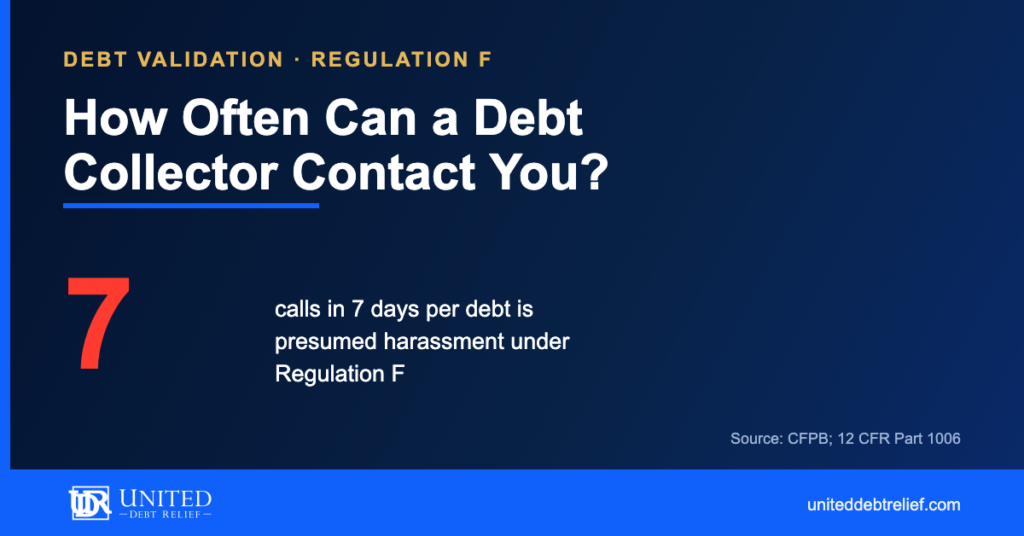
Federal law caps how often and how a debt collector may reach a consumer. Under Regulation F, 12 CFR Part 1006, in force since November 2021, a collector is presumed to violate the law if it calls about one debt more than 7 times in 7 consecutive days, or within 7 consecutive days after a telephone conversation about that debt. Contact before 8:00 a.m. or after 9:00 p.m. local time is treated as inconvenient. Texts and emails are legal but must carry a clear opt-out. Private social media messages are allowed. Public posts are prohibited. Postcards are prohibited. A written stop request ends contact.
Regulation F is the Consumer Financial Protection Bureau rule implementing the Fair Debt Collection Practices Act. It governs third-party collection agencies, collection law firms and debt buyers, not a creditor collecting its own account. These limits are a federal floor, and some states are stricter. Results vary by situation.
How many times can a debt collector call in 7 days?
Section 1006.14(b)(2) sets two call frequency triggers. A collector is presumed to violate the harassment prohibition if it places a telephone call to a person about a particular debt:
- More than 7 times within 7 consecutive days, or
- Within a period of 7 consecutive days after having had a telephone conversation with that person about that debt.
Three details decide most real cases:
- The count is per debt, not per person. Four accounts at the same agency can lawfully produce well over 7 calls in a week.
- A placed call counts, not a completed one. Unanswered rings count.
- The presumption cuts both ways. Fewer than 7 calls can still be harassment when the pattern is abusive.
One caveat governs everything above: exceeding 7 in 7 creates a rebuttable presumption, not an automatic violation. A collector may rebut it, and a court decides. Anyone who believes a violation occurred should have the facts reviewed by a licensed consumer protection attorney.
What hours can a debt collector call?
Section 1006.6(b)(1) treats a time before 8:00 a.m. and after 9:00 p.m. as inconvenient, measured in the consumer’s local time zone rather than the collector’s. A collector must also avoid any time or place it knows or should know is inconvenient. Once a consumer says “do not call during my shift,” that restriction binds the collector.
Can debt collectors text or email you?
Yes. Regulation F expressly contemplates email and text message collection. The 7 in 7 presumption applies only to telephone calls, so it does not cap texts or emails. The general ban on conduct whose natural consequence is to harass, oppress or abuse still covers every channel.
Two protections matter most:
- Every electronic message needs an opt-out. Section 1006.6(e) requires a clear and conspicuous statement describing a reasonable and simple method to opt out of further electronic communications. Using it cannot cost money.
- A consumer can shut down any medium. Section 1006.14(h) bars a collector from using a medium of communication after the person asks it not to: a specific phone number, a work email, a messaging app.
What is allowed on each channel?
| Channel | Allowed? | The limit under Regulation F |
|---|---|---|
| Telephone call | Yes | Presumed violation above 7 calls in 7 days per debt, or within 7 days of a phone conversation |
| Voicemail | Yes | Limited-content message allowed; the placed call counts toward the 7 in 7 tally |
| Text message | Yes | No numeric cap; every message needs an opt-out and the number must be verified |
| Yes | No numeric cap; every message needs an opt-out and the address must be verified | |
| Social media direct message | Yes | Must stay private and include an opt-out |
| Social media public post or comment | No | Prohibited if viewable by the general public or the person’s contacts |
| Postcard | No | Prohibited outright |
| Mailed envelope | Yes | No language or symbol beyond the address, except a non-revealing business name |
| Contact at work | Conditional | Prohibited once the collector knows the employer bars it |
Can a debt collector contact you on social media?
A private direct message is permitted. A public post is not. Section 1006.22(f)(3) prohibits communicating about a debt through a social media platform when the communication is viewable by the general public or by the person’s social media contacts. A collector sending a connection request must identify itself as a debt collector, and each private message must carry an opt-out.
Can a debt collector call you at work?
Section 1006.6(b)(1)(iii) prohibits communicating with a consumer at the place of employment when the collector knows or has reason to know that the employer prohibits such communications. Telling the collector, ideally in writing, supplies that knowledge immediately. Whether a collector may call a supervisor or human resources is covered in this guide to employer contact rules.
What is a limited-content message?
A limited-content message is a voicemail narrowly defined in 1006.2(j) that is not treated as a “communication” about a debt, so a collector can leave it without disclosing the debt to a third party who overhears it. It must contain:
- A business name that does not indicate the collector is in the debt collection business
- A request that the consumer reply to the message
- The name or names of one or more natural persons the consumer can contact
- A telephone number or numbers the consumer can use to reply
Optional additions include a salutation and suggested reply times. Anything beyond that list, such as naming the original creditor or stating a balance, converts the voicemail into a full communication. If a vague voicemail leaves the account owner unclear, tracing who owns the debt is the first move.
How do you tell a debt collector to stop contacting you?
Section 1006.6(c) gives every consumer this right. Written notice that the consumer refuses to pay, or wants contact to cease, requires the collector to stop. The CFPB advises sending a letter, and notes that an electronic submission works if the collector offers one. Keep proof of delivery. After receipt, a collector may contact the consumer only to:
- Advise that its further collection efforts are being terminated
- Notify the consumer that it or the creditor may invoke a specified remedy it ordinarily invokes
- Notify the consumer that it or the creditor intends to invoke a specified remedy
Stopping contact does not erase the balance. The account can still be reported, sold, or sued on. That is why a stop request is usually paired with a substantive challenge: requesting verification with a debt validation letter, understanding what validation requires a collector to produce, or formally disputing the debt.
What can you do when a collector breaks these rules?
Documentation comes first. A call log with date, time, number and whether anyone spoke is the evidence a claim rests on. Screenshots and saved voicemails carry the rest. From there:
- Send the stop request in writing and keep proof of delivery.
- File a complaint with the CFPB, which routes it to the company for a response.
- Consider a private lawsuit. The FDCPA gives consumers a private right of action. The CFPB states that a suit must be filed within one year of the offense, that a proven violation may be worth $1,000 in statutory damages plus actual harm, and that a winning consumer may recover lawyer fees and costs.
- Talk to a licensed consumer protection attorney before treating any of this as a decided claim, since the call-frequency rule is a presumption a collector may rebut.
Threats of arrest, false legal claims or fake service form a separate category, covered in this breakdown of illegal collector threats. Results vary by situation.
Frequently Asked Questions
How many times can a debt collector call in one week?
Under 12 CFR 1006.14(b)(2), a collector is presumed to violate the law by placing more than 7 calls in 7 consecutive days about a single debt, or by calling within 7 consecutive days of a telephone conversation about that debt. The count is per debt, so several accounts can lawfully produce more calls.
Can debt collectors text me?
Yes. Regulation F permits text message collection, and the 7 in 7 call presumption does not apply to texts. Every message must include a clear, conspicuous and simple way to opt out, and the number must be verified.
Is a debt collector allowed to message me on Facebook or Instagram?
A private direct message is allowed. Section 1006.22(f)(3) prohibits any collection message on a social media platform viewable by the general public or by the person’s social media contacts, so public posts and comments are off limits.
Can a debt collector call before 8 a.m. or after 9 p.m.?
No. Section 1006.6(b)(1) treats any time before 8:00 a.m. or after 9:00 p.m. in the consumer’s local time as inconvenient. A consumer can also declare other times or places inconvenient.
Does telling a collector to stop contacting me erase the debt?
No. A written cease request under 1006.6(c) stops the calls and messages, with narrow exceptions, but the balance remains. The account can still be reported to credit bureaus, sold, or made the subject of a lawsuit.
What can I recover if a collector violates the rules?
The FDCPA gives consumers a private right of action. According to the CFPB, a suit must be filed within one year of the offense, a proven violation may be worth $1,000 in statutory damages plus compensation for actual harm, and a winning consumer may recover lawyer fees and costs.
Your Next Step
Knowing the contact limits stops the calls. It does not resolve the balance behind them. United Debt Relief enrolls clients directly in its own five programs: Debt Settlement, Debt Validation, Debt Consolidation Loans, Tax Resolution, and Credit Repair & Builder. In-network providers are Better Business Bureau Accredited with an A rating and stringently vetted. The first consultation is free.
For accounts already at an agency, the sequence is laid out in this guide to getting out of collections. To review options against an actual balance, start with a free consultation.
This article is general information, not legal advice. Anyone who believes a collector violated federal or state law should consult a licensed attorney.