

In 2024, consumers filed 207,800 debt collection complaints with the Consumer Financial Protection Bureau, and 45% alleged that collectors were attempting to collect debts the consumer did not actually owe. That means nearly half of all collection complaints involve money that may never have been legitimately owed in the first place. If a debt collector has contacted you about an account you don’t recognize, that appears incorrect, or that you suspect is invalid, federal law gives you the right to dispute it. Here is exactly how to use that right in 2026.
What Does Federal Law Require Before a Collector Can Collect?
Under the Fair Debt Collection Practices Act (FDCPA), every third-party debt collector is legally required to verify that any debt they attempt to collect is valid, accurate, and legally collectible. This is not optional, it is a federal mandate. When you send a formal written dispute demanding validation, the collector must immediately cease all collection activity and provide complete documentation. If they cannot produce that documentation, collection must stop entirely.
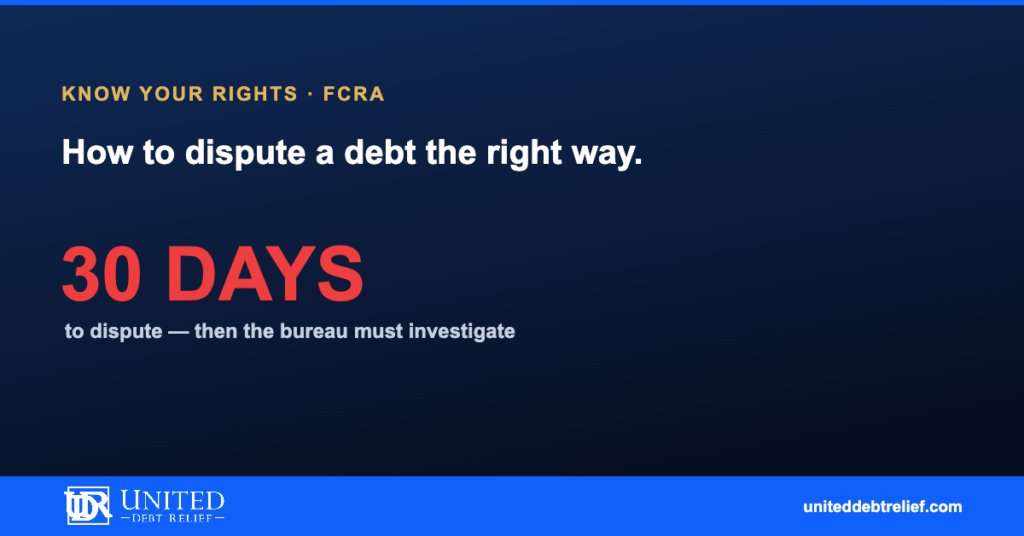
The Fair Credit Reporting Act (FCRA) adds a second layer of protection specifically for your credit report. Under the FCRA, you have the right to dispute inaccurate, unverifiable, or outdated information with all three major credit bureaus, Equifax, Experian, and TransUnion, and those bureaus must investigate and respond within 30 days. Items that cannot be verified as accurate must be removed. The first letter you send sets the tone, so review how to respond to debt collection letters before you put anything in writing.
Together, these two federal laws give you powerful tools to challenge debts that should not be on your plate, or on your credit report.
Step 1, Verify the Debt Before You Respond
Before you dispute anything, gather the facts. Pull your credit reports from all three bureaus, you can do this for free, and identify the specific account in question. Note the original creditor, the reported balance, the account open date, and the date of last activity.
Key questions to answer before disputing:
- Do you recognize this account and the original creditor?
- Is the balance amount accurate, or does it appear inflated?
- Is the debt within your state’s statute of limitations? Most states set this at 3 to 6 years for credit card debt.
- Does this account look like it could be the result of identity theft or a reporting error?
If any of these raise red flags, you have strong grounds for a dispute.
Step 2, Send a Written Debt Validation Demand
Do not call the collector. Put everything in writing. A formal debt validation letter sent via certified mail creates a legal paper trail and triggers your FDCPA protections. Your letter should include your full name and address, the account or reference number the collector provided, a clear statement that you dispute the debt and are requesting full validation, and a request that the collector cease all communication until they provide documentation.
Once your validation demand is received, the collector must stop all collection calls, letters, and credit bureau reporting of the disputed account. If they continue collecting before providing validation, that is a federal FDCPA violation, and you are entitled to statutory damages up to $1,000 per lawsuit, plus actual damages and attorney fees.
Send the letter via certified mail with return receipt requested. Keep the receipt and a copy of the letter permanently.
Step 3, Analyze the Collector’s Response
Once the collector responds, review every document they provide. A legitimate validation response should include: the original creditor’s name and the original account agreement, documentation of the full chain of ownership if the debt was sold to a third party, confirmation that the balance they are seeking is accurate, and evidence that the statute of limitations has not expired.
Debt that has been sold and transferred multiple times is especially prone to what is called a chain-of-title gap, missing documentation for each ownership transfer. If the collector cannot produce an unbroken ownership trail, the debt may be legally unenforceable. Our in-network law firms specifically analyze chain-of-title documentation as part of every Debt Validation review.
Step 4, Dispute Credit Report Errors Simultaneously
If the disputed debt appears on your credit report, file a separate dispute directly with each bureau where it is listed, Equifax, Experian, and TransUnion. Credit bureaus must investigate and respond within 30 days of receiving your dispute. If the account cannot be verified as accurate, it must be removed from your report. This is called a trade line deletion, and it can produce a measurable improvement in your credit score.
Research by Consumer Reports found that 44% of Americans who reviewed their credit reports found at least one error. The Brookings Institution found that more than 1 in 5 consumers have a material error that makes them appear riskier than they actually are. A systematic credit report dispute process, covering all three bureaus simultaneously, is what United Debt Relief’s Credit Repair and Rebuilding program delivers.
When the Debt Cannot Be Validated
If the collector cannot produce required documentation, they must stop all collection activity and the trade line must be deleted from each bureau where it was listed. This is not a loophole, it is a federal consumer protection enacted by Congress specifically because debt collection abuses are widespread and well-documented.
If the collector provides documentation and the debt is verified as valid, United Debt Relief’s network of professionals can review all available resolution options with you, including our done-for-you Debt Settlement program, which negotiates with creditors to reduce the total balance owed, often by 40 to 50% before fees.
What Not to Do When Disputing a Debt
What not to do when disputing a debt matters as much as what you do, because a handful of common missteps can quietly undo the federal protections you just triggered.
- Do not make any payment, even a partial payment, before the debt is validated. A payment can restart the statute of limitations clock in many states.
- Do not provide your bank account number or additional personal information to a collector verbally or in writing beyond what is in your dispute letter.
- Do not ignore collection letters. Ignoring a debt does not make it go away, it may escalate to legal action. A written dispute does far more to protect your rights than silence.
- Do not assume the debt is valid just because the collector says it is. FDCPA violations are pervasive, nearly half of all complaints involve collectors pursuing debts they may not be able to verify.
Frequently Asked Questions, Disputing a Debt
Q: What is a debt validation letter?
A debt validation letter is a formal written demand sent to a debt collector requiring them to verify the debt is valid, accurate, and legally collectible under the FDCPA. Upon receiving it, the collector must cease all collection activity until they provide the required documentation.
Q: What happens if a collector cannot validate the debt?
They must stop all collection activity, calls, letters, and credit bureau reporting of the disputed account. Continued collection after a validation demand is a federal FDCPA violation. The debt may also qualify for trade line deletion from your credit report under the FCRA.
Q: Does disputing a debt hurt my credit score?
No. Sending a debt validation letter or filing a credit bureau dispute does not directly impact your credit score. If a collection account is removed as a result of a successful dispute, your score typically improves.
Q: What is a chain-of-title gap?
A chain-of-title gap occurs when a debt has been sold between multiple collectors but the documentation trail for each ownership transfer is incomplete. If a collector cannot verify they legally own the debt, it may be legally unenforceable. This is one of the most common reasons debt validation demands succeed.
Q: Can United Debt Relief handle the debt validation process for me?
Yes. United Debt Relief enrolls clients with in-network law firms that specialize in FDCPA debt validation nationwide. The process, sending the formal demand, analyzing the collector’s response, identifying violations, and pursuing legal remedies, is handled on your behalf. The initial consultation is free, and we serve clients across all 50 states.
Ready to dispute a debt or review your collection accounts? Call United Debt Relief at 1 (888) 802-2092 or Get My Free Debt Reduction Quote. In-network legal professionals. All 50 states. Debt settlement carries no upfront fees.
For the latest numbers on what Americans owe, credit card balances, average APRs, and delinquency trends, see our regularly updated Debt Data page. Further reading from official sources: the CFPB’s debt collection resources and the Federal Reserve’s G.19 consumer credit report.