

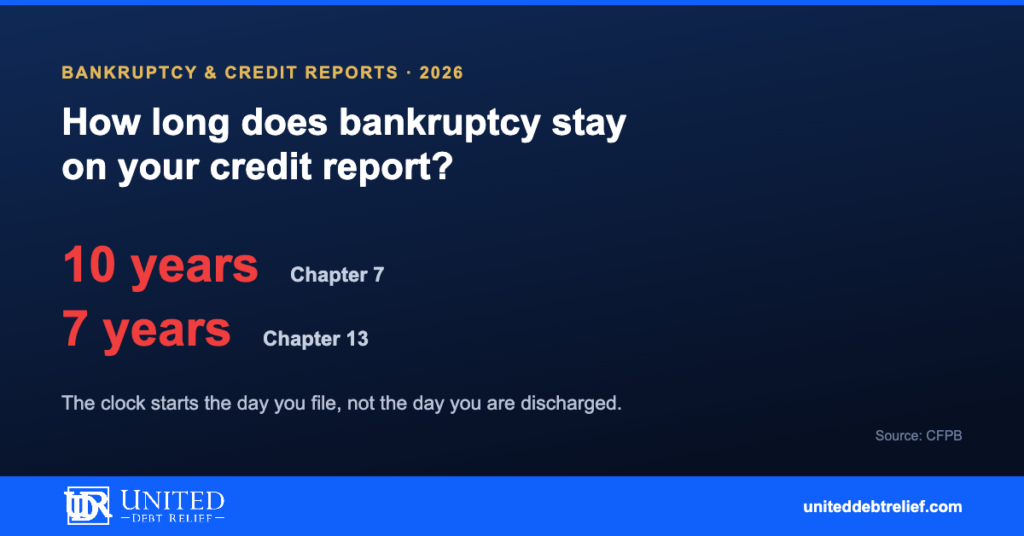
Short answer: A Chapter 7 bankruptcy stays on your credit report for 10 years from the date you filed. A Chapter 13 bankruptcy usually comes off after 7 years. But the Fair Credit Reporting Act permits up to 10 years for every chapter, Chapter 13 included. The 7-year number is a voluntary policy the credit bureaus apply to completed repayment plans, not a law.
That gap between what the law allows and what the bureaus actually do is the part most people get wrong, and it changes how you should plan the next decade of your credit life.
It is a live question for a lot of households right now. The Federal Reserve Bank of New York put total U.S. household debt at $18.771 trillion in the second quarter of 2026, with $1.263 trillion of that sitting on credit cards. Roughly 4.7% of all outstanding balances were in some stage of delinquency, and 7.1% of credit card balances newly rolled into serious delinquency over the past year. When people reach that point, bankruptcy stops being an abstraction and starts being a calendar.
What does the law actually say about the 10-year rule?
What the law actually says is set out plainly by the Consumer Financial Protection Bureau: if you file for bankruptcy protection, that information can remain on your credit report for up to 10 years from the date of entry of the order or the date of adjudication. The CFPB lists four chapters that carry the same 10-year ceiling:
- Chapter 7 (liquidation)
- Chapter 11 (reorganization)
- Chapter 12 (family farmers and fishermen)
- Chapter 13 (wage-earner repayment plan)
So where does the familiar 7-year figure for Chapter 13 come from? From the bureaus themselves. Because a Chapter 13 filer spends three to five years paying creditors back rather than discharging the debt outright, the credit reporting agencies voluntarily remove a completed Chapter 13 at the seven-year mark. It is a policy, not a statute. If a Chapter 13 is dismissed instead of completed, or certain conditions are not met, it can sit on your report for the full 10 years.
Practical translation: do not treat the 7-year number as a guarantee. Treat it as the likely outcome if you finish what you started.
The clock starts the day you file, not the day you are discharged
The clock starts the day you file, not the day you are discharged, so part of the reporting window is already spent by the time your case closes. This is the second thing people miss, and it usually works in their favor.
The reporting window runs from the filing date. (The FCRA phrases it as the date of entry of the order for relief, which for a voluntary consumer petition is the day you file.) A Chapter 7 typically reaches discharge in about three to five months, so a meaningful slice of the 10 years is already spent by the time the case closes. Chapter 13 is more dramatic: a filer on a five-year plan who makes the final payment has only about two years left before the entry is due to fall off, because the seven-year clock has been running the entire time they were paying.
If you are trying to time a mortgage application or a car loan, calculate from the filing date on your court paperwork, not from the discharge letter.
How much does bankruptcy hurt your credit score?
There is no single number that applies to everyone. How far a score falls depends almost entirely on where it started: a strong file with few missed payments has further to fall, so a bankruptcy takes a larger bite out of a high score than a low one. Someone whose score was already battered by months of collections and charge-offs often sees a smaller drop, because most of that damage was recorded before the filing ever happened. The Consumer Financial Protection Bureau publishes no point figure for a bankruptcy, and no one can tell a filer in advance what theirs will be.
The more useful point is that the damage does not stay static for a decade. Credit scoring models weight recent behavior most heavily, so the drag from a bankruptcy fades year over year even while the entry remains visible. Some filers see meaningful recovery within a year, simply because the bleeding stopped and a clean payment history started. That is not a promise, and how quickly it happens depends entirely on what you do next.
Can you get a bankruptcy removed from your credit report early?
If the bankruptcy is accurate, no. And you should be skeptical of anyone who says otherwise.
The CFPB’s guidance is unambiguous: no one has the right to remove negative information from a credit report if it is accurate, and you can only get a report fixed if it contains errors. Companies that promise to erase an accurate, properly reported bankruptcy for an upfront fee are describing something that cannot be done.
What can be corrected is a bankruptcy entry that is wrong, and these entries go wrong more often than you would expect. Pull all three reports and check every one of the following:
- The chapter is wrong. A Chapter 13 miscoded as a Chapter 7 costs you three extra years on the report.
- The filing date is wrong. A date entered even one year late pushes your fall-off date out by a year.
- Discharged accounts still show a balance. Debts wiped out in the bankruptcy should report a $0 balance and be flagged as included in bankruptcy. They should not still be accruing late marks.
- A dismissed case is reported as discharged, or the reverse.
- The bankruptcy is not yours at all. Mixed files and identity errors happen, especially with common names.
You can dispute errors yourself, for free, with each bureau. If you would rather have the FCRA dispute process handled for you across all three reports, that is what United Debt Relief’s Credit Repair & Builder program does: it challenges inaccurate, unverifiable, and outdated items and builds positive credit alongside the cleanup. It does not, and cannot, remove an accurate bankruptcy.
What falls off your credit report before the bankruptcy does?
What falls off first is everything that led to the filing: most negative information has a 7-year life under the FCRA, not 10. That includes the late payments, charge-offs, and collection accounts that led to the filing in the first place. So in a Chapter 7, the underlying wreckage typically ages off your report about three years before the public record of the bankruptcy itself does.
That three-year window is worth planning around. Once the individual delinquencies clear and the only negative item left is the bankruptcy notation, a file built on on-time payments, low utilization, and a secured card or two can look surprisingly healthy despite the flag still sitting there.
The comparison most people are actually making
Almost nobody researches bankruptcy timelines out of curiosity. They are weighing bankruptcy against the alternatives, and the credit report is one of the scales.
Here is the honest version. Every serious debt strategy leaves a mark. Settled accounts are reported as settled for less than the full balance, and that is negative information the FCRA generally caps at seven years, running from 180 days after the delinquency that led to the charge-off. It is not free, and it is not invisible. What it is not is a 10-year public record attached to a federal court case, and it does not require liquidating assets or committing to a court-supervised payment plan.
United Debt Relief’s five programs exist to give people something to compare against a filing:
- Debt Settlement, for unsecured balances a household cannot realistically pay in full
- Debt Validation, which uses the FDCPA to make collectors verify a debt before they can keep pursuing it
- Debt Consolidation Loans, for people whose credit still supports a fixed-rate payoff
- Tax Resolution, for IRS and state balances, which bankruptcy often cannot touch
- Credit Repair & Builder, for the rebuild afterward
Which one fits depends entirely on your numbers, and results vary by situation. But you should know what each option costs you on paper before you pick one, and 10 years is a long time to find out you had a better option.
Frequently asked questions
Q: How long does a Chapter 7 bankruptcy stay on your credit report?
Ten years from the date you filed, not from the date of discharge. This is the maximum the Fair Credit Reporting Act allows, and the credit bureaus report Chapter 7 for the full term.
Q: How long does a Chapter 13 bankruptcy stay on your credit report?
Typically seven years from the filing date. The FCRA permits up to 10 years, but the credit bureaus voluntarily remove a completed Chapter 13 after seven. A dismissed or incomplete Chapter 13 can remain for the full 10 years.
Q: Can you remove a bankruptcy from your credit report early?
Not if it is accurate. The CFPB states that no one has the right to remove accurate negative information from a credit report. You can only correct entries that are inaccurate, incomplete, or unverifiable, such as a wrong chapter, a wrong filing date, or discharged accounts still showing a balance. You can dispute those errors yourself at no cost.
Q: Does a bankruptcy fall off your credit report automatically?
In almost every case, yes. Once the seven or ten year window closes, the credit bureaus remove the entry on their own. You do not need to file anything or pay anyone to make it happen. There are narrow exceptions: the FCRA’s time limits do not apply when a report is pulled for a credit transaction or life insurance policy of $150,000 or more, or for a job paying $75,000 or more per year. Outside those situations, an entry still showing after the window has closed is an error you can dispute.
Q: How many points does bankruptcy drop your credit score?
There is no fixed number. How far a score falls depends on where it started: a higher score before filing generally means a steeper drop, because a strong file has further to fall, while a score already damaged by collections and charge-offs tends to move less. The Consumer Financial Protection Bureau publishes no point figure for a bankruptcy. The impact also diminishes over time as newer, positive payment history accumulates, even while the entry remains on the report.
Q: Does debt settlement stay on your credit report as long as bankruptcy?
No. Accounts resolved through settlement fall under the FCRA’s general seven-year limit, which runs from 180 days after the delinquency that led to the charge-off, rather than the up-to-ten-year window that applies to a bankruptcy public record. Settlement still affects your credit, and results vary by situation.
Not sure which clock you want to start
If you are far enough into this that you are researching how long a bankruptcy stays on a credit report, the real question is whether you need to file at all. That answer depends on what you owe, to whom, and what your income can actually support.
A United Debt Relief specialist will walk through your numbers, explain how each of the five programs would apply to your situation, and tell you plainly if a program is not the right fit. There is no cost to find out. Get your free consultation or call (888) 802-2092.
United Debt Relief is a nationwide debt relief company serving all 50 states. Our five programs span debt settlement, debt validation, debt consolidation loans, tax resolution, and credit repair, so your debt, tax, and credit problems are handled together rather than referred out. Program services are performed by our stringently vetted in-network providers and law firms, each BBB Accredited with an A rating. This article is educational and is not legal, tax, or financial advice. Results vary by situation.
Sources
- Consumer Financial Protection Bureau, How long does a bankruptcy appear on credit reports?
- Consumer Financial Protection Bureau, How long does information stay on my credit report?
- Federal Reserve Bank of New York, Quarterly Report on Household Debt and Credit, Q1 2026
- Consumer Financial Protection Bureau, Is it possible to remove accurate but negative information from my credit report?
- U.S. Courts, Chapter 7 Bankruptcy Basics and Chapter 13 Bankruptcy Basics