

Debt consolidation combines several debts into one payment, usually a single loan at a lower interest rate. For veterans it can be a smart move, but only when three things are true at the same time: the new rate is genuinely lower than what you carry now, the term is not stretched out to fake a lower payment, and you can leave the paid-off cards alone. One thing it does not do is reduce what you owe. It restructures it. If your real problem is that you cannot repay the balance at any rate, consolidation is the wrong tool, and this guide covers what fits instead.
Quick answer: Veterans can consolidate debt in 2026 through a personal consolidation loan, a VA cash-out refinance that taps home equity, or a military-focused credit union loan. There is no official “VA debt consolidation loan.” Before you borrow, check whether the SCRA 6% cap applies, because it lowers your rate without a new loan. If you cannot repay the balance at any rate, consolidation is the wrong tool.
Does consolidation actually reduce a veteran’s debt, or just move it?
Consolidation does not reduce a veteran’s debt, it moves it. A consolidation loan pays off your existing debts and leaves you owing the same principal to one lender, ideally at a lower rate. What shrinks is the interest you pay over time, and only if the new rate is lower than what you are paying now. Anyone selling consolidation as a way to “reduce your debt” is describing a different product, usually settlement.
The size of the benefit is bigger than most people expect, and it comes entirely from the rate. Take $25,000 in credit card debt at 24% APR. Consolidate it into a five-year loan at 12% and your payment lands around $556 a month. You finish in five years and pay roughly $8,400 in interest. Now take that same $25,000 sitting at 24% and pay that exact same $556 a month against the cards instead. It takes about nine and a half years and costs you roughly $39,500 in interest. Same balance, same payment. The rate alone is the difference. That is why the veteran-specific rate rules below matter so much.
Veteran rights that change the math before you consolidate anything
Veteran rights change the math first: two federal protections can lower what you pay before a consolidation loan is even on the table. If you are currently serving or recently separated, use them first, because they can change whether consolidation makes sense at all.
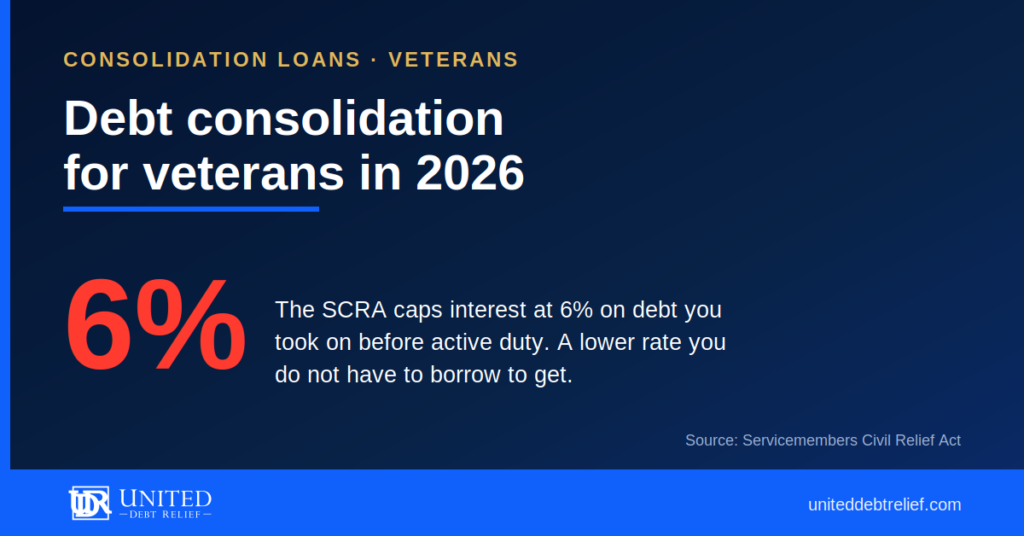
- The SCRA 6% cap. The Servicemembers Civil Relief Act caps interest at 6% on debts you took on before you went on active duty. If a pre-service credit card or loan is sitting above 6%, you can request the reduction in writing with a copy of your orders. That is a lower rate you do not have to borrow to get.
- The Military Lending Act 36% cap. The MLA caps most consumer credit at a 36% Military Annual Percentage Rate for active-duty servicemembers and their dependents, which matters most for payday, auto-title, and similar high-cost products.
- Debt owed to the VA is different, and no one can consolidate it. If your debt is a VA benefit overpayment, that is handled through the VA Debt Management Center with a waiver, a compromise offer, or a payment plan. A consumer consolidation loan does not apply to it, and any company that tells you it can resolve VA debt is not being straight with you.
Will debt consolidation affect my security clearance?
Debt consolidation usually helps a security clearance rather than hurts it. Clearance adjudicators under Guideline F care about unresolved and unaddressed debt, not about the fact that you consolidated. Taking a structured, on-time plan to handle delinquent accounts is exactly the kind of responsible action they look for as a mitigating factor. What actually raises flags is ignoring debt, leaving accounts delinquent, or failing to disclose them on the SF-86. A consolidation loan you pay on time is generally a point in your favor, not a problem. The thing to avoid is opening new credit you cannot manage, because a fresh missed payment is what does the damage.
What are your consolidation options as a veteran?
Your consolidation options as a veteran come down to four routes: a personal consolidation loan, a VA cash-out refinance, a military-focused credit union loan, or a debt relief program when a loan is not realistic. There is no single government “VA debt consolidation loan” for consumer debt, so most veteran consolidation happens through one of these.
| Route | How it works | Best fit | The catch |
|---|---|---|---|
| Personal consolidation loan | A fixed-rate installment loan pays off your cards, leaving one predictable payment | Credit and income strong enough to earn a genuinely lower rate | A hard inquiry, and the rate depends entirely on your credit |
| VA cash-out refinance | Replaces your mortgage with a larger one and returns the difference in cash | Veterans with meaningful home equity and a stable income | Your home secures the balance. Turning unsecured card debt into debt against your house cannot be undone. Confirm the funding fee and closing costs with a VA-approved lender first |
| Military credit union loan | Personal loan from a credit union serving servicemembers, often with hardship options | Members with an existing relationship | Membership eligibility rules apply |
| Debt relief program | Settlement or validation instead of a new loan | Credit already strained, or the balance is beyond repayment | Credit impact and possible tax on forgiven debt |
Check the SCRA 6% cap before any of these. A rate reduction you are legally entitled to beats a rate you have to qualify for.
When is consolidation not the right tool for a veteran?
Consolidation is the wrong tool when you cannot repay the balance at any rate, or when your credit cannot earn you a better one. If you cannot realistically repay the full balance at any interest rate, a consolidation loan just relocates the problem and adds an origination fee on top. And if your credit already took damage from carrying high balances, the rate you actually qualify for may be no better than the cards you are trying to escape. In those cases the honest options are debt settlement, a nonprofit debt management plan, or sometimes bankruptcy. This is the part a lender that only sells loans will never tell you.
Here is the piece that matters most for veterans specifically. A servicemember in post-separation debt often has credit cards, plus a tax issue from a year of transition, plus credit damage from a few late payments during the move to civilian life. That is three separate problems, and a consolidation loan solves one of them. The right approach is to fit the program to the problem, not force the problem into one product. United Debt Relief runs five programs for exactly this reason: debt settlement, debt validation, debt consolidation loans, tax resolution, and credit repair. Sometimes the honest answer is that a consolidation loan is not your best move, and you deserve to hear that before you sign.
How to vet a “veteran debt consolidation” offer
Vet any veteran debt consolidation offer on accreditation, fees in writing, and whether anyone is guaranteeing you a specific result. Veterans are actively targeted in this space. In July 2025 the FTC shut down a debt relief operation of roughly $100 million specifically for targeting seniors and veterans, and it has since published alerts on military debt-relief scams. Screen every offer the same way: look for real accreditation, confirm the provider network holds an A rating with the Better Business Bureau, refuse any fee charged before something is actually delivered, insist on the fees and timeline in writing, and walk away from anyone guaranteeing a specific result. If a “veteran debt consolidation” pitch leads with a grant or free government money, that is your signal to leave. For the full screen, we keep a checklist for spotting a legitimate debt relief company.
Frequently asked questions
Is there a special debt consolidation program just for veterans?
There is no single federal program that erases or specially discounts a veteran’s consumer debt through consolidation. What veterans do have are specific rights, mainly the SCRA 6% cap and the MLA 36% cap, plus veteran-serving nonprofits and standard consolidation options available to anyone. Be cautious with anything advertised as a veteran-only program that asks for money upfront.
Can I consolidate debt I owe to the VA?
No. Debt owed to the VA, such as a benefit overpayment, is handled through the VA Debt Management Center by waiver, compromise, or a payment plan. A consumer consolidation loan does not apply, and no legitimate company can resolve VA debt on your behalf.
Does consolidation hurt my credit?
In the short term your score can dip from the new inquiry and the new account. Over time, on-time payments and lower card utilization usually help. Because consolidation keeps you paying the full balance, it is generally gentler on your credit than settlement, where accounts go delinquent as part of the process.
What if I am a disabled veteran on a fixed income?
Consolidation only works if the payment is sustainable on your income. If it is not, do not force it. A hardship-based option or settlement may fit better. It is also worth knowing that VA disability compensation carries federal protections against most commercial creditor garnishment, so that income is more secure than many veterans realize.
For context on the pressure behind all of this, United Debt Relief’s debt data shows U.S. households owed $18.771 trillion in the second quarter of 2026, a 0.1% decrease from the prior quarter, with credit card balances rising $21 billion to $1.263 trillion, according to the Federal Reserve Bank of New York. Veterans carry that same weight with the added stakes of transition and, for many, a security clearance. That is why fitting the right program to your actual situation matters more here than almost anywhere.
Results vary, and this is educational information rather than individual financial or legal advice. If you want the full picture across every option, see our guide to debt relief for veterans.