

Last updated: October 22, 2026
Reviewed by Nick Avila, Founder, United Debt Relief, on October 22, 2026.
Key Points
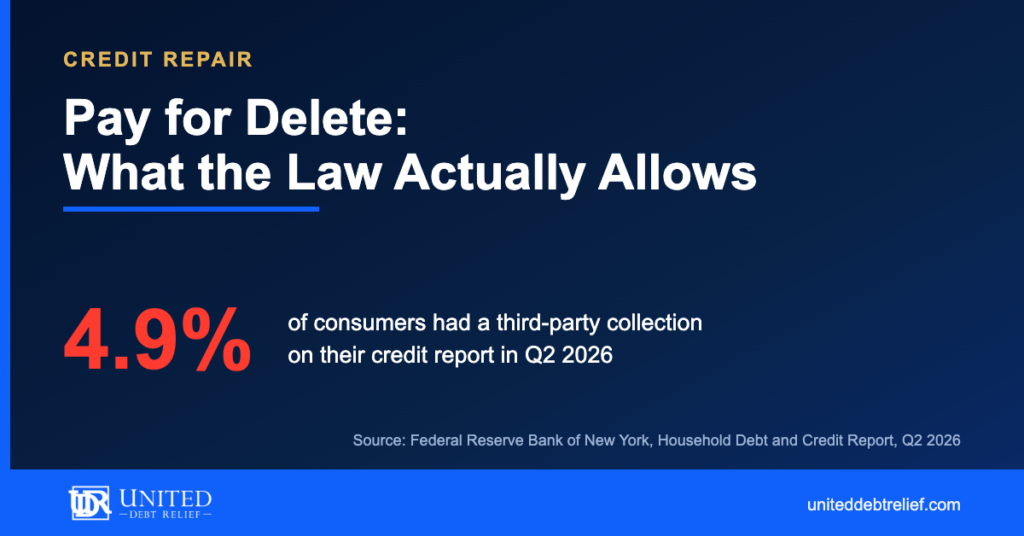
- About 4.9% of consumers had a third-party collection on their credit report in the second quarter of 2026, according to the Federal Reserve Bank of New York.
- The CFPB received about 5,806,800 credit or consumer reporting complaints in 2025, according to its Consumer Response Annual Report.
- Under 15 USC 1681c, a collection can stay on a credit report for 7 years, measured from 180 days after the delinquency began, and paying does not restart that clock.
- Under 15 USC 1681s-2, a furnisher may not report information it knows or has reasonable cause to believe is inaccurate, which is why many collectors decline to delete accurate items.
Pay for delete is a request that a collection agency remove a collection account from your credit report in exchange for payment. The short answer: it sometimes works, it is not illegal for you to ask, and no law requires a collector to say yes. The Fair Credit Reporting Act requires furnishers to report accurate information, so many collectors decline to delete an accurate account. About 4.9% of consumers had a third-party collection on their credit report in the second quarter of 2026, according to the Federal Reserve Bank of New York.
What is pay for delete?
Pay for delete is an agreement in which a debt collector agrees to stop reporting, or ask the bureaus to remove, a collection account after you pay an agreed amount. It is a private deal, not a legal right.
A paid collection usually stays on the report with a zero balance, so people offer payment in exchange for removal. The CFPB logged about 387,400 debt collection complaints in 2025, and the top issue was attempts to collect debt not owed, according to its Consumer Response Annual Report. That number is a reminder to confirm the debt is yours before you offer anything.
Pay for delete applies mainly to third-party collection accounts; original creditors are less likely to agree. Verify any balance directly with the collector, in writing, before you pay.
Is pay for delete allowed under the FCRA?
Pay for delete is allowed in the sense that no federal statute bans the request, but the FCRA puts an accuracy duty on every furnisher. Under 15 USC 1681s-2(a)(1)(A), a furnisher may not report information it “knows or has reasonable cause to believe” is inaccurate.
A collector cannot report a debt it knows is wrong, and it has no duty to remove a debt that is accurate. Under 1681s-2(a)(2), a furnisher that finds it reported incomplete or inaccurate data must promptly correct it. Under 1681s-2(a)(5), it must report the date the delinquency began within 90 days of reporting a collection or charge-off.
Many collectors say their data agreements with the bureaus do not let them delete accurate information because a consumer paid. A collector can still lawfully agree to things that stay accurate:
- Update the account to show it was paid in full or settled for less.
- Accept a lower amount than the balance claimed.
- Stop reporting the account going forward, since furnishing data to the bureaus is voluntary.
What a collector cannot do is report something it knows is false. Confirm your state’s rules before acting, since some states add their own collection and reporting protections.
Does pay for delete increase your credit score?
Pay for delete may change a credit score if a collection is actually removed, but no one can promise a specific result. The effect depends on the scoring model the lender uses and on everything else in the file.
Scoring models treat paid collections differently. Some newer models disregard a collection with a zero balance, while older models still used by many lenders may count it either way. Deletion may not change much if other late payments remain. Results vary.
Under 15 USC 1681c, a collection can report for 7 years, measured from 180 days after the original delinquency began. Paying or settling does not restart that 7-year clock. If a collection is already 6 years old, it will age off on its own soon, paid or not.
| Outcome | What the report shows | Is the collector required to agree? | What to watch |
|---|---|---|---|
| Paid in full | Collection stays, balance updated to $0 | Yes, if you pay the full verified balance, it must report accurately | Still reports for the rest of the 7-year period |
| Settled for less | Collection stays, marked settled | No, a lower amount is the collector’s choice | Canceled debt of $600 or more can trigger Form 1099-C |
| Pay for delete | Collector stops reporting or asks bureaus to remove it | No, it is a voluntary deal | Get the promise in writing before paying |
| Dispute of an inaccurate item | Bureau must delete or correct an item it cannot verify | Yes, the FCRA requires a reinvestigation | Only works on items that are inaccurate, incomplete or unverifiable |
How do you ask for a pay for delete agreement, and what should it say in writing?
A pay for delete agreement should be requested in writing and signed by the collector before any money moves. Start by pulling all three credit reports and confirming the account, the balance and the date of first delinquency. Our guide on how to read a credit report shows where each field sits.
Next, confirm the debt. A written dispute by the dispute-by date on the validation notice requires the collector to pause collection until it verifies the debt, under 15 USC 1692g(b). Our debt validation program page explains that process. A pay for delete letter then needs only a few plain parts:
- Your name, the collector’s name, and the account number shown on your report.
- The amount you will pay and the date you will pay it.
- The exact action the collector will take: stop reporting the account, or ask each bureau that shows it to remove it.
- A deadline for that action after payment clears.
- A signature from someone at the collection agency, on its letterhead.
Keep copies of the signed letter and proof of payment, and pay by a traceable method rather than giving open access to a bank account. Check all three reports after the deadline. If the account still shows, send the signed agreement to the collector and ask it to correct the reporting.
Nick Avila, founder of United Debt Relief, notes that the most useful document in these talks is usually the credit report itself, because the reported dates and balances show what is accurate before anyone discusses payment.
What is the CROA-safe alternative when a collector says no?
The CROA-safe alternative to pay for delete is a dispute of any item that is inaccurate, incomplete or unverifiable. Under 15 USC 1681i, a credit bureau generally must finish its reinvestigation within 30 days of receiving your dispute.
If the bureau cannot verify an item, or finds it inaccurate or incomplete, it must promptly delete or modify it. Common errors include a wrong balance, the same debt reported by two collectors, or a wrong delinquency date that keeps an item past 7 years. Our step-by-step guide to how to dispute a debt walks through the letter.
No dispute process or company can lawfully require a bureau to remove an accurate, verifiable item before its reporting period ends. The Credit Repair Organizations Act also protects you if you hire help. Under 15 USC 1679b, a credit repair organization cannot charge you before its services are fully performed, and under 15 USC 1679e you have 3 business days to cancel a contract.
In the United Debt Relief Credit Repair and Builder program, providers dispute items that appear inaccurate, incomplete or unverifiable under the FCRA. Results vary. If the balance itself is too large to pay, debt settlement or validation may be worth a conversation first. Our post on whether to pay a collection agency covers that order.
The worst case to plan for
The worst case is paying on a phone promise that is never kept: the collection stays for the rest of its 7-year period and the deal cannot be enforced. If a collector accepts less than the full balance, canceled debt of $600 or more can be reported on Form 1099-C, according to the IRS. In some states, a payment on an old debt can also restart the period a creditor has to sue. Tax outcomes depend on your full situation; consult a licensed tax professional, and confirm your state’s rules before acting.
How does United Debt Relief approach collection accounts?
United Debt Relief approaches a collection account by checking accuracy first and payment second. A specialist reviews the reported dates, balances and collector names, then explains whether a dispute, validation, settlement or a simple payment fits.
United Debt Relief is a national debt relief company serving all 50 states, offering five programs spanning debt settlement, debt validation, debt consolidation loans, tax resolution, and credit repair, so a client’s debt, tax, and credit problems are handled together rather than referred out. Its specialists consult with consumers, determine which program fits, and handle enrollment. Program services are performed by stringently vetted in-network providers and law firms, each BBB Accredited with an A rating.
Frequently Asked Questions
Is pay for delete illegal?
No federal law makes it illegal to ask for pay for delete. The FCRA requires furnishers to report accurate information, so a collector has no duty to delete an accurate account and many decline.
Does pay for delete increase your credit score?
It may, if a collection is actually removed, but no one can promise a result. Scoring models treat paid collections differently, and the rest of the credit file still counts. Results vary.
What should a pay for delete letter include?
It should name the account, the amount and date of payment, the exact reporting action the collector will take, a deadline for that action, and a signature from the collection agency.
Does paying a collection restart the 7-year reporting clock?
No. Under 15 USC 1681c, a collection reports for 7 years measured from 180 days after the original delinquency began, and paying or settling does not restart that period.
What can I do if a collector refuses pay for delete?
You can dispute any item that is inaccurate, incomplete or unverifiable. The credit bureau generally has 30 days to reinvestigate and must delete or modify items it cannot verify.
Sources
- 15 USC 1681s-2 (Cornell LII)
- 15 USC 1681c (Cornell LII)
- 15 USC 1681i (Cornell LII)
- 15 USC 1679b (Cornell LII)
- 15 USC 1679e (Cornell LII)
- 15 USC 1692g (Cornell LII)
- Federal Reserve Bank of New York, Household Debt and Credit Report, Q2 2026
- CFPB, Consumer Response Annual Report 2025
- IRS, About Form 1099-C, Cancellation of Debt
- IRS Publication 4681
Not sure whether a collection on your report is accurate? Schedule a free consultation with United Debt Relief or call 1 (888) 802-2092. Results vary.