

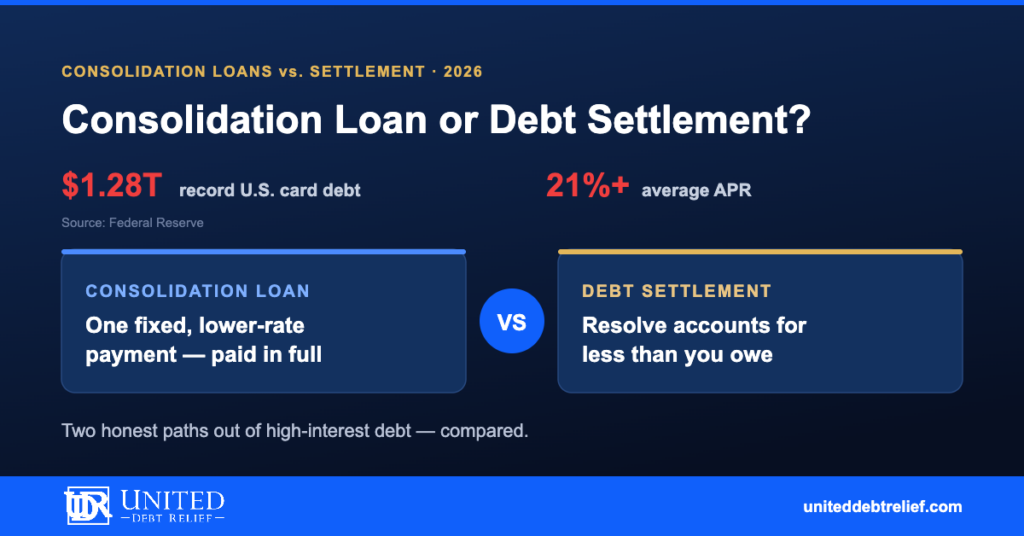
Two of the most popular ways to take on high-interest debt in 2026 pull in opposite directions. A debt consolidation loan combines what you owe into a single new loan you pay back in full at a lower rate. Debt settlement negotiates with your creditors to resolve accounts for less than the full balance. With average credit card APRs above 21%, according to the Federal Reserve, and credit card balances at a record $1.28 trillion as of late 2025 per the Federal Reserve Bank of New York, more people are weighing exactly this choice. Here is an honest, side-by-side comparison so you can see which path fits your situation. Results vary, and the right answer depends on your credit, your balances, and your budget.
Quick answer: A debt consolidation loan is usually the better fit when your credit still qualifies you for a fixed rate lower than your credit cards and you can realistically repay the full balance. Debt settlement is usually the better fit when your balances have become unaffordable and your credit has already taken hits, because it works to resolve accounts for less than you owe. Neither is guaranteed, and results vary by situation.
How a debt consolidation loan works
With a debt consolidation loan, you borrow a lump sum and use it to pay off several existing debts at once, usually high-interest credit cards. From that point on, you have one fixed monthly payment at a fixed interest rate, ideally lower than the blended rate you were paying across all those cards. The appeal is simplicity and potential interest savings: one due date instead of five, and less money lost to interest if the new rate beats your cards.
Because you keep paying your balances in full, a consolidation loan does not create the negative marks that settlement can. The trade-off is that you need credit strong enough to qualify for a worthwhile rate. If the best offer you can get is not lower than your current cards, a loan may not save you anything. You can learn more about our Debt Consolidation Loans option, and see how a loan stacks up against a 0% balance transfer if you are comparing every route.
How debt settlement works
Debt settlement takes the opposite approach. Instead of borrowing to pay your balances in full, you work to resolve them for less than the full amount owed. Typically you stop paying creditors directly and build funds in a dedicated account you control. As that account grows, negotiators contact your creditors and work to settle each account for a reduced payoff. Settlement is used mainly for unsecured debt like credit cards.
The upside is that, when it works, you resolve accounts without paying the full balance and without a court filing. The trade-off is credit impact: accounts may be reported as delinquent while the process plays out, which affects your score. Reputable settlement also follows the Federal Trade Commission rule that fees are charged only after an account is actually settled, never upfront. Explore our Debt Settlement program for the full picture.
The key differences at a glance
Both tackle unsecured debt, but they differ on the points that matter most:
- Credit required. A consolidation loan depends on qualifying for a good rate, so it favors stronger credit. Settlement is often used by people whose balances have outgrown what they can afford.
- Credit impact. A consolidation loan has little negative impact when you pay on time. Settlement usually creates negative marks during the process, though many people see their scores recover afterward.
- What you repay. With a loan, you repay the full balance at a lower rate. With settlement, you aim to resolve accounts for less than the full balance.
- Timeline. Consolidation loans run a fixed term, often two to five years. Settlement timelines vary, often two to four years, depending on how quickly you can fund it.
- Fees. Loans may carry an origination fee plus interest. Settlement fees apply only after each account is settled, and never before.
Which one fits your situation
A debt consolidation loan tends to suit someone whose credit still qualifies them for a rate below their cards, who can keep up with a fixed monthly payment, and who wants the simplicity of a single payoff. Debt settlement tends to suit someone whose balances have become genuinely unaffordable, whose credit has already been strained, or who is facing hardship and needs to resolve accounts for less than the full amount.
The honest caveat is that both depend on your specifics. A loan only helps if you can qualify for a better rate, and settlement is never a guaranteed outcome. Anyone who promises a fixed result from either is overpromising. If your credit sits in a gray area, comparing both side by side with a professional is the fastest way to see which actually saves you more, including how consolidation affects your credit score.
How United Debt Relief helps you decide
United Debt Relief is a national debt relief company serving all 50 states, and we are not a lender. That independence matters, because it means we are not steering you toward a single product. Through a free consultation, a specialist reviews your full picture and enrolls you with stringently vetted, BBB Accredited, A-rated professionals in the program that actually fits, whether that is a Debt Consolidation Loans option or our Debt Settlement program. We never charge upfront consultation fees, and we do not guarantee approvals, rates, or specific savings. Results vary by individual circumstances.
Frequently asked questions
What is the difference between a debt consolidation loan and debt settlement?
A debt consolidation loan combines multiple debts into one new fixed-rate loan that you repay in full, usually at a lower interest rate. Debt settlement instead negotiates with your creditors to resolve accounts for less than the full balance. One pays the debt off in full more efficiently; the other aims to reduce what you owe.
Which hurts your credit more, consolidation or settlement?
A consolidation loan usually has little negative impact when you make payments on time, and can help as you lower your credit utilization. Debt settlement typically creates negative marks while accounts are resolved, though many people see their scores recover afterward. Results vary.
Is debt settlement cheaper than a consolidation loan?
It can be, because settlement aims to resolve accounts for less than the full balance, while a loan repays the full balance with interest. But settlement carries a credit cost and is not guaranteed, so cheaper on paper is not always the right fit. A free consultation can compare the real numbers for your situation.
Can I switch from a consolidation loan to debt settlement later?
Some people do, depending on how their situation changes. If a loan is no longer affordable, settlement may become the better path. Reviewing both with a professional before you commit helps you avoid a costly detour.
Take the first step
The smartest move is comparing both options honestly before you sign anything. Get your free consultation and we will help you find the path that actually fits. Results vary by individual circumstances.