

The Numbers That Should Wake Every American Up
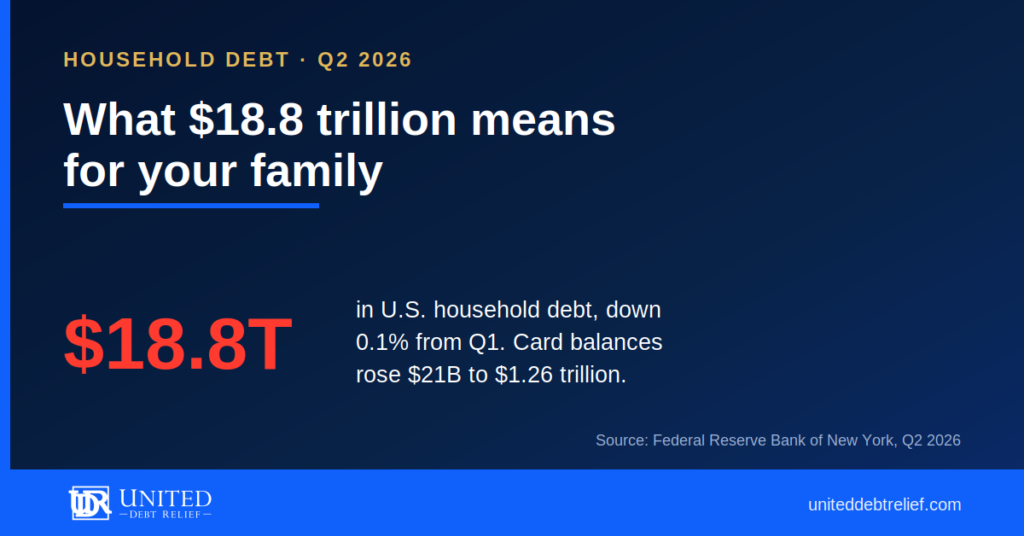
These numbers arrived quietly, the way most financial crises do. In the second quarter of 2026, the Federal Reserve Bank of New York reported total U.S. household debt of $18.771 trillion, a decrease of $13 billion, or 0.1%, from the first quarter. That works out to roughly $56,000 per person as a share of total household debt, a figure that covers mortgages, credit cards, auto loans, and student loans.
What Makes Up the $18.8 Trillion in Household Debt?
The $18.8 trillion is made up of four main categories, with mortgages accounting for the largest share and credit cards, auto loans, and student loans making up the balance.
| Debt Category | Balance (Q2 2026) | Key Fact |
|---|---|---|
| Mortgage | $13.117 Trillion | Largest share; tied to assets |
| Credit Cards | $1.263 Trillion | Rose $21 billion in Q2 2026; 22.15% average APR |
| Auto Loans | $1.713 Trillion | Driven by elevated vehicle prices |
| Student Loans | $1.651 Trillion | 7.83% annualized flow into serious delinquency, Q2 2026 |
The Credit Card Problem Is Uniquely Dangerous
Credit card debt is uniquely dangerous because, unlike a mortgage or an auto loan, no asset sits behind it, so there is nothing to sell or borrow against if the balance gets away from you.
At 22.15% APR, the current average for credit cards carrying a balance, a $10,000 balance builds about $2,215 in interest a year, roughly $185 a month, before any principal is paid down. That is a simple-interest illustration; actual interest depends on each card’s terms and daily balance. Credit card balances rose by $21 billion in the second quarter of 2026 and stand $54 billion higher than a year earlier. As of the second quarter of 2026, 4.7% of all outstanding household debt is in some stage of delinquency.
Your Five Options From Here
Your five options from here are separated by the kind of debt you carry, so the right path depends on whether the balance is unsecured, tax related, or a credit reporting problem.
- Debt Settlement, For those with $10,000+ in unsecured debt who cannot realistically repay in full. Negotiators work to reduce what you owe. Results vary by creditor, balance, and individual circumstances.
- Debt Validation, Leverages federal FDCPA rights to challenge whether collectors can verify the debt is valid and legally collectible.
- Debt Consolidation Loans, Replace multiple high-APR card balances with one fixed-rate loan. Whether the new rate is lower depends on credit and lender terms. Results vary.
- Tax Resolution, Licensed Enrolled Agents, CPAs, and Tax Attorneys negotiate IRS back taxes directly.
- Credit Repair & Builder, Disputes errors across all three bureaus while building positive payment history simultaneously.
Frequently Asked Questions
What is the average American household debt in 2026?
Total U.S. household debt was $18.771 trillion in the second quarter of 2026, a decrease of $13 billion from the first quarter, according to the Federal Reserve Bank of New York. That total covers mortgage, credit card, auto, and student loan debt. Per-household averages vary widely, because most of the total is mortgage debt and not every household carries a mortgage.
What percentage of Americans are in debt?
The Federal Reserve Bank of New York does not publish a share-of-households figure, so the reliable measure is the aggregate balance. As of the second quarter of 2026, 4.7% of all outstanding debt was in some stage of delinquency, and total household debt stood at $18.771 trillion across mortgage, credit card, auto, and student loan balances.
What debt relief options are available in 2026?
Americans have five primary options: Debt Settlement, Debt Validation, Debt Consolidation Loans, Tax Resolution, and Credit Repair & Builder. United Debt Relief offers all five programs with free consultations nationwide.
Get your free debt reduction quote today.
Call 1 (888) 802-2092 or schedule your free consultation online. No obligation. All 50 states.
For the latest numbers on what Americans owe, credit card balances, average APRs, and delinquency trends, see our regularly updated Debt Data page. Further reading from official sources: the CFPB’s consumer tools and the Federal Reserve’s G.19 consumer credit report.