

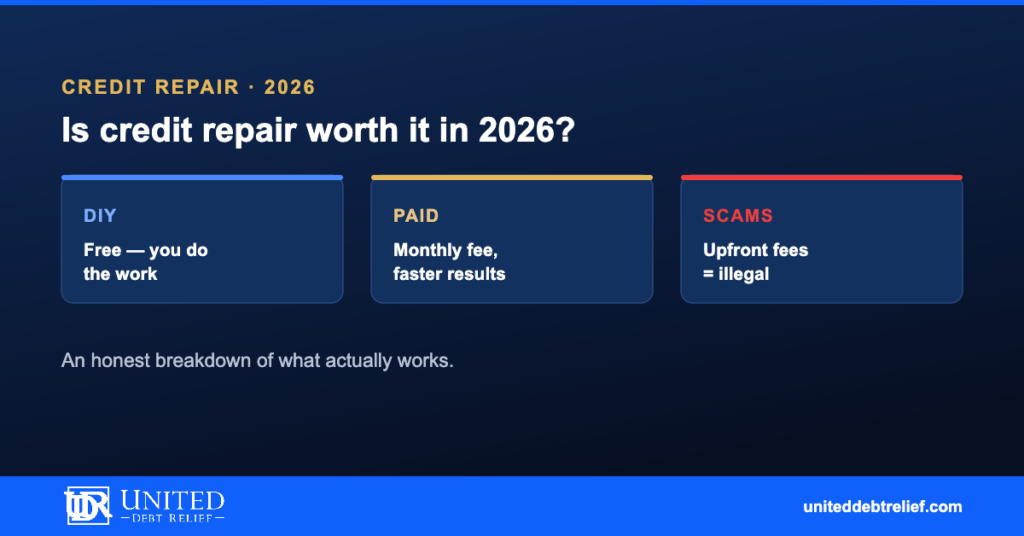
Honest answer: sometimes. It depends on whether you’re getting actual FCRA dispute work backed by the Credit Repair Organizations Act (CROA), or paying a scammer for vague “guarantees.”
The average U.S. FICO Score dropped to 714 in Spring 2026 per FICO’s Credit Insights Report, and the credit repair industry is growing alongside the score pressure. The 2026 reality includes legitimate paid services that deliver real results, and a growing number of scams targeting consumers who don’t know their FCRA rights.
This is the honest breakdown.
The 714 FICO Reality: Why So Many Are Asking This Now
The 714 FICO reality is why so many people are asking the question now: average scores slipped at the same moment new negative marks hit millions of reports. Three macro forces created the 2026 surge in demand:
- Average FICO dipped to 714, small headline, big psychological impact
- Resumed student loan reporting hit millions of borrowers’ scores
- Rising delinquency rates added negative marks to consumer reports
The combination drove millions of Americans into this market, both legitimate and otherwise.
What Does Credit Repair Actually Do? (FCRA Rights in Plain English)
The work consists of exercising the dispute rights you already hold under federal law, in an organized way across all three bureaus. The Fair Credit Reporting Act (FCRA) gives every consumer the right to:
- Dispute inaccurate, outdated, or unverifiable items on their credit report
- Have credit bureaus investigate disputed items within 30-45 days
- Have unverifiable items removed
- Receive a free annual report from each bureau (now weekly at annualcreditreport.com)
Professionally exercising these rights is the entire service.
What the process cannot do legally: remove accurate negative items (unless past the 7-year FCRA limit), “sweep” your file clean, add positive accounts you don’t actually have, or change your SSN / create a new credit identity (federal crime).
DIY Credit Disputes: Free, Slow, Sometimes Effective
Most of this work can be done without paying anyone:
- Pull your free reports weekly from annualcreditreport.com
- Identify inaccurate, outdated, or unverifiable items
- File disputes online with Equifax, Experian, and TransUnion
- Track responses (30-45 day investigation windows)
- File CFPB complaints for unresolved disputes at consumerfinance.gov/complaint
Pros: Free. Builds knowledge. Effective for clear-cut errors.
Cons: Time-intensive. Steep learning curve for complex disputes. No leverage when bureaus stonewall.
Paid Credit Repair: Real Help vs. Costly Scams
A legitimate paid service (typically $79-$149/month) provides:
- Systematic dispute filing across all 3 bureaus
- Specific FCRA citation expertise for complex items
- Escalation to CFPB and state AG when bureaus stonewall
- Coordination across multiple accounts simultaneously
- Combination with credit-building programs
The CROA truth: Every legitimate company in this field must:
- Provide a written contract before charging
- Wait 3 days before starting work (cooling-off period)
- NOT charge upfront fees before delivering services
- Provide a written notice of cancellation rights
Companies that violate any of these are illegal under federal law.
The 7 FTC-Flagged Scam Red Flags in 2026
The seven FTC-flagged red flags below all signal the same thing: a company operating outside CROA and FCRA rules. If a company does any of these, walk away:
- Charges upfront fees before delivering services (violates CROA)
- Guarantees specific score improvements (no legitimate company can guarantee this)
- Claims they can remove accurate negative items (illegal under FCRA)
- Suggests using a new “credit identity” or EIN instead of SSN (federal crime, file segregation fraud)
- Pressures you to sign before reading the contract (violates CROA)
- Refuses to provide a written contract (violates CROA)
- Tells you not to contact credit bureaus or creditors directly (you have that right under FCRA)
Report violations at reportfraud.ftc.gov and the CFPB.
When Is Paid Credit Repair Worth It?
Paid repair typically pays off when:
- You have multiple complex disputes across multiple bureaus
- Bureaus have stonewalled your DIY disputes
- You need coordinated FCRA + FDCPA + state-law strategy
- Your time value exceeds the monthly fee ($79-$149/mo)
- The repair is part of a larger plan (e.g., post-debt-settlement rebuild)
For simple, single inaccuracies, DIY usually wins on cost.
Free Credit Review
UDR’s Credit Repair + Builder program combines FCRA dispute work with positive credit-building (the dual-track approach). Free initial credit review with a vetted specialist, fully CROA-compliant.
→ Free 2026 Credit Review: uniteddebtrelief.com/free-consultation/
Frequently Asked Questions
What does the Credit Repair Organizations Act (CROA) protect me from?
CROA bars upfront fees, requires written contracts, provides a 3-day cooling-off period, and prohibits misleading claims. Violators are illegal under federal law.
Can credit repair legally remove accurate negative items?
No. Legitimate credit repair only removes items that are inaccurate, outdated (beyond 7-year FCRA limit), or unverifiable.
What’s the average cost of legitimate paid credit repair in 2026?
Typically $79-$149 per month, charged after services begin (CROA prohibits upfront fees). Engagements run 3-12 months.
How do I file an FTC complaint if a credit repair service scammed me?
File at reportfraud.ftc.gov, CFPB, and your state AG. Keep written communications and receipts.
When is DIY credit repair better than paid?
DIY is usually better for single inaccuracies or recent errors. Paid wins for complex disputes, stonewalled bureaus, or coordinated multi-bureau strategy.