

Medical debt is one of the most stressful balances a household can carry, and the good news is that you have two clear ways to handle hospital bills: consolidate them into one lower fixed payment, or settle them for less than the full amount owed. The direct answer is that consolidation fits when you can still afford steady monthly payments and want to protect your credit, while settlement fits when the balances have grown too large for regular payments to work. U.S. household debt reached $18.771 trillion in the second quarter of 2026, according to the Federal Reserve Bank of New York.
Quick answer: Medical debt consolidation rolls multiple hospital bills into one loan with a single fixed monthly payment, ideally below credit card rates. Settlement instead negotiates the balance down to a partial payoff. Consolidation protects your credit, while settlement trades a short-term credit dip for a lower total paid.
How is medical debt different from credit card debt?
Medical debt is different from credit card debt because hospital bills are cheaper to carry and far more negotiable, which gives you room to act. Medical bills usually start with no interest, so a $6,000 balance today is still $6,000 next month unless it moves to a collection agency or onto a credit card.
Before you do anything, request a fully itemized bill and ask the hospital about financial assistance or charity care, because billing errors and duplicate charges are common. Verify each line item against your insurance explanation of benefits before you pay anything, since a charge you cannot match to a service is worth questioning with the billing office first. Many providers also offer interest-free, in-house payment plans if you simply ask.
The trouble starts when people put medical bills on a credit card to make them feel handled. The average APR on credit card accounts assessed interest is 22.15%, according to the Federal Reserve for May 2026, which means a no-interest hospital bill can quietly turn into one of the most expensive debts you own.
| Factor | Consolidation | Settlement |
|---|---|---|
| What you pay | The full balance, at one lower fixed rate | A negotiated partial payoff, less than the full balance |
| Best fit | Steady income, credit still in reasonable shape | Balances too large for regular payments, already falling behind |
| Credit impact | Generally protected while you stay current | A likely dip while accounts go delinquent |
| Timeline | The loan term you sign for | Typically 24 to 48 months |
| Tax consideration | None, nothing is forgiven | Forgiven debt of $600 or more may be reported on a 1099-C |
Option A: consolidating your hospital bills
Consolidating your hospital bills means folding several medical balances into one fixed monthly payment you can plan around. A debt consolidation loan combines several medical bills, and often other unsecured balances, into one loan with a single fixed monthly payment and a set payoff date. Moving balances to one lower fixed rate instead of the 22%-plus APR that credit cards now carry can ease both your monthly stress and your total interest paid.
Consolidation makes the most sense when your income is steady, your credit is still in reasonable shape, and you can commit to the payment. You keep accounts current, you stop juggling multiple due dates, and your credit is generally protected because you are paying the debt in full over time.
Option B: settling your medical debt for less
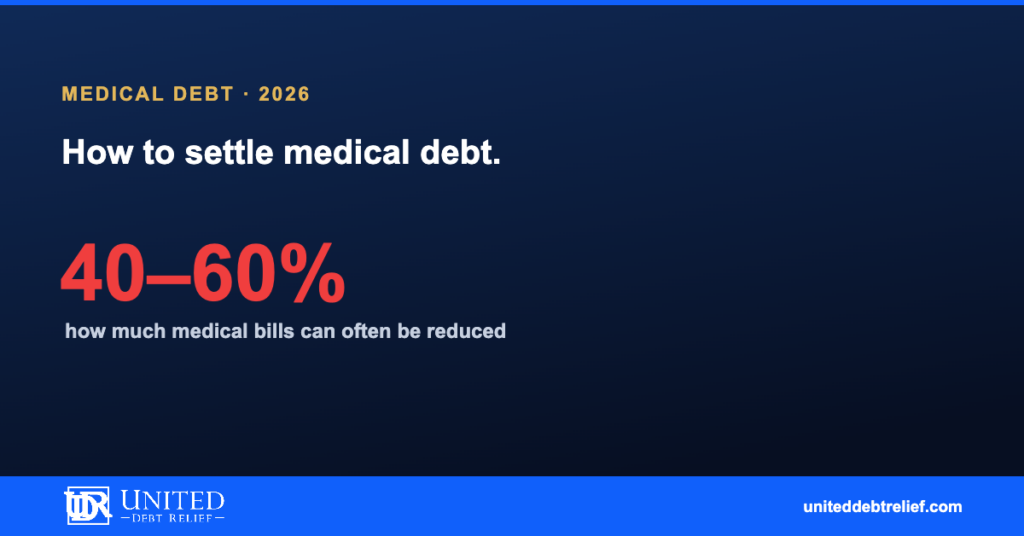
Settling your medical debt for less means negotiating each balance down to a partial payoff instead of paying the full amount owed. In a debt settlement program, funds are set aside in a dedicated account while negotiators work to resolve each balance for less than the full amount owed. According to United Debt Relief, settlement programs are designed to resolve roughly 40 to 50% of enrolled debt before fees, and programs typically run 24 to 48 months. Results vary.
“Medical debt is often the most negotiable balance a family has, because the provider or collector would rather recover part of the bill than none of it,” says Nick Avila, founder of United Debt Relief. Settlement is a serious step and not a shortcut, but for households already falling behind, it can be the most realistic path out.
Learn how debt settlement works and whether your medical balances could qualify.
What are the downsides of settling medical debt?
The downsides of settling medical debt fall into five areas: credit impact, collections, lawsuit risk, program length, and taxes on forgiven debt.
- Credit impact. Your credit score will likely dip, because settlement usually involves falling behind on payments before a deal is reached.
- Collections. Accounts can be sent to collections during the program.
- Lawsuit risk. A creditor or collector keeps the right to file a lawsuit on an unpaid balance.
- Program length. Settlement takes time, commonly 24 to 48 months, so it rewards patience and steady deposits.
- Taxes on forgiven debt. The IRS generally treats forgiven debt of $600 or more as taxable income, which means you could receive a 1099-C and owe tax on the amount written off. Whether an exclusion applies depends on your full financial picture, including whether you were insolvent, so review it with a licensed tax professional before you budget for a settlement.
Results vary, and no outcome is guaranteed.
How does United Debt Relief help you decide?
United Debt Relief helps you decide by walking you through both options and the numbers behind them before you commit to anything. In a free consultation, a specialist will review your balances, explain each option, assess your budget, and help determine which path fits your situation. Medical debt is often the single most negotiable balance a household owns, which makes hospital bills strong candidates for either a lower fixed-rate consolidation loan or a settlement for less than the full amount. If a program is the right fit, every in-network provider is Better Business Bureau Accredited with an A rating and is stringently vetted, and those providers perform the actual program work. Debt settlement carries no upfront fees.
Want the bigger picture before you choose? Explore the latest debt data and trends.
Frequently asked questions
Can medical debt be settled like credit card debt?
Yes. Medical bills, especially those already handed to a collection agency, are often negotiable. Because a provider would rather recover part of a bill than none of it, medical debt is frequently one of the more settlement-friendly balances a household carries.
Will consolidating medical debt hurt my credit?
Generally no. A consolidation loan is paid in full over time, so as long as you keep the new payment current, your credit is typically protected. Settlement is the option more likely to cause a temporary credit dip.
Do I owe taxes if my medical debt is forgiven?
Possibly. The IRS generally treats forgiven debt of $600 or more as taxable income, and you may receive a 1099-C. A qualified tax professional can help you understand whether any exclusions apply.
How long does a medical debt settlement program take?
Programs typically run 24 to 48 months, depending on how much debt you enroll and how much you can set aside each month.
Talk it through before you decide
Whether consolidation or settlement is the smarter route for your hospital bills, a short conversation can save you months of guessing. Schedule a free consultation with United Debt Relief to review your balances, weigh both paths, and get a plan built around your budget. Individual results vary.