

By Nick Avila, Founder, United Debt Relief · Last updated September 23, 2026
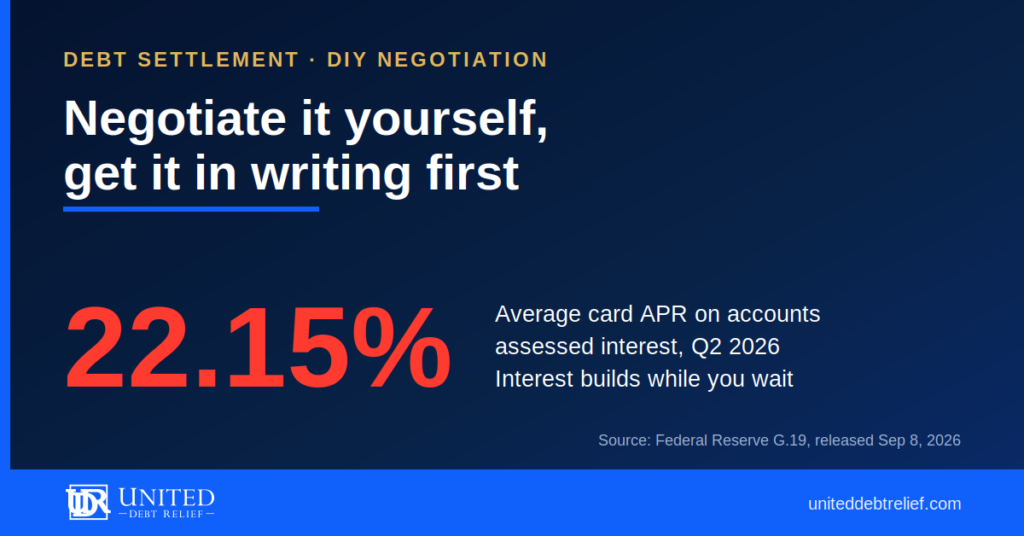
Negotiating credit card debt settlement yourself means confirming what you owe and who owns the account, offering an amount you can actually pay, and getting the terms in writing before any money moves. This walkthrough is for people with past-due card accounts deciding between doing it themselves and a settlement program. Timing matters because the average credit card APR on accounts assessed interest was 22.15% in Q2 2026, according to the Federal Reserve’s G.19 release, so interest keeps building.
Key Takeaways
- At the Federal Reserve’s 22.15% average card APR, a $10,000 balance accrues about $2,215 a year (simple-interest illustration).
- Under the FDCPA, a written dispute within 30 days pauses collection of the disputed debt until the collector mails verification.
- Under the Fair Credit Reporting Act, most negative items report for up to 7 years from the original delinquency, and settling does not restart that clock.
- The IRS requires a creditor to file Form 1099-C when $600 or more of debt is canceled.
- The FTC Telemarketing Sales Rule lets a settlement company charge a fee only after 3 conditions are met.
How Do You Negotiate Credit Card Debt Settlement Yourself?
You negotiate credit card debt settlement yourself by working through seven steps in order. The CFPB notes that many card companies are willing to work with you to change your payment if you are facing a financial emergency.
- Know the balance and who owns it. Check whether the issuer or a collector holds the account.
- Verify first if a collector has it. Request validation and dispute in writing if anything looks wrong.
- Decide what you can pay. The CFPB suggests listing take-home pay and expenses, and not paying more than you can afford.
- Ask about hardship programs. If the issuer still holds the account, ask about credit card hardship programs first.
- Make an offer. Name a specific amount and payment date, and expect a counteroffer.
- Get the agreement in writing before paying. Never send money on a verbal promise.
- Keep copies of everything. Agreement, payment proof, and call notes.
What Should You Check Before Negotiating With a Debt Collector?
Before negotiating with a debt collector, check that the debt is yours and the amount is right. A balance is a claim, not a fact. Under the FDCPA, a collector must send validation information within 5 days of first contact, and a timely written dispute requires it to stop collecting the disputed debt until it mails verification. The CFPB received about 387,400 debt collection complaints in 2025, most commonly about attempts to collect debt not owed. Our debt validation program starts there.
The CFPB notes that most state statutes of limitations run three to six years, and a partial payment on an old debt may restart that period. Confirm your state’s statute of limitations before acting.
What Should a Settlement Agreement Say Before You Pay?
A settlement agreement should say, before you pay, what you will pay, when, and what the creditor will do afterward. The CFPB advises getting the plan and the collector’s promises in writing before you make a payment, including ending collection and forgiving the debt once the plan is complete. Check for:
- The creditor or collector name and account number
- The settlement amount and each payment date
- A statement that the remaining balance is forgiven
- How the account will be reported to the credit bureaus
How Does Settling a Credit Card Affect Your Credit Report?
Settling a credit card resolves the account, but earlier late payments and a charge-off can stay on your credit report. Under the Fair Credit Reporting Act, most negative items such as collections and charge-offs can report for up to 7 years from the original delinquency, and settling does not restart that clock. The CFPB warns that debt settlement can have a negative impact on your credit scores. Results vary.
Do You Owe Taxes on Settled Credit Card Debt?
You may owe taxes on settled credit card debt, because the IRS generally treats canceled debt as taxable income. A creditor files Form 1099-C when $600 or more is canceled, yet IRS Publication 4681 says you must report canceled debt even without the form unless an exclusion applies. The insolvency exclusion (Form 982) may apply if your liabilities exceeded your assets just before cancellation. Tax outcomes depend on your full financial picture; a licensed tax professional can confirm yours. See whether settled debt is taxable.
What Does the FTC Require If You Hire a Debt Settlement Company?
If you hire a debt settlement company, the FTC Telemarketing Sales Rule bars it from collecting a fee until three conditions are met. Under 16 CFR 310.4(a)(5), (1) at least one debt must be settled or its terms changed under an agreement you signed, (2) you must have made at least one payment under that agreement, and (3) the fee must be proportional to the enrolled debt settled or a set share of the amount taken off the balance.
When Does a Debt Settlement Program Fit Better Than Negotiating Yourself?
A debt settlement program tends to fit better when you have several accounts, larger balances, or no time or appetite to run the negotiations. Interest builds while you work each account: at 22.15%, a $10,000 balance accrues about $2,215 a year in a simple-interest illustration.
| Negotiating yourself | Settlement program | |
|---|---|---|
| Who talks to creditors | You | The provider, after enrollment |
| Fees | None beyond your time | Only after the three FTC conditions |
| Best suited to | One or two smaller accounts | Several accounts, larger balances |
| Written agreement | You request and review it | Obtained per debt; you approve each |
| Credit reporting and taxes | FCRA and IRS rules apply | The same rules apply |
When a client brings us a stack of card statements, the first thing we check is who owns each account today: the issuer, a collection agency, or a debt buyer. Then we review hardship options, statute of limitations dates, and 1099-C exposure.
United Debt Relief is a national debt relief company serving all 50 states. Its specialists consult with consumers, determine which program fits, and handle enrollment; program services are performed by stringently vetted in-network providers and law firms. See how the debt settlement program works.
What Is the Worst Case When You Negotiate Settlement Yourself?
The worst case when you negotiate settlement yourself is a refusal, a growing balance, and a lawsuit. The CFPB notes that stopped payments usually bring late fees and penalty interest, and a creditor may sue. Even a completed settlement can leave a tax bill and up to 7 years of negative reporting. Read about lawsuit and tax risk during settlement.
Frequently Asked Questions About Negotiating Credit Card Debt Settlement
How do I settle debt with creditors?
Confirm the balance and who owns the account, verify the debt if a collector holds it, set an amount you can pay, and make a specific offer. Get the terms in writing before you pay.
Does settling a credit card restart the credit reporting clock?
No. Under the Fair Credit Reporting Act, most negative items report for up to 7 years from the original delinquency, and settling does not restart that period.
Will I get a 1099-C after a settlement?
A creditor files Form 1099-C when $600 or more of debt is canceled. Smaller amounts may still be reportable, and the insolvency exclusion in IRS Publication 4681 may apply.
Can a debt settlement company charge fees before settling a debt?
No. The FTC Telemarketing Sales Rule bars fees until at least one debt is settled under an agreement you accept and you have made at least one payment under it.
When should I use a debt settlement program instead of negotiating myself?
A program may fit when you have several accounts, larger balances, or no time to handle each negotiation. Results vary.
Before you make an offer, schedule a free consultation with United Debt Relief or call 1 (888) 802-2092. Free consultation, no obligation. Results vary. Debt settlement carries no upfront fees.
Sources: Federal Reserve G.19 · CFPB 2025 Consumer Response Annual Report · FTC Debt Collection FAQs · CFPB on negotiating a settlement · CFPB on old debts · CFPB on unpaid card bills · CFPB on debt relief programs · Fair Credit Reporting Act · IRS Publication 4681 · 16 CFR 310.4