

By Nick Avila, Founder, United Debt Relief. Last updated August 24, 2026.
VA debt relief means two different things, and confusing them wastes time. VA benefit overpayment debt is owed directly to the Department of Veterans Affairs and is resolved through VA’s own waiver, compromise, or repayment process, while consumer debt relief for veterans covers credit cards, medical bills, and other private debt through civilian programs. This guide is for veterans and separating servicemembers who need to know which process applies to which debt. It matters now because total U.S. household debt held at $18.8 trillion in the second quarter of 2026, and many veterans are carrying both categories of debt at once, according to the Federal Reserve Bank of New York.
Key Takeaways
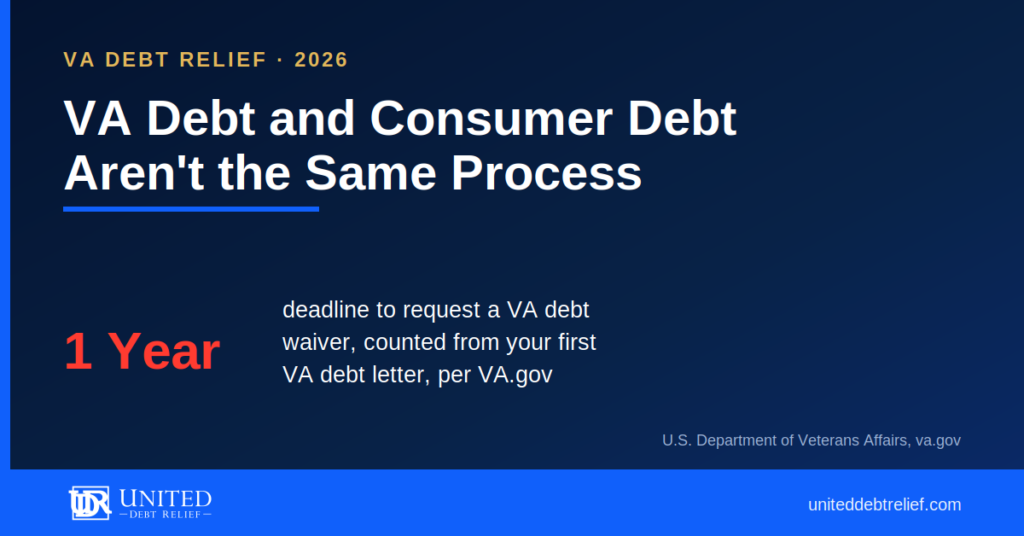
- Veterans have 1 year from the date of their first VA debt letter to request a waiver of a benefit overpayment, according to VA.gov.
- A VA debt dispute must be submitted within 30 days of the debt notice to avoid collection action, according to VA.gov.
- The Servicemembers Civil Relief Act caps interest at 6% on loans taken out before entering active duty, once the servicemember provides written notice and proof of service, according to the CFPB.
- The Military Lending Act caps the Military Annual Percentage Rate at 36% on many types of consumer credit for active-duty members and their dependents, codified at 10 U.S.C. 987 and implemented by 32 CFR Part 232.
- Total U.S. household debt decreased by $13 billion, or 0.1%, to $18.8 trillion in the second quarter of 2026, according to the NY Fed’s Household Debt and Credit Report.
- The CFPB’s Office of Servicemember Affairs tracks complaints from military and veteran consumers through a searchable database and pursues enforcement against violations, according to the CFPB.
Why Does “VA Debt Relief” Mean Two Different Things?
The phrase “VA debt relief” gets searched by two different groups with two different problems. One group owes the VA itself, usually from a benefit overpayment, education benefit adjustment, or a copay balance. The other group is a veteran carrying ordinary consumer debt, credit cards, medical bills, personal loans, who happens to search “VA” because of their veteran status, not because the VA is the creditor.
These two situations go through entirely separate channels. VA benefit debt is handled by the VA Debt Management Center. Consumer debt is handled the same way it would be for any civilian, through direct negotiation, validation, consolidation, or credit repair. The rest of this guide covers both, starting with VA’s own process.
What Are Your Options for a VA Benefit Overpayment?
The VA offers five distinct paths for a benefit overpayment, and each has its own form and deadline. The table below lists them as described on VA.gov.
| Option | What It Does | Form / Deadline |
|---|---|---|
| Repayment Plan | Pays back the overpayment in monthly installments | Plans under 5 years can be requested online, by phone, or by mail; plans of 5+ years require VA Form 5655 |
| Waiver | Asks the VA to forgive the debt entirely | VA Form 5655, within 1 year of the first debt letter |
| Compromise Offer | Asks the VA to accept a lower lump sum as full payment | VA Form 5655 |
| Hardship Suspension | Pauses repayment temporarily during financial hardship | VA Form 5655 |
| Dispute | Challenges the debt as incorrect in a written statement | Within 30 days of the notice, submitted online, through Ask VA, or by mail to the Debt Management Center |
Confirm your own deadline directly against the date on your VA debt letter before choosing a path, since the waiver and dispute windows run from that letter, not from when you happen to act on it.
What Federal Protections Apply to Servicemembers’ and Veterans’ Debt?
Two federal laws cap interest rates on debt tied to military service, and both remain relevant to veterans after separation.
The Servicemembers Civil Relief Act (SCRA)
The SCRA caps interest at 6% on loans taken out before entering active duty, including auto loans, mortgages, student loans, personal loans, and credit card debt, according to the CFPB. To get the cap, a servicemember sends the lender written notice plus a copy of military orders or a commanding officer’s letter, either while serving or within 180 days of leaving active duty. For most loan types the reduced rate applies during active duty; for mortgages, the reduction extends one additional year afterward. SCRA also requires a lender to get a court order before repossessing property tied to a pre-service debt on which a payment was made before service began, according to the CFPB.
The Military Lending Act (MLA)
The MLA caps the Military Annual Percentage Rate at 36% on many types of consumer credit extended to active-duty members, including National Guard and reserve members on active duty for 30 days or more, and their dependents, codified at 10 U.S.C. 987 and implemented by 32 CFR Part 232. Covered credit includes payday loans, tax refund anticipation loans, vehicle title loans, credit cards, and many unsecured and installment loans. Loans secured by the vehicle or property being purchased, and home mortgages, are excluded. A charge above the 36% MAPR on covered credit during active duty may be challengeable even after separation.
What Consumer Debt Challenges Do Veterans Commonly Face?
Once a debt is not owed to the VA, it is handled the same way as any civilian debt, based on what kind of debt it is.
- Credit card debt is unsecured, which makes it eligible for negotiation or consolidation.
- Medical bills, including gaps not covered by VA healthcare, are also unsecured and can be negotiated or validated.
- Personal loans, including high-rate loans, are unsecured and can be addressed through settlement or validation.
- Student loans differ by type: federal loans have their own income-driven repayment and forgiveness programs through the Department of Education, while private student loans can sometimes be addressed through civilian debt settlement.
For any collection account tied to this kind of debt, a collector generally must provide required information about it, and the consumer has 30 days from that notice to dispute it in writing, under the CFPB’s Reg F debt collection rule, 12 CFR 1006.34.
How Do United Debt Relief’s Five Programs Apply to Veterans?
United Debt Relief serves veterans across all 50 states through the same five programs available to any client, applied to civilian consumer debt, not VA benefit debt.
- Debt Settlement negotiates directly with creditors and collection agencies to resolve unsecured debt, such as credit cards, medical bills, and personal loans, for less than the full balance owed.
- Debt Validation uses FDCPA and Reg F rights to require a collector to verify a debt’s amount and ownership before further collection.
- Debt Consolidation Loans combine multiple balances into one new loan, typically at a fixed rate, for a single monthly payment.
- Tax Resolution addresses federal or state back taxes through options such as an Offer in Compromise or an installment agreement, separate from any VA debt.
- Credit Repair & Builder disputes inaccurate items under the FCRA and can add a credit-building trade line that reports new payment history.
Confirm which category your own debt falls into, VA benefit debt or civilian consumer debt, before you start, since the wrong process can waste a deadline that matters, like VA’s 30-day dispute window. A free, no-obligation consultation can help sort a mixed situation into the right channel.
Frequently Asked Questions
What’s the difference between VA debt relief and debt relief for veterans?
VA debt relief refers to resolving a debt owed to the VA itself, through the VA Debt Management Center’s waiver, compromise, repayment, or dispute options. Debt relief for veterans refers to a veteran’s ordinary consumer debt, owed to private creditors, addressed through civilian programs like those United Debt Relief offers.
How do I dispute a VA benefit overpayment?
Submit a written statement explaining why you believe the debt is incorrect within 30 days of the debt notice, through VA’s online form, Ask VA, or by mail to the Debt Management Center, according to VA.gov. Disputing within that window can avoid collection action while the VA reviews it.
Can I address VA debt and civilian debt at the same time?
Yes, but through separate channels. VA benefit debt goes through the VA Debt Management Center. Civilian debt, such as credit cards, medical bills, or personal loans, can be addressed at the same time through a program like United Debt Relief’s Debt Settlement or Debt Validation.
Does the SCRA interest rate cap still apply after I leave the military?
You can request it up to 180 days after leaving active duty, but only for debt taken out before you entered service, according to the CFPB. After that window, the SCRA request option generally closes, though the MLA’s protections apply only during active duty in the first place.
Is civilian debt settlement reported to the VA or the Department of Defense?
No. Civilian debt settlement is a private arrangement between a client, their creditors, and negotiators, separate from any VA process. It does affect a client’s civilian credit report while the program runs.
Where do I find official VA resources for benefit debt?
VA.gov’s debt help page lists all five options with current forms, and the VA Debt Management Center can be reached directly for benefit-specific questions. The CFPB’s Office of Servicemember Affairs offers separate resources for consumer debt and financial protections tied to military service.
United Debt Relief serves veterans across all 50 states through five programs for civilian consumer debt. A free, no-obligation consultation can help sort VA benefit debt from consumer debt and map which program fits. Results vary by situation. Call (888) 802-2092 or visit uniteddebtrelief.com to get started.
Sources
- U.S. Department of Veterans Affairs, “Options to request help with VA debt”
- CFPB, “The Servicemembers Civil Relief Act (SCRA)”
- CFPB, “Military Lending Act, Applicability flow chart”
- CFPB, “Financial resources for serving servicemembers, veterans, and military families” (Office of Servicemember Affairs)
- CFPB, “What information does a debt collector have to give me about the debt?” (Reg F, 12 CFR 1006.34)
- Federal Reserve Bank of New York, “Household Debt Balances Decreased Slightly,” Q2 2026 Household Debt and Credit Report (August 11, 2026)
- 50 U.S.C. 3937, Maximum rate of interest on debts incurred before military service