

By Nick Avila, Founder, United Debt Relief. Last updated August 24, 2026.
Rebuilding credit after a repossession means disputing any inaccurate entries under the Fair Credit Reporting Act, resolving the deficiency balance the lender says you still owe, and adding new on-time payment history through tools like a secured credit card. This guide is for anyone whose vehicle was repossessed, voluntarily or involuntarily, and who needs a concrete sequence rather than a vague timeline. It matters now because auto loan balances reached $1.713 trillion in the second quarter of 2026, and 94% of completed repossessions in a recent federal dataset left the borrower with a deficiency balance still owed, according to the CFPB.
Key Takeaways
- Auto loan balances totaled $1.713 trillion in the second quarter of 2026, according to the Federal Reserve Bank of New York’s Household Debt and Credit Report (August 2026).
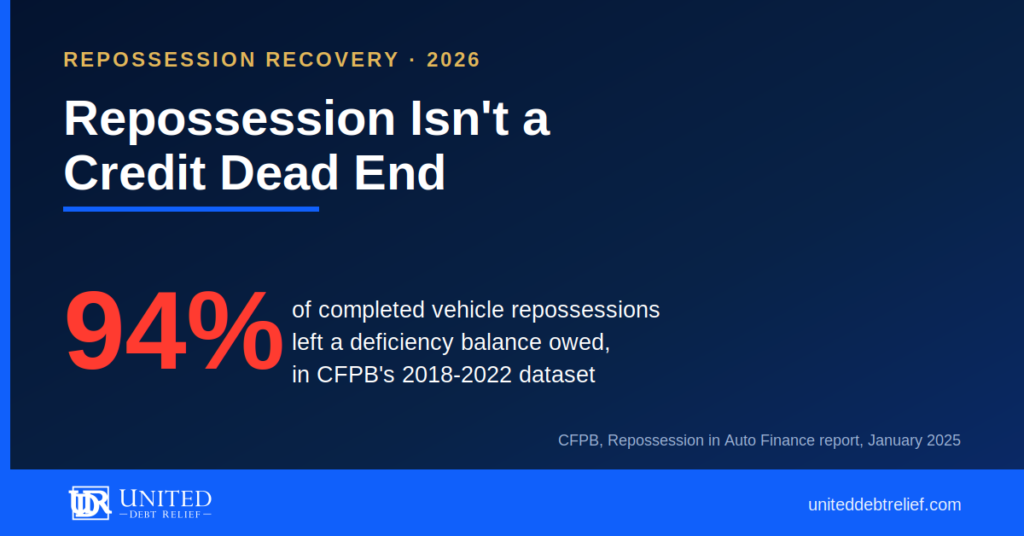
- 94% of completed vehicle repossessions left the borrower owing a deficiency balance, in CFPB’s 2018-2022 dataset covering over 33 million auto loans, according to CFPB’s January 2025 report.
- The average deficiency balance reached $11,340 in December 2022, up from $10,747 in December 2019, according to the same CFPB report.
- A repossession-related collection account must come off a credit report seven years after the date the underlying delinquency began, not seven years from the tow date, under the FCRA, 15 U.S.C. 1681c(a)(4) and (c)(1).
- Voluntary surrenders made up about 10% of completed repossessions in 2021-2022, down from 15% to 19% in 2018-2019, according to CFPB.
- Creditors may report late payments and the repossession itself “even with a voluntary repossession,” according to the FTC’s consumer guidance on vehicle repossession.
What Happens to Your Auto Loan After Repossession?
After a vehicle is repossessed, the lender sells it, usually at auction, and applies the proceeds to what you owe. Any shortfall between the sale price and your remaining balance becomes a deficiency balance you still legally owe, and that obligation does not end when the vehicle is gone.
The FTC’s consumer guidance gives a concrete example: owe $15,000, the lender sells the car for $8,000, and the deficiency is $7,000 plus fees. The CFPB confirms the same mechanism: a sale price below the loan balance means you owe the difference, and a sale price above it entitles you to the surplus. That shortfall was the outcome in 94% of completed repossessions in CFPB’s dataset, and the average deficiency reached $11,340 in December 2022, up from $10,747 in December 2019.
Ask the lender in writing for the auction sale price and an itemized deficiency calculation before paying anything. Auction shortfalls and fee calculations are frequently disputed, so verify the number before treating it as final.
How Long Does a Repossession Stay on Your Credit Report?
A repossession-related account generally leaves a credit report seven years after the delinquency that led to it began, under the FCRA, not seven years from the day the vehicle was towed. Three separate items typically carry their own seven-year clocks.
Under 15 U.S.C. 1681c(a)(4), an account placed for collection or charged to profit and loss must be removed from a credit report after seven years. Under 15 U.S.C. 1681c(c)(1), that seven-year period is measured from 180 days after the date the delinquency that led to the charge-off began, so the clock starts before the repossession itself, not after it. Late payments, the repossession status notation, and any deficiency sent to collections can each carry a different start date depending on when that specific item became delinquent.
One exception matters for major financial decisions: under 15 U.S.C. 1681c(b), the seven-year limit does not apply to a credit report used for a credit or life insurance transaction of $150,000 or more, or a job paying $75,000 or more a year. For those specific purposes, older repossession history can still surface.
Does Voluntary Surrender Look Different Than Involuntary Repossession?
The credit-reporting outcome is nearly identical whether you surrender the vehicle voluntarily or the lender repossesses it, though the collection experience can differ. The FTC states plainly that a creditor may still report late payments and the repossession itself “even with a voluntary repossession.”
CFPB’s data shows voluntary surrenders declining as a share of completed repossessions, from 15% to 19% of cases in 2018-2019 to about 10% in 2021-2022, with superprime borrowers surrendering voluntarily at higher rates than subprime borrowers in both periods. The table below summarizes what actually shows up on your report and for how long.
| Report Item | What It Is | How Long It Can Report | Governing Rule |
|---|---|---|---|
| Late payment notations (30/60/90-day) | Each missed payment before repossession, reported as a separate negative mark | 7 years from the date of that specific missed payment | FCRA, 15 U.S.C. 1681c(a)(4)-(c)(1) |
| Repossession or charge-off notation | The account status update showing the loan closed via repossession | 7 years, measured from 180 days after the delinquency that led to the charge-off began | FCRA, 15 U.S.C. 1681c(c)(1) |
| Deficiency balance placed for collection | The unpaid shortfall, reported separately if sent to a collection agency | 7 years from the date that deficiency became delinquent | FCRA, 15 U.S.C. 1681c(a)(4) |
| Large-transaction exception | No new item; older history can still be included on specific report types | The 7-year limit does not apply for credit or insurance of $150,000+, or a job paying $75,000+/year | FCRA, 15 U.S.C. 1681c(b) |
How Do You Rebuild Credit After a Repossession?
Rebuilding credit after repossession is a sequence, not a single fix: correct what is wrong on the report, resolve the deficiency balance, and then add new positive payment history.
Step 1: Dispute Inaccurate Repossession Entries
Before assuming every repossession-related item on your report is accurate, request your free reports at annualcreditreport.com and review each entry, per the CFPB. Common errors include a wrong delinquency date that extends the reporting window, a deficiency balance duplicated between the lender and a collection agency, and a voluntary surrender coded incorrectly. Bureaus generally must investigate a dispute within 30 days, according to the CFPB. United Debt Relief’s Credit Repair & Builder program disputes inaccurate items across Equifax, Experian, and TransUnion under the FCRA.
Step 2: Verify and Address the Deficiency Balance
If the deficiency has been placed with a collection agency, a collector generally must provide required information about the debt, and you have 30 days from that notice to dispute it in writing, according to the CFPB’s Reg F debt collection rule. Deficiency balances are unsecured once the vehicle is gone, since there is no collateral left to reclaim, which is why they are addressed the same way as other unsecured debt. United Debt Relief’s Debt Settlement program can include an auto deficiency balance alongside other unsecured debt, negotiating directly with the creditor or collection agency. Results vary by situation, and any settlement should be confirmed in writing before you pay.
Step 3: Add New Positive Payment History
Time alone does not repair a credit file. CFPB guidance points to two concrete tools: a secured credit card, which sets its credit limit from a refundable cash deposit and reports payments to the bureaus monthly, and keeping credit utilization well under 30%, ideally under 10%. United Debt Relief’s Credit Repair & Builder program adds a credit-building trade line that reports payment history to all three bureaus each month, alongside the dispute and deficiency-resolution steps above.
How Does United Debt Relief’s Credit Repair & Builder Program Fit In?
United Debt Relief’s Credit Repair & Builder program disputes inaccurate or unverifiable repossession-related items across all three major bureaus under the FCRA and can add a credit-building trade line that reports new, on-time payment history each month. It works as one piece of a larger plan: dispute what is wrong, resolve what is owed, build what comes next. Confirm your own repossession’s delinquency date directly with the original lender before disputing it, since that date determines how long the item can legally report.
Frequently Asked Questions
How long does a repossession stay on my credit report?
Seven years, measured from 180 days after the delinquency that led to the repossession began, under the FCRA. Because late payments, the repossession notation, and any deficiency collection account can each have a different delinquency date, they do not necessarily fall off your report on the same day.
Will paying off the deficiency balance remove the repossession from my report?
No. Settling the deficiency updates its status to paid or settled, which future lenders can see, but the repossession notation and related late payments remain for their own seven-year windows under the FCRA. Settling stops collection activity; it does not erase the reporting history.
Does voluntary surrender hurt my credit less than an involuntary repossession?
Reporting-wise, the FTC says a creditor can report late payments and the repossession “even with a voluntary repossession,” so the credit report outcome is largely the same. CFPB data shows voluntary surrender has become less common, at about 10% of completed repossessions in 2021-2022 versus 15% to 19% in 2018-2019.
What is a deficiency balance, and do I have to pay it?
It is the gap between what you owed and what the lender got selling the repossessed vehicle, plus fees, per the FTC. It remains a legal debt until resolved through payment, a negotiated settlement, or a successful validation challenge if the debt cannot be verified.
Can United Debt Relief help if I have both a deficiency balance and inaccurate items on my report?
Yes. United Debt Relief’s Credit Repair & Builder program addresses inaccurate reporting under the FCRA, and its Debt Settlement program can address an unsecured deficiency balance alongside other unsecured debt. A free consultation reviews both pieces together. Results vary by situation.
United Debt Relief offers a free, no-obligation consultation to review a repossession’s effect on your credit and which of its five programs fit your situation. Results vary by situation, and this article is general information, not individualized financial or legal advice. Call (888) 802-2092 or visit uniteddebtrelief.com to get started.
Sources
- CFPB, “Repossession in Auto Finance” report (January 2025)
- CFPB, “What happens if my car is repossessed?”
- CFPB, “How to rebuild your credit”
- CFPB, “What information does a debt collector have to give me about the debt?” (Reg F, 12 CFR 1006.34)
- CFPB, “How long does it take to repair an error on a credit report?”
- FTC, “Vehicle Repossession”
- 15 U.S.C. 1681c, Fair Credit Reporting Act, requirements relating to information contained in consumer reports
- Federal Reserve Bank of New York, “Household Debt Balances Decreased Slightly,” Q2 2026 Household Debt and Credit Report (August 11, 2026)